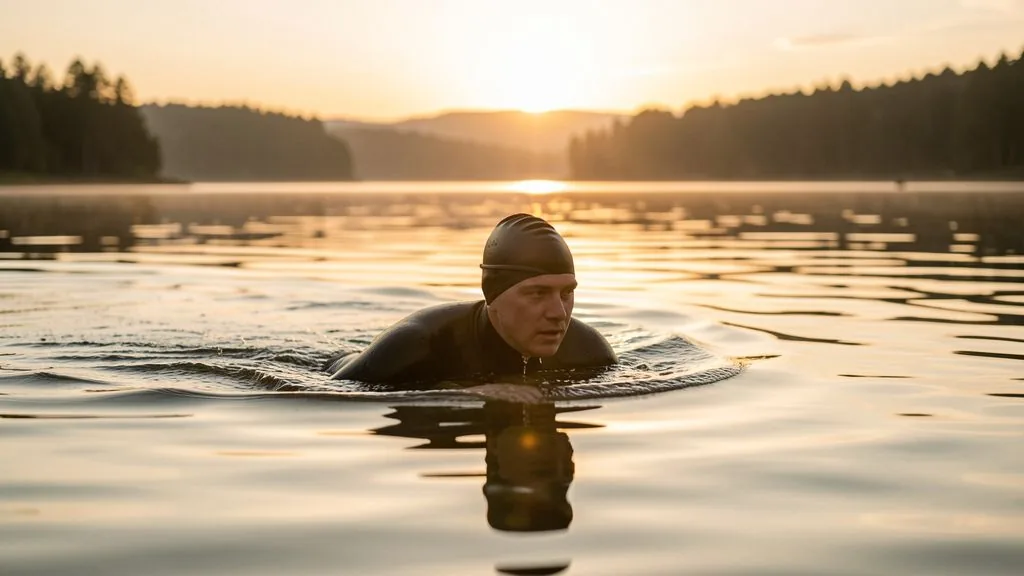
A kickboard, a pull buoy, two pairs of fins, paddles in three sizes, a snorkel — the swim bag of many triathletes weighs more than their bike rucksack. Yet the equipment does not decide your progress; the question does: which stimulus are you setting, and how much of it can you absorb? Gear is no substitute for technique. It is a magnifying glass: it makes visible what happens in your stroke, and it amplifies every mistake at the same time.
Why equipment works in swimming at all
Swimming has a perception problem: you cannot see your arms under water, there is no footstrike sound like in running, and drag scales with the square of speed but rarely feels that way. Training tools solve exactly this by isolating or altering part of the movement. A pull buoy removes the kick so you feel the arm stroke. Paddles enlarge the hand surface so you feel the pressure point at forearm and trunk more clearly. Fins push the speed up so the movement pattern imprints at a higher tempo. Every tool answers a specific question — and none of them replaces the work without a tool.
The second reason is load management. Swimming is joint-friendly, not stimulus-free: three sessions of 3,000 metres with paddles every week builds a shoulder load that no runner with knee trouble would accept voluntarily. Equipment is therefore also a dosing question — the concrete limits follow below.
Pull buoy: legs quiet, arms in focus
The pull buoy is the most used and most misunderstood tool. Clamped between the thighs, it lifts the legs, reduces drag and makes you about five to ten seconds per 100 metres faster at the same effort. That is not a training gain, it is physics: the body sits higher, the wetted surface shrinks, wave-making drops.
The pull buoy earns its place as a diagnostic tool. If your pace with the buoy is clearly better than without, your hips sit too low in normal swimming — a classic sign of missing trunk tension, a gaze too flat towards the front, or an incomplete kick. That is precisely when the work belongs on body position, not on more buoy metres. As a training stimulus the buoy suits long, calm pull sets: 4 × 400 metres with 20 seconds rest, focused on entry point, high elbow and trunk rotation. The legs stay together and quiet — kicking with the buoy means swimming against your own body position.
Two limits. First, the pull buoy must never account for more than a third of your swim volume, otherwise you lose the leg work that decides body position in open water. Second, it is not a beginner's aid. Without a stable body position you only learn to rely on buoyancy — and then swim with sinking legs at the first race without a wetsuit.
Paddles: the strongest and riskiest stimulus
Hand paddles enlarge the surface area and with it the pressure you can build against the water. That is the most effective strength stimulus in the pool without added weights — and at the same time the reason behind a large share of the swimmer's shoulder cases we see in clubs. The mechanism is simple: more surface means more resistance per stroke, and that resistance travels through forearm, elbow and shoulder into the trunk. If the rotator cuff has nothing to counter that load with, the stress moves into the supraspinatus tendon.
Dosing therefore decides everything. The rules of thumb: paddles no larger than your palm plus one centimetre around, never more than 20 to 25 percent of weekly volume, at most once or twice a week, and never in a session where you have already swum 2,000 metres. A clean entry point is 6 × 100 metres with full rest: fully recovered you can set the stroke deliberately instead of dragging it under fatigue. Anyone using paddles for long sets is not training the stroke, but the ability to keep pulling while technique degrades.
A technique check comes before the first use. Put the paddles on without the wrist strap — with a correct high elbow and pressure across the whole forearm they stay in place without gripping. If they slip away or the wrist collapses inwards, the stroke is not ready for paddles. Details on the link between stroke and shoulder are in the article Swimmer's shoulder.
Fins: body position, pace, ankle mobility
Fins are surprisingly versatile in swim training once you pick the right length. Short rubber fins with a 15 to 25 centimetre blade are the standard tool: they lift the feet, improve body position and allow a pace at which the arm stroke imprints faster. Long dive fins are unsuitable for swim training — they overextend the ankle, push the kick into too large an amplitude and beat down on the knees.
The second benefit is the ankle. Triathletes often have limited dorsiflexion in the upper ankle because they run and ride a lot; in the water that produces a stiff, braking foot. Regular fin work, especially combined with long, extended kick sets, mobilises the joint over time — not through stretching, but through repeated movement in the lengthened position.
The third, often overlooked benefit is the pace experience. Someone who normally swims 2:00 minutes per 100 metres suddenly sees 1:40 with fins — and feels what water pressure, glide phase and breathing rhythm are like at that speed. That is not an end in itself: it builds the reference point you later work towards. Concrete sets: 8 × 50 metres kick with fins and board, 30 seconds rest, or 4 × 200 metres freestyle with fins and 20 seconds rest. In triathlon preparation fins belong in the base phase, not in the final week before a race.
Kickboard, snorkel and ankle band: the underrated helpers
- Kickboard. The board isolates the kick — and immediately exposes how much propulsion your legs really deliver. If you barely move with a board, you have a braking leg position in normal swimming. Sets like 6 × 50 metres kick with 20 seconds rest are standard. One technique note: the head stays in the water, the arms lie extended on the board, the hips are high. Anyone lifting the head to breathe sits in the water like an anchor.
- Snorkel. The front-mounted snorkel is the best technique tool most swimmers do not own. It removes the breathing rotation from the movement, so you can observe and correct head position, body line and trunk rotation without interruption. Two sets are enough: 4 × 100 metres freestyle with snorkel, focus on a stable head position, and 4 × 50 metres with eyes closed to sharpen the feel for the water.
- Ankle band. The rubber band around the ankles is the most honest test of body position. Without a kick, without board and without buoy you sink immediately if the hips do not carry. Four 25-metre repeats per session are enough — hardly anyone manages more, and that is the point: the drill shows you unforgivingly where the tension is missing.
An equipment mix for the training week
An example for a triathlete with three swim sessions and 7,000 metres of weekly volume, where equipment is used deliberately rather than randomly:
- Session 1 — technique (2,200 m): 400 m warm-up, 8 × 50 m technique drills with snorkel, 6 × 100 m freestyle focused on the high elbow, 200 m cool-down. No equipment beyond the snorkel.
- Session 2 — volume (2,800 m): 600 m warm-up, 4 × 400 m with pull buoy and 20 s rest, 8 × 50 m kick with board, 400 m cool-down. Equipment share around 60 percent, but no strength stimulus.
- Session 3 — stimulus (2,000 m): 400 m warm-up, 6 × 100 m with paddles and full rest, 4 × 50 m freestyle with fins at race pace, 200 m cool-down. This is the only hard pull stimulus of the week.
Equipment therefore accounts for roughly 45 percent of total volume, paddles for 6 percent — clearly below the threshold at which the shoulder starts paying. The order within a session matters: first technique without gear, then the stimulus with gear, then cool-down without anything. Anyone who starts with paddles and then practises technique is practising tired technique.
The five most common mistakes
- Equipment as a volume substitute. Anyone swimming 80 percent of their metres with buoy and fins is training a sport that does not exist in racing. Without a wetsuit, no buoyancy aid carries you.
- Paddles too big and too often. The shoulder forgives it for weeks, then reports with a bang. Check the size, cap the volume, stabilise technique first.
- Fins in race week. The altered movement pattern needs two or three sessions to settle. Anyone swimming with fins for the first time three days before a race starts with an unfamiliar kick.
- The buoy as a technique substitute. The buoy improves your result, not your technique. If you are clearly slower without it, that is the work-on — not the tool.
- No plan behind the tool. Equipment without a concrete focus is busywork. Every set needs a question: what do I want to feel or check here?
How equipment fits into load management
Swim sessions with equipment differ in load more than the distance suggests. A session with 1,500 metres of paddles is harder on the shoulder than 3,000 metres of easy freestyle, even though the number on the plan is smaller. Peakora counts swimming into weekly load via TSS, so a hard swim session does not stay invisible just because it did not happen on the road.
The same applies to technique work: it needs a place in the plan, not just good intentions. Anyone scheduling two technique sessions per week in the base phase and anchoring the equipment sets there reaches the race phase without rebuilding. The framework for season planning is on the triathlon pillar page, the system behind the zones and terms in the glossary.
Conclusion: four tools, clear jobs
A board for the kick, a pull buoy for isolating the arms, short fins for body position and pace, one pair of palm-sized paddles for the strength stimulus — that is a complete swim training kit. Everything beyond it, from snorkel to ankle band, is a useful addition for anyone who wants to check their technique systematically.
The actual rule is: every tool has to answer a question. If you cannot say what you want to check or feel with a set, leave the tool in the bag and swim the metres clean without it. That is less comfortable, but it shows you faster where you really stand.
Frequently asked questions about swim equipment
Do beginners need swim training equipment?
No — for the first few weeks trunks, goggles and a kickboard are enough. A pull buoy and fins make sense from about 800 to 1,000 metres per session, paddles only once your stroke is technically stable and pain-free.
How often can I swim with paddles?
At most once or twice a week and never more than 20 to 25 percent of weekly volume. Paddles bigger than your palm are too much for most recreational swimmers: they raise the load on the shoulder joint faster than the shoulder can stabilise it.
Do fins actually help in swim training?
Yes, but not in the way most people assume. Short fins lift the feet, improve body position and allow a higher speed at the same effort — they are a technique and pace tool, not a replacement for kick sets without fins.
Why am I faster with a pull buoy?
Because the buoyancy carries your legs and reduces drag — not because your technique improved. That is exactly why the pull buoy is a poor everyday tool: it hides low hips that you pay for with drag as soon as you take it away.
How much equipment do I need for triathlon training?
A kickboard, a pull buoy, short fins and one pair of palm-sized paddles cover 90 percent of it. A snorkel and an ankle band are the useful additions, everything else is optional.
Plan your swim training with Peakora
Technique, volume and stimulus in one week — matched to your race and your form. Start free, no credit card required.
Start free