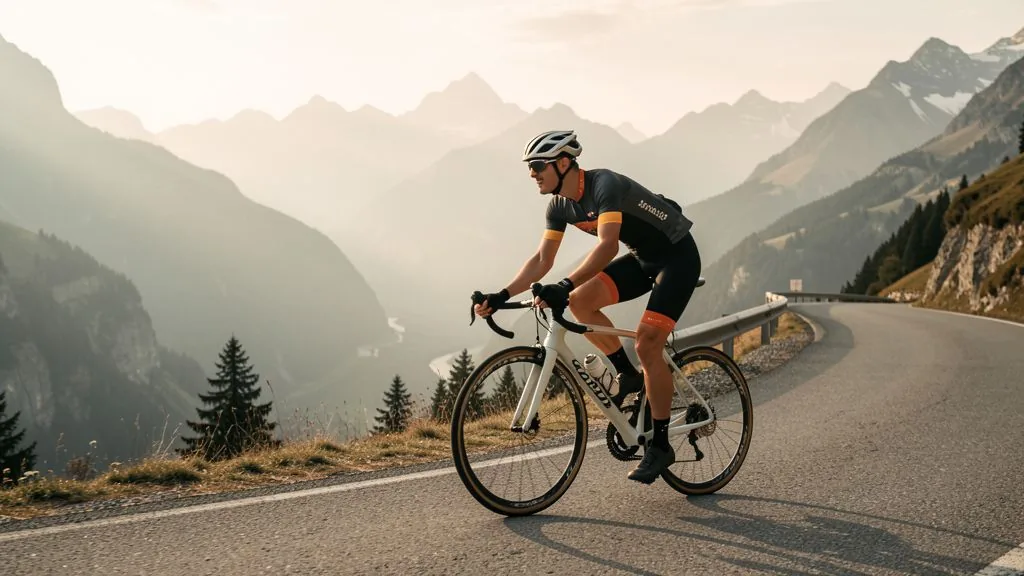
Aquabike is the multisport format for everyone who loves the water and handles a bike well — but falls apart on the run. Officially it is its own classification: swim, transition, ride, and the race is over when you reach the second transition. It sounds like a triathlon with the hard part removed. In reality aquabike is the discipline that shows most honestly how good your swim technique and bike fitness really are, because there is nothing left to hide behind.
What aquabike is — and what it is not
Aquabike consists of two disciplines with exactly one transition. You start in the same wave as the triathlon field, swim the same course, and ride the same route. The difference comes at the end: instead of putting on running shoes you roll into transition, dismount, and your time stops at the dismount line. There is no run course, no aid station after five kilometres, no fight against heavy legs.
The distances are identical to triathlon: sprint (750 m swim, 20 km bike), Olympic (1.5 km, 40 km), middle distance (1.9 km, 90 km) and long distance (3.8 km, 180 km). In practice two formats dominate: the Olympic distance at state championships and smaller events, and the middle distance at large races, where aquabike runs as a separate classification inside the field of a 70.3. Most aquabike classifications in Austria, Germany and Switzerland are staged as part of existing triathlon events — a standalone aquabike start is the exception.
One point on classification matters: aquabike is not "triathlon lite" for the undertrained. The load in the water and on the bike is the same as in triathlon, and because the run is missing, riders push harder on the bike than they otherwise would. Anyone covering 90 km in a field of 2,000 starters at 30 °C needs the same base as a triathlete — just without the run afterwards.
Who actually benefits from aquabike
The target group is larger than the name suggests. Five situations come up again and again in practice:
- Runners with load tolerance problems. After cartilage damage, an irritated Achilles or a stress fracture, running is off the table for months — but endurance training is not. Aquabike maintains fitness without the impact. What the return looks like afterwards is covered in return to running after injury.
- Swimmers with no running ambition. Athletes from a swimming background can gain time in the water but lose all of it on the run course. Without a run, swim time counts in full.
- Cyclists with knee trouble when running. Bike training is joint-friendly and can be dosed over hours — in aquabike it becomes the second main discipline instead of preparation.
- Returners and older athletes. In age groups from 50 upwards, aquabike is often the largest field by number. The reason is obvious: the injury stimulus of running disappears while the endurance work stays.
- Time-poor athletes. Three rides plus two swims fit a full calendar better than adding four runs on top. Anyone short on time will find the prioritisation logic in running with little time.
Anyone who simply wants to train less, however, is in the wrong place. The race takes two and a half to four hours at middle distance — the preparation is not smaller, it is only distributed differently.
Training split: one third water, two thirds bike
The most common mistake when moving over from triathlon is the wrong weighting. In triathlon roughly 50 to 60 percent of training time goes to the bike and 20 to 25 percent to the run. When the run disappears, those hours are reflexively added to swimming — with the result that bike fitness stagnates and time is lost exactly where most of it could be gained.
The reality on course: at Olympic distance the bike accounts for about 65 to 70 percent of total time and the swim for 20 to 25 percent, with transitions making up the rest. At middle distance this shifts to 75 to 80 percent bike. Training should follow accordingly:
- Two swim sessions per week totalling 3,000 to 5,000 m. One technical session (stroke length, breathing, kick, turns), one main set of 6 × 200 m or 10 × 100 m at race pace. Anyone coming from running who has not yet mastered freestyle technique should flip the ratio to three swims for the first eight weeks.
- Three to four bike sessions per week totalling five to eight hours: one long ride (2.5 to 4 h easy), one threshold session (3 × 12 min or 2 × 20 min at threshold), one technique or strength-endurance session in the hills or on the indoor trainer, and one easy recovery ride.
- Two short strength blocks of 20 to 30 minutes. Core and shoulder girdle are doubly demanded: pulling in the water, then stabilising on the bike. What actually counts there is covered in core training for endurance athletes.
- Mobility instead of a run substitute. Dropping the run leaves no gap in aerobic fitness, but it does leave one in impact tolerance. Anyone planning to run again later needs a structured build — not a spontaneous attempt on race day.
A note on intensity distribution: the 80/20 rule applies in aquabike too. Of eight sessions per week, six or seven should be easy. Anyone stacking two hard bike sessions and a hard swim set into the same week will not recover — and that shows up more clearly on the bike than on the run, because the sessions are longer. The principles are in 80/20 training.
The transition zone: once only, but decisive
Aquabike has just one transition — but it is the only one, and therefore the only place where you can lose time without fitness. In practice an unpractised swim-to-bike transition costs 90 to 150 seconds. Practised, 45 to 70 seconds is realistic. At Olympic distance with a target time around 2:30 hours that is one to two percent — and those seconds are free.
What makes the difference:
- Practise the wetsuit exit, don't just buy the suit. Getting out is a movement sequence you can train cleanly three times over: grab the cord, pull with the opposite hand, strip the sleeves over your hands, peel the suit to the hips, then sit down and pull each foot out with your hand instead of hopping upright. Do that three times a week after swimming and you halve your transition time.
- Leave shoes mounted on the bike and fix them level with an elastic band on the frame. On flat courses the flying mount takes under ten seconds. Anyone who has never done it should practise on an empty car park before trying it in a race.
- Put the helmet on before touching the bike. By rule the helmet must be fastened before the bike leaves the rack — in the heat of the moment this is often forgotten and costs a disqualification. Repeat the order until it runs automatically.
- Everything else prepared on the bike. Bottles filled, gels on the top tube or in the jersey pocket, bike computer started, glasses on a strap. Every reach into a jersey pocket while riding costs three to five seconds and is a safety risk under non-drafting rules.
One detail that is often underestimated: the path from swim exit to transition is part of the course. At races with a beach exit you add 50 to 200 m on wet sand, sometimes over steps or a ramp. That runs differently from asphalt and belongs in your simulation. Anyone who does not walk the transition zone before the race loses more time there than getting out of the wetsuit.
Bike pacing: the actual race
In aquabike the race is decided between kilometre 20 and kilometre 80. Because no run awaits after the bike, the temptation is to ride the whole split as a time trial — a mistake that regularly becomes expensive at middle distance. The reason: the swim load is not metabolically neutral. Anyone who has swum 1.9 km hard has burned glycogen and cooled the circulation inefficiently under water. A 90 km time trial therefore starts with a preload you never have in pure cycling.
Three practical rules:
- Ride the first 15 minutes deliberately below target watts. Not "easy" but structured: 85 to 90 percent of target intensity, focusing on cadence and calm breathing. That quarter hour costs around 30 seconds and saves several minutes by the end.
- Spread the effort instead of exploding on the climb. Physics cannot be fooled: at 75 kg system weight a 5 percent gradient at 300 watts gives about 15 km/h; pushing 400 watts there gains 40 seconds and loses three times that on the next climb. Even effort across the whole course beats fighting in patches under non-drafting rules.
- Hold cadence between 85 and 95. After swimming the leg muscles are pre-fatigued; higher cadence spreads the load onto the cardiovascular system instead of individual muscle groups. Grinding at 70 rpm is paid for on the last climb.
Riders with a power meter should split the bike leg into three blocks and keep Normalized Power in the first third five to seven percent below the overall target. Those without watts — the majority in age-group fields — work off breathing and RPE: the first 20 km must feel as if you could go on like that forever. Details on steering by feel are in RPE training.
A note on fuelling: without a run leg, the part of the race where stomach problems usually become visible is gone. That does not mean you can skip fuelling — over 90 km and two to three hours you need 60 to 90 grams of carbohydrate per hour, otherwise output drops 10 to 15 percent in the final hour. One 750 ml bottle plus two gels per hour is a workable base. How to plan it systematically is in carb loading.
Gear: less than triathlon, but targeted
Because the run is gone, the gear list shrinks noticeably. What really counts:
- Wetsuit or race suit. Below 16 °C water temperature a wetsuit is mandatory with most federations, above 22 °C it is banned. For aquabike a model with short legs is worth it — the exit is faster, and the loss of buoyancy matters little over 1.5 km.
- Triathlon road bike or time trial bike. Under non-drafting rules a pure TT bike with aero bars has the advantage on flat courses; on rolling profiles with many corners a road bike with clip-ons is the better choice. Anyone still shopping will find the criteria in buying a road bike.
- TT helmet saves roughly 30 to 60 seconds over 40 km compared with a standard road helmet — but in heat and on rolling terrain the loss of ventilation is a real drawback. Above 28 °C you are better off with a road helmet.
- Two bottle cages plus a top tube bag. Fully sufficient for Olympic distance; at middle distance add a third bottle behind the saddle or use an aid station.
What you can leave out: running shoes in transition (obviously), socks, glasses with interchangeable lenses, a hydration belt. What you should not leave out: a spare tube, tyre levers and a CO2 cartridge. Under non-drafting rules nobody will help you, and a flat without spares means the end — the technique is in roadside bike repairs.
The 10-week build at a glance
- Weeks 1–2: Baseline. A 1,000 m test set in the water, a 20-minute time trial on the bike for your starting value, two easy rides. No intensity, just establish volume.
- Weeks 3–4: First structured swim set (4 × 200 m), first threshold session on the bike (2 × 15 min). Extend the long ride to 2.5 hours. Practise the transition dry three times a week.
- Weeks 5–6: Build bike volume to six or seven hours per week. Two transition training days with a wet exit and the full sequence. Hill work or indoor trainer intervals for strength endurance.
- Week 7: Simulation week. One race-day test at full distance but 80 percent of target volume, including fuelling and transition routine. Two easy days afterwards.
- Weeks 8–9: Sharpening. Short, hard stimuli: 4 × 5 min above threshold, 8 × 100 m in the water. Volume drops 20 percent, intensity stays.
- Week 10: Taper. Cut volume by 40 to 50 percent, two rest days before the start, only short activations. Details are in tapering and race preparation.
Common mistakes
- Training aquabike as "triathlon without the run." Anyone who simply deletes the running kilometres and changes nothing else loses bike fitness because total load drops. The run has to be replaced by additional bike time, not by rest.
- Overvaluing the swim. Two sessions per week are enough. Four swims at unchanged bike time might gain 60 seconds at Olympic distance — good bike fitness gains five minutes.
- Underestimating the drafting rule. 12 metres sounds like a lot but is quickly undercut in a field. Anyone caught drafting receives a two-minute penalty — more than any transition mistake costs.
- Riding without watts or heart rate. Anyone pacing the bike leg purely by feel generally starts too hard. Even a simple bike computer with cadence and heart rate is better than nothing.
- Planning the return to running but not training it. Many aquabike starters want to race triathlon again later. The running build takes eight to twelve weeks of short, frequent stimuli — not three long runs before the first race.
How Peakora plans aquabike
The Peakora engine treats swimming and cycling as two sports with their own load profiles and combines them within a week so that key sessions do not collide. The recovery monitor scores a 90-minute ride differently from a 45-minute swim — water has no impact stimulus but a high metabolic share — and places the threshold session on the bike exactly when recovery from the last hard session is complete. Because transitions are scheduled as their own unit, they do not vanish between the kilometres. And if you want to run again later, the plan introduces running stimuli step by step instead of dropping them in overnight.
Frequently asked questions
What is aquabike?
Aquabike is a multisport race of swimming and cycling with no run. The race ends in the second transition, and your time is measured from the start until you dismount the bike.
What distances are raced in aquabike?
The distances mirror triathlon: sprint with 750 m swim and 20 km bike, Olympic with 1.5 km and 40 km, middle distance with 1.9 km and 90 km, long distance with 3.8 km and 180 km. Olympic and middle distance are the formats offered most often.
Who is aquabike suitable for?
Mainly endurance athletes who cannot or do not want to run: after knee or Achilles problems, during pregnancy, when returning to sport, or when running volume no longer fits the week. Strong swimmers and cyclists without running ambitions also find a race format that suits them.
How much training per week does aquabike require?
For the Olympic distance six to eight hours per week are enough: two swim sessions of 3,000 to 5,000 m and three bike sessions totalling three to five hours. For the middle distance the volume rises to nine to twelve hours, while the swim share stays similar.
Is drafting allowed in aquabike?
Normally not in age-group racing. Non-drafting rules apply with 12 metres to the rider ahead, and any pass must be completed within 25 to 30 seconds. Only dedicated professional or draft-legal races permit drafting.
Aquabike with a plan instead of guesswork
Swim and bike in one week, aligned with your recovery. Start free, no credit card required.
Start free