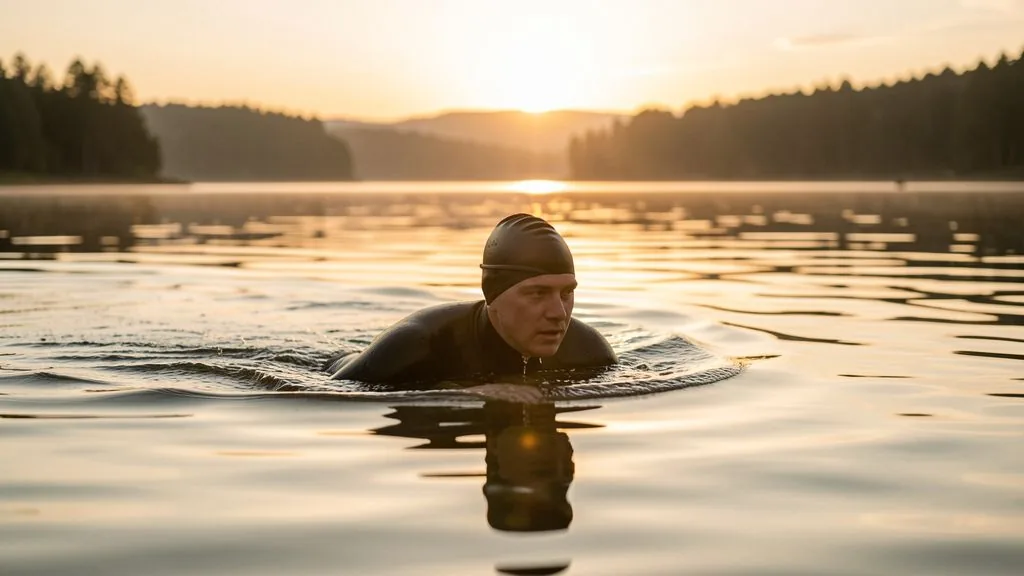
Aquathlon is the smallest form of multisport endurance racing there is: swim, transition, run — no bike, no flat tyres, no drafting rules. That is exactly why it gets underestimated. Anyone coming from triathlon assumes they can just pick it up. In reality aquathlon rewards one ability almost nobody trains in triathlon: running fast immediately after a hard swim, without the legs refusing to cooperate.
What aquathlon is — and why it gets underestimated
An aquathlon consists of two disciplines with one transition between them. The standard formats: 750 m to 1 km of swimming followed by 5 km of running (sprint distance, the format used at most championships and regional series), plus the classic long distance of 2.5 km swim and 10 km run. Some events also offer a fun or relay category over 500 m and 3 km — a good entry point.
The decisive difference to triathlon is not the missing bike, it is the load sequence. In triathlon the bike acts as a buffer: after the water you get 40 to 180 km to settle your circulation before you put on running shoes. In aquathlon there are often fewer than 90 seconds between exiting the water and starting the run. The body goes from a horizontal, cooling position with high breathing frequency straight into upright, impact-loaded movement — and has to hold race pace while doing so.
For runners, aquathlon is the most honest form of cross-training: two swim sessions per week measurably unload tendons and joints without costing endurance. For triathletes it is the cheapest form test of the year — it shows without bike-related camouflage how good the swim fitness really is. And anyone already deep in triathlon training will find the environment for both disciplines there.
The transition without a bike: 90 seconds that count
The transition zone in aquathlon is a narrow strip: wetsuit off, running shoes on, goggles in hand or on the head, go. Sounds trivial, but beginners regularly lose 60 to 120 seconds — over 5 km that is two to four percent of total race time. Three details decide it:
- Back zipper, practise the pull first. Anyone who has never opened a wetsuit in training fights a stuck zipper with wet hands on race day. Rehearse the exit three times a week in your race suit — not dry, but after swimming.
- Elastic laces instead of tying. Two loops, foot in, done. That saves 15 to 30 seconds depending on dexterity and still works with cold hands. Most athletes tie conventional laces more slowly than they think in the finish area.
- Skip socks — or test them first. Over 5 km, running without socks is unproblematic for most. Anyone who blisters does not need socks, they need better-fitting shoes. Over 10 km on the long distance, a thin sock pre-placed in the shoe is the better choice.
One point that is often forgotten: the path from water to transition zone is part of the course. At sea aquathlons with waves and surf you add 50 to 150 m of running on wet sand — that runs differently from asphalt and belongs in your training.
Weekly split: two swims and three runs
The most common mistake in aquathlon training is copying a triathlon week one to one. In triathlon you spend 50 to 60 percent of training time on the bike. Remove the bike and those hours usually get poured into swimming — with the result that run fitness stalls and the athlete complains about missing top-end endurance at the finish. The right split for sprint distance:
- Two swim sessions per week, totalling 3,000 to 5,000 m. One technical (stroke length, breathing, kick), one as a main set with 4 × 200 m or 8 × 100 m at race pace. Consistency beats volume: two sessions every week for twelve weeks delivers more than four sessions for three weeks and then a break.
- Three to four runs per week: one long (60 to 90 minutes easy), one at threshold (4 × 8 min or 20 min continuous), one as a combined session after swimming, and one easy regeneration run.
- One swim-run brick per week as a fixed appointment. Details below — this is the session that separates aquathlon from duathlon.
- Two short strength blocks of 20 to 30 minutes for trunk, calves and shoulder girdle. The shoulder girdle is doubly challenged in aquathlon: pulling in the water, then arm work while running. Anyone who already has strength training for runners in place adds two pulling exercises and leaves the rest unchanged.
If you come from running and are learning to swim, flip the ratio for the first eight weeks: three swims, three runs. Technique needs frequency — 45 minutes three times a week is worth more to a beginner than one 90-minute block at the weekend. A technique check pays off: anyone who has not mastered freestyle technique loses more time in the water than any run interval session will ever gain.
The swim-run brick: the most important session
A brick is a session in which two disciplines are chained together without a break — the body learns the switch as part of training. In triathlon the classic is bike plus run. In aquathlon swimming replaces the bike, which makes things less comfortable: the load change is sharper because there is no easy stretch in between.
A proven format for beginners, once a week:
- Part 1: 200 to 300 m easy warm-up swim.
- Part 2: 800 m at planned race pace — not everything, but brisk enough that breathing is at its limit.
- Part 3: Exit, transition in under 60 seconds (time it!), then run 2 km straight away. Deliberately easy for the first 500 m, then race pace.
- Progression: After eight weeks, two to three rounds per session. On the long distance the set extends to 1,500 m swim and 5 km run.
Order matters: only once transition time is consistently under 60 seconds does it pay to work on run pace. If you need 90 seconds in training, you lose against athletes with identical swim and run times — mathematically roughly 25 seconds per kilometre over 5 km, which otherwise has to be earned the hard way in the water or on the road.
An additional format for advanced athletes: the aquathlon simulation day four weeks before the target race. Two complete runs of the race distance with 20 minutes of rest in between. That sounds excessive, but it is the only honest test of whether recovery between two efforts is sufficient — and whether your fuelling works.
Pacing: control the water, win the run
Time distribution in aquathlon is extremely front-loaded. In a sprint race with 750 m swim and 5 km run, the water accounts for 25 to 35 percent of total time depending on level. Even so, the temptation to give everything in the water is huge — heart rate is hard to control there, the watch shows no pace, and the pull of the field drags you forward.
The result is a run that is 20 to 30 seconds per kilometre slower than in training. Two rules against it:
- Deliberately slow first minute in the water. Do not sprint, treat the first 100 m as a warm-up in the water. The body needs that minute to find breathing rhythm and stroke length. Start 5 seconds per 100 m too fast here and you pay it back twice.
- Deliberately below pace for the first 400 m after transition. Accept that running feels wrong at first. Legs are heavy, heart rate is high, breathing is shallow. That is physiologically normal and disappears after 400 to 800 m. Anyone who "fights" in this phase burns glycogen for nothing.
As a conversion guide: a runner with 25 minutes for 5 km in a pure running race should expect 28 to 30 minutes at a sprint aquathlon. Anyone faster was too slow in the water — or has a very good transition. How water resistance, water temperature and waves affect total time is covered under pacing strategy in training science; the basics of run pacing are in the article race tactics for running races.
Gear: short and without ballast
Aquathlon gear is a backpack, not a suitcase. What you actually need:
- Wetsuit or race suit. Below 16 °C water temperature a wetsuit is mandatory at most federations, above 22 °C it is banned. On short courses a race-legal suit with a back zipper is often enough — it comes off faster than a classic wetsuit with long legs.
- Race goggles with a double strap so they do not slip on exit. Avoid goggles with buckles that catch during transition.
- Running shoes with elastic laces, pre-placed in the transition area. For sand or gravel in the start-finish area, an extra pair of old shoes left at the exit is worth it.
- Race number on an elastic band — not with pins. Pins on wet skin are always a time sink in transition.
Everything else — drink belt, gels, heart rate strap — is optional. Over 5 km you need no fuelling. On the long distance with 10 km of running, one aid station is enough; anyone planning gels there should test them with water, not with sports drink, or the stomach will object.
The 8-week build at a glance
- Weeks 1–2: Technique focus in the water, two easy runs, no intensity. Goal: 800 m continuous with controlled breathing.
- Weeks 3–4: First swim-run brick with 600 m and 1.5 km. Slightly increase run volume, one threshold run per week.
- Weeks 5–6: Build the brick to race distance (750 m / 2 × 2 km). First run interval session, swim main set with 4 × 200 m.
- Week 7: Simulation day with two rounds, then two easy days. Rehearse the transition routine three times dry and three times wet.
- Week 8: Cut volume by 40 percent, keep short sharp stimuli, two rest days before the start. Race week details are in the article on tapering.
Common mistakes
- Training aquathlon as "triathlon without the bike". Anyone who just deletes bike sessions loses the specific ability to run fast after swimming. The brick session is not an add-on, it is the heart of the plan.
- Too much swim volume, too little technique. 4,000 m per week with poor stroke length delivers less than 2,500 m with clean technique. Water resistance grows with the square of speed — technique is the only lever that works without a fitness cost.
- Not training the transition. 60 to 120 seconds lost in transition is more than two percent in a 45-minute race — and it costs no fitness, only practice.
- Ignoring cold water temperatures. Starting below 16 °C without a wetsuit is not only against the rules, it is risky: cold shock at entry spikes heart rate and constricts breathing. If you are sensitive, swim the first 200 m with your face in the water deliberately slowly.
- Starting the run work too late. After four weeks of brick training you can see whether the load chain works. Anyone who starts two weeks before the race has no buffer left for adjustments.
How Peakora plans aquathlon
The Peakora engine treats swimming and running as separate sports with their own load profiles and combines them within a week without hard sessions getting in each other's way. The recovery monitor scores swim load differently from run load — water has no impact stress but a high metabolic component — and schedules the brick session exactly when recovery from the last hard run is complete. Because the plan carries transitions as their own session type, they do not disappear between the kilometres.
Frequently asked questions
What are the distances in an aquathlon?
Most events run 750 m to 1 km of swimming followed by 5 km of running. The classic long distance is 2.5 km swim and 10 km run, while championships usually use the sprint format.
Do I need a wetsuit for an aquathlon?
Only if water temperature requires it. Below 16 °C a wetsuit is mandatory at most federation events, above 22 °C it is banned. For short races a race suit with a back zipper is often enough.
How do I practise the transition from water to running shoes?
At least once a week as a swim-run brick: swim 800 m at pace, get into your shoes in under 60 seconds and run 2 km straight away. That teaches you to handle heavy legs and a high heart rate.
How many swim and run sessions per week make sense?
For sprint distance, two swims and three to four runs per week are enough. Consistency in the water and one weekly combined stimulus matter more than volume. Coming from triathlon, swap bike kilometres for extra runs.
Why do my legs feel heavy after swimming?
Because after swimming horizontally the body must work against gravity again and blood flow redistributes. The transition also drives heart rate up. It usually settles after 400 to 800 m of running.
Aquathlon with a plan, not by feel
Swimming and running in one week, aligned with your recovery. Start free, no credit card required.
Start free