Triathlon has a reputation for being an expensive hobby — and the industry's marketing does everything to keep it that way. The truth: for your first starter or sprint triathlon you need a fraction of what glossy catalogues suggest. This guide sorts the gear into "mandatory", "sensible" and "can wait" — with real prices and honest recommendations.
The golden rule: used beats expensive
Before we dive into the details, the single most important rule: don't buy anything new until you know you'll stick with the sport. Triathlon has a high dropout rate after the first year — classifieds sites are full of nearly-new time trial bikes and power meters from people who never made it to their second race. Borrowing, buying used and using what you already own beats every new purchase. Only once you've finished two or three races and know which distance excites you do targeted investments make sense.
Second rule: everything you use on race day has been used in training first. New shoes, a freshly bought wetsuit, an untested gel — classic race-day failure sources. For more on avoiding mistakes, see our race day checklist.
Swimming: wetsuit, goggles, swim cap
The swim leg is the biggest hurdle for most beginners — and the gear here genuinely affects both your result and your safety.
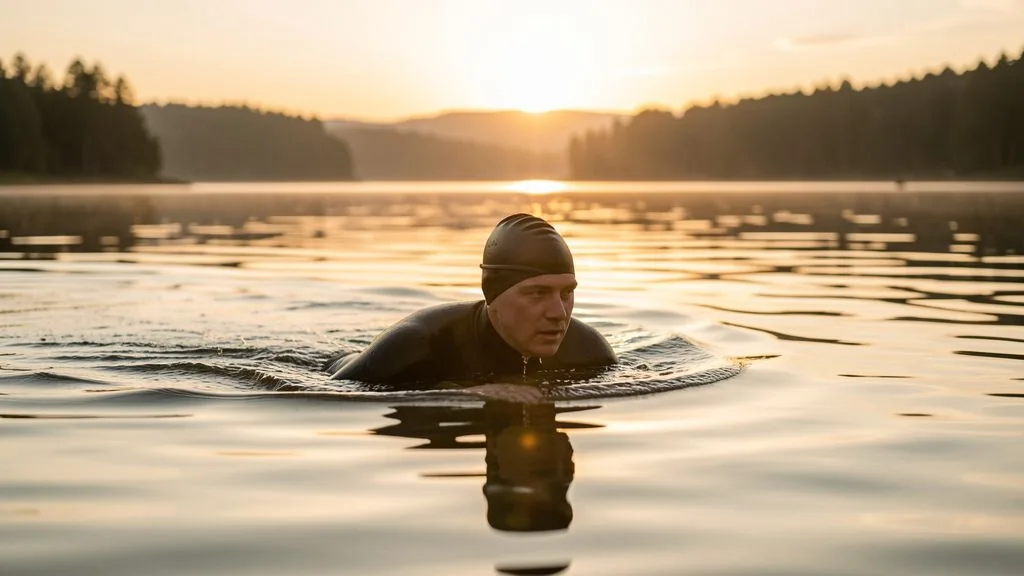
- Wetsuit: Whether you need one depends on the water temperature. The usual rules: below about 15–16 °C racing without a wetsuit is often not allowed at all, between 16 and 21 °C it is mandatory or strongly recommended, and above roughly 24 °C it is banned. A wetsuit provides buoyancy (a gift for leg-sinkers), glide and warmth. Entry-level models cost 150–250 €; renting starts at around 30 € per weekend. Fit is crucial: too loose means water flushing in, too tight restricts your breathing. For technique in the water, see triathlon swimming: technique tips for beginners.
- Goggles: 15–30 €, and quality is worth it here. Choose a model with a wide field of view (a swim mask or wide-cut lenses) that you have tested in open water beforehand. Tinted lenses for sun, clear lenses for overcast days.
- Swim cap: Provided at almost every race (the numbered race cap). Your own silicone cap underneath helps against the cold and keeps your goggles in place.
Cycling: any roadworthy bike works
The bike leg is the longest discipline, and this is where beginners' biggest fear sits: "without a road bike I'm hopeless." Not true. At starter and sprint distances you'll see everything in the field from mountain bikes to 12,000-€ time trial machines — and the rules explicitly allow any roadworthy bike with two working brakes. Riding a well-maintained hybrid with slick tyres, you'll lose maybe two to three minutes over 20 km compared to an entry-level road bike. In a first race that is about finishing, that is completely irrelevant.
- Road bike: The most sensible first purchase once you stay in the sport. Used aluminium road bikes with Shimano shifting start at 300–500 €; solid new entry-level models from around 900 €. More important than the price: the bike has to fit. A poorly fitting 1,500-€ bike is worse than a fitting 500-€ one — read our article on bike fitting.
- Helmet: Absolutely mandatory, no discussion. Certified EN 1078 models start at 50 € and protect exactly like the 250-€ versions — the extra money buys ventilation and weight savings, not safety. Race rule: helmet buckled before the bike leaves the rack; unbuckled only once the bike is racked again.
- Pedals and shoes: Flat pedals with running shoes are fine to start with. Clipless pedals (from about 80 € including used shoes) give you a rounder pedal stroke and a more secure connection — but only if you've practised clipping in and out. The classic: the standing-still tip-over right after clipping in. Practise, practise, practise.
- Puncture kit: Spare tube, two tyre levers, mini pump or CO₂ cartridge — stashed under the saddle, about 40 €. A flat without a kit means the end of your race. And: practise changing a tube once at home, otherwise the kit is useless.
For a structured start into bike training, see road cycling for beginners.
Running: shoes — and almost nothing else
The good news at the end: the run leg is the cheapest discipline gear-wise. You need good running shoes (100–150 €, picked at a specialist shop with a gait analysis — criteria in our article buying running shoes: 8 criteria that matter) and functional clothing that doesn't chafe. That's it.
One detail saves time and nerves: elastic quick laces for 5–10 €. They let you slip into your shoes in the second transition instead of tying bows with clumsy fingers. Socks are a matter of taste — many race short distances barefoot in their shoes, but that too belongs in training first, because blisters are otherwise guaranteed.
The trisuit (one-piece, 80–150 €) is the single purchase that makes life as a triathlete noticeably easier: you swim, ride and run in the same garment, the thin chamois doesn't bother you on the run, and you skip changing clothes in transition entirely. For the very first start, swim trunks plus a quickly pulled-on cycling jersey will do, though.
The transition area: the fourth discipline
Transitions need hardly any gear, but smart organisation: a towel as your base of order (bike and run gear laid out on it), a race number belt (8–12 € — the bib is worn on the belt, not pinned on, and flips from back to front in seconds), plus gels for the bike and run legs if needed. Rehearse the sequence: helmet on before the bike is taken in hand; run shoes on, helmet off only once the bike is racked again. Sounds trivial, but it is the most common source of time penalties among beginners. Details and step-by-step flow: T1 and T2: the fourth discipline of triathlon.
What you can skip at the start
- Time trial / triathlon bike: 3,000–10,000 € for an aero advantage worth maybe two minutes over 20 km — provided you can even hold an aerodynamic position. A topic only once middle-distance ambitions appear.
- Power meter: From 400 € upwards. A great training tool — but only once you know what watt numbers mean and how to train by them. Before that, it's an expensive speedometer.
- Carbon wheels: Deep-section rims cost 1,000 €+, weigh little and look fast. Beginners ride faster with proper tyre pressure and trained legs than with expensive rims on a weak base.
- Expensive multisport watch: A basic GPS watch (from 150 €) or even your smartphone is enough to begin with. The 800-€ solar titanium watch doesn't buy you fitness.
- Aero helmet: Time trial helmets deliver aero gains at high speeds — and look plainly out of place on a city bike in the middle of the field. Normal helmet, done.
Budget overview: three ways to the start line
- Minimal setup (about 100–250 €): Use what you have — any bike you own, existing running shoes, swim trunks and goggles. You only add a helmet (50 €), a race belt (10 €) and possibly a rented wetsuit (30 €). Perfect for the very first starter triathlon.
- Solid starter setup (about 600–1,000 €): Used road bike (400 €), entry-level wetsuit (200 €), helmet (60 €), trisuit (100 €), new running shoes (130 €), small items. With this you're well equipped for sprint and even Olympic distance.
- Comfort setup (from 2,000 €): New road bike (1,000 €+), quality wetsuit (300–400 €), GPS watch, clipless system, trisuit. Makes sense once you know for sure: triathlon is my sport.
What stays the same across all setups: no equipment replaces well-designed training. A structured triathlon training plan for beginners gets you to the finish minutes faster on the very same gear.
Frequently asked questions about triathlon gear
Do I need a wetsuit for my first triathlon?
Not always. Below roughly 21 °C water temperature a wetsuit is mandatory or strongly recommended; above about 24 °C it is usually banned. For a first race, renting one from around 30 € per weekend is often enough. Buying only makes sense from your second or third race.
Can I race on a mountain bike or city bike?
Yes. At starter and sprint distances any roadworthy bike with two working brakes is allowed. A road bike makes you faster but is not a requirement for getting started. The investment pays off once you race regularly.
How much does basic triathlon gear cost?
Roughly 300–600 € at minimum: a rented or budget entry-level wetsuit (150–250 €), a used road bike from about 300 €, a helmet from 50 €, plus running shoes and goggles many people already own. Buying everything new and high-end quickly exceeds 2,000 €.
Is a helmet mandatory in a triathlon?
Yes, without exception. Without a fastened, certified helmet (EN 1078 standard) you may not touch the bike — violations mean disqualification. The helmet must be buckled before you take your bike off the rack and stays fastened until you rack it again.
Do I need a GPS watch or a power meter?
No. For beginners, perceived effort and split times are enough. A basic GPS watch helps with pacing; power meters and carbon wheels are gear for later — once your training and technique are in place, they matter far more than any gadget.
Training beats gear — every time
The honest bottom line: between the 250-€ and the 2,000-€ setup there are maybe five to eight minutes over a sprint distance. Between untrained and systematically trained there are thirty. That's why Peakora doesn't contain an equipment planner but a training engine: it builds your weeks around your goal race, balances the three disciplines to your level, and adapts when life gets in the way. The gear above gets you to the start — training gets you to the finish.
Train for your first triathlon with Peakora
An individual training plan for swimming, cycling and running — matched to your level and your goal race. Start free, no credit card required.
Start for free