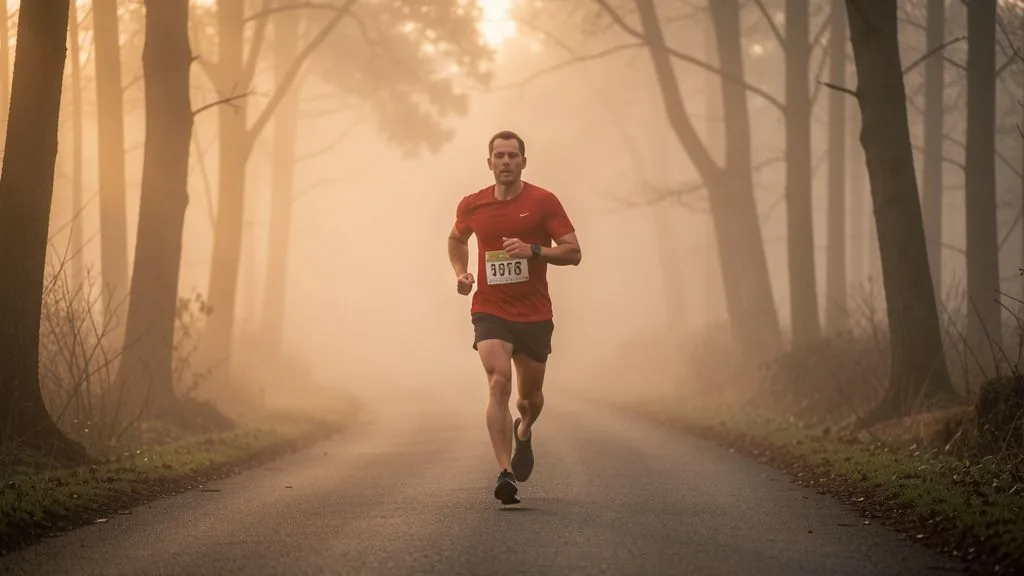
There is one diagnosis athletes rarely receive: obstructive sleep apnea. Not because it is rare, but because it does not fit the picture. Someone running 80 kilometres a week with a resting heart rate of 46 does not look ill — and blames the fatigue on training. That is exactly the problem. Untreated sleep apnea costs deep sleep, distorts load management and blunts adaptation, and it does so for years without ever showing up as a training mistake.
What happens at night
In obstructive sleep apnea the muscles of the throat relax so far during sleep that the upper airway collapses. The result is breathing pauses of at least ten seconds, often 20 to 40, and longer in severe cases. Blood oxygen drops, the body jolts upright with an arousal, gasps for air — and falls back asleep, usually without remembering any of it.
These arousals often last only seconds, but they slice up sleep architecture. Deep sleep and REM sleep are hit hardest: precisely the phases in which growth hormone is released, muscle repair happens and the autonomic nervous system switches into recovery mode. At an AHI of 30 — thirty breathing pauses per hour — that is arithmetically one interruption every two minutes. Eight hours of sleep become eight hours of struggle.
The measure for this is the apnea-hypopnea index (AHI): the number of apneas and partial obstructions per hour of sleep. Up to five is normal, five to 15 mild, 15 to 30 moderate, above 30 severe. Oxygen saturation comes on top — 95 to 99 percent at night in healthy people, with repeated dips below 90 percent once apnea is relevant.
Why endurance athletes notice it so late
In endurance athletes the condition is systematically underestimated, for three reasons:
- The phenotype does not fit. Sleep apnea is classically associated with excess weight and a thick neck. In fact there is a relevant group of normal-weight, trained people with apnea — the cause then lies in anatomy: a narrow throat, large tonsils, a receding jaw, a long tongue, impaired nasal breathing after a broken nose or chronic mucosal swelling.
- Fitness masks the symptoms. Regular endurance training lowers resting heart rate, stabilises blood pressure and improves mood. Many complaints that would stand out in everyday life get compensated — until the load is high enough that compensation no longer suffices.
- Fatigue is normalised in sport. Train hard, be tired. Be tired, sleep badly. Sleep badly, be more tired. This loop is accepted as part of training life rather than read as a symptom.
There is a second, often overlooked point: endurance athletes frequently sleep with a higher breathing drive and deeper breathing — and they snore more often than they think. Snoring alone is not apnea, but it is the most common clue a partner notices at night.
The warning signs that matter
Not every snore needs treatment. It becomes notable in combination with these signs:
- Loud, irregular snoring with breathing pauses. Your partner reports silence followed by a jolt, a gasp or spluttering. This is the most reliable everyday signal.
- Waking at night with a tight chest or shortness of breath. Often in the second half of the night, frequently with heart pounding.
- Morning headaches and a dry mouth. Typical consequences of mouth breathing and oxygen dips.
- Daytime sleepiness. Especially in the car, at the cinema, in meetings. If you can barely keep your eyes open while waiting in the car, that is not toughness — it is a warning sign.
- Night-time urination. Twice or more per night without a large evening fluid intake — driven by the hormonal shift in apnea.
- Training that stops responding. Same volume, same intensity, but the fitness curve flattens or declines. The article on overcoming a training plateau covers the training-side causes — sleep belongs in the same review.
- Unusually high heart rate at easy pace. A morning resting heart rate five to eight beats elevated, plus altered heart rate variability patterns: both are signs of nocturnal sympathetic activation.
- Blood pressure that will not come down. Sleep apnea is one of the most common causes of hard-to-control hypertension — including in lean, athletic people.
A single one of these signs means little. Three or more, over weeks, with a partner's report of breathing pauses: get it checked.
What research in athletes shows
Studies in endurance athletes — including marathon runners, cyclists and triathletes — find prevalence rates of roughly 5 to 15 percent for moderate to severe sleep apnea, depending on population and diagnostic criteria. For comparison: in the general middle-aged population, rates in men are similarly high, in women considerably lower. What stands out in athletes is the large share of normal-weight cases, which makes classic screening questionnaires (such as the Epworth Sleepiness Scale or STOP-BANG) less reliable: they weight body weight, age and neck circumference heavily.
On performance, the data points consistently in one direction, even though controlled trials in competitive athletes are small. Untreated sleep apnea comes with increased daytime sleepiness, longer reaction time, poorer overnight recovery and a measurably higher sympathetic tone. In practice: the same training week produces less adaptation, and recovery between two hard sessions takes longer. With treated apnea — above all with CPAP therapy — studies show improvements in VO2max, anaerobic threshold and subjective performance, sometimes in the range of several percentage points.
The route to a diagnosis
The first step is unspectacular: see your GP, describe the symptoms, bring your partner's account. A referral to a sleep lab or a pneumology practice usually follows. Two types of investigation are standard:
- Home sleep test (polygraphy): a device recording airflow, oxygen saturation, body position, heart rate and snoring sounds overnight. Fiddly to use, but ambulatory and widely available. The result is a provisional AHI.
- Sleep lab (polysomnography): the full measurement including EEG, eye movements, muscle tone and ECG. This confirms the AHI and also reveals sleep architecture — how much deep sleep is actually left.
Relevant for athletes: some practices offer athlete screenings focused on load and recovery. If you have a sports watch with overnight oxygen measurement, you can get early hints — but be careful, wrist-based optical sensors are not validated for apnea screening. An abnormal reading is a reason to get checked; a normal reading is not an exclusion.
Treatment: what actually works
Therapy depends on severity and cause. For endurance athletes the decisive question is usually: what can I do without wrecking my training routine?
- CPAP (positive airway pressure): the reference treatment for moderate and severe apnea. A mask keeps the airway open with mild positive pressure. Getting used to it takes two to six weeks for many people and is the most common reason for abandoning therapy — persistence and a well-fitted mask pay off here. The good news for athletes: modern devices are quiet, and therapy is compatible with any sleeping position and any training routine.
- Mandibular advancement splint: a dental splint that holds the lower jaw slightly forward at night. Effective in mild to moderate apnea, a good option for anyone who cannot tolerate CPAP. Fitted by a specialist dentist.
- Positional therapy: for purely supine-dependent apnea, positional aids help keep you sleeping on your side. Simple, but sufficient only for a subset of patients.
- Weight reduction: with excess weight, the most effective long-term lever — a 5–10 percent loss of body weight often lowers the AHI by roughly a quarter in studies. In normal-weight athletes this lever does not apply; here losing weight is even counterproductive.
- Surgical and anatomical corrections: septoplasty, tonsillectomy, jaw surgery. Sensible when there is a clear anatomical cause. In athletes this is worth checking, because the cause frequently sits exactly there.
- What does not work: anti-snoring sprays, nasal strips, nasal clips and chin straps address nasal breathing, while the obstruction in obstructive apnea sits in the throat. They can dampen the noise and thereby delay the diagnosis — which is what makes them risky. Alcohol in the evening and sleeping pills also worsen the situation, because they further relax the throat muscles.
What this means for your training plan
If you do not recover at night, you cannot compensate with more training — that is the most common and most expensive mistake. A plan that does not know about untreated sleep apnea reads every bad session as insufficient fitness and pushes volume up. The spiral then turns in exactly the wrong direction.
The smarter order is reversed: clarify the cause first, then steer the load. Until the diagnosis is in, one simple rule applies: no increase in volume, no additional quality sessions, hard efforts only if the previous night was decent. One extra rest day costs nothing — a week with two botched quality sessions costs several weeks of form.
Concretely, for the interim period:
- Hold volume, do not increase. 80 to 100 percent of your usual load, but without progression until the diagnosis is clear.
- Intensity by daily readiness. Instead of fixed intervals from a plan: warm up for ten minutes, then decide. If your heart rate at a known pace sits ten beats too high, the session becomes an easy run.
- Drop double sessions. The second stimulus of the day needs recovery that is not reliably available in this phase.
- Log your sleep. The watch does not decide — how you feel in the morning plus objective values do. A simple training diary is enough: bedtime, wake time, perceived recovery 1 to 5, resting heart rate. After two weeks you see patterns no single value reveals. How to keep it properly is described in the article on keeping a training log.
Sleep hygiene: what makes a difference — and what does not
With suspected apnea, sleep hygiene is no substitute for a diagnosis, but it measurably improves the baseline and night quality:
- No alcohol in the evening. Alcohol relaxes the throat muscles and prolongs apneas. Two glasses of wine three hours before bed are no small matter for those affected. Details in the article on alcohol in endurance sport.
- Encourage side sleeping. A pillow in your back or a dedicated positional aid is often enough. Supine position doubles the AHI for many people.
- Keep nasal breathing clear. With a chronically blocked nose: get it assessed and treated. Impaired nasal breathing increases negative pressure in the throat and therefore collapse.
- Consistent times. Regular bed and wake times stabilise sleep architecture — including at weekends and after long runs.
- Keep evening training at a distance. Hard sessions less than two hours before bed increase sleep latency and night-time heart rate. The article on training in the morning vs the evening puts this in context.
- No alcohol as a sleep aid, no sleeping pills without medical advice. Both worsen apnea.
What does not help: expensive unvalidated gadgets, "anti-snoring" pillows without a positional test, and the hope that more fitness will sort it out. Untreated obstructive apnea does not disappear through training.
Who this matters most for
- Men over 40 with regular snoring and daytime fatigue — statistically the most common group.
- Women during and after menopause. Risk rises markedly as oestrogen falls, and symptoms are often atypical: exhaustion, headaches, low mood instead of loud snoring. The article on menopause and training covers the training-side context.
- People with untreated hypertension, even with good fitness.
- Anyone stuck at a training plateau despite appropriate volume, intensity and nutrition — sleep is the next variable to check.
Frequently asked questions about sleep apnea and sport
How do I recognise sleep apnea as an athlete?
Loud, irregular snoring with breathing pauses, waking at night and daytime fatigue despite enough sleep. In athletes it often stays undetected because fitness masks the symptoms and training numbers still look acceptable.
Can I compete in endurance sports with sleep apnea?
Yes — with treated sleep apnea, competitive sport is usually fine. Treatment belongs before your next training block, because untreated apneas distort recovery and load management and raise cardiovascular risk.
Does losing weight reduce sleep apnea?
With excess weight, yes, sometimes substantially: a 5–10% weight loss often lowers the AHI by roughly a quarter. In normal-weight endurance athletes the cause usually sits in the anatomy of the upper airway, not in body weight.
Do anti-snoring sprays help against sleep apnea?
No. Sprays and nasal strips only affect nasal breathing, while the obstruction in obstructive apnea sits in the throat. They may make snoring quieter but do not replace a proper diagnosis.
How many breathing pauses per hour are normal?
Up to five are considered normal. Five to 15 is mild, 15 to 30 moderate and above 30 severe obstructive sleep apnea. For endurance athletes even values in the mild range matter.
How Peakora handles bad nights
Peakora cannot diagnose apnea — and does not try to. What the engine does: it reads sleep as part of the recovery assessment. The form model combines training stress (CTL/ATL) with a sleep factor; a short or restless night lowers daily readiness, and the plan responds with an easier session instead of the scheduled interval. This is deliberately conservative: better to shift one session than to block a whole week.
For context, look at TSB — the form value that shows whether you are building or drifting into overreaching. If form falls for weeks although the plan is being followed, that is a signal worth taking seriously: CTL, ATL and TSB explains how to read the values, and the article on overtraining warning signs covers where the line to genuine overload sits. Sleep apnea is one of the causes that often goes missing from that list.
Anyone wanting to deepen the fundamentals of sleep and recovery will find them in the article on sleep and endurance performance and in the article on sleep before a race.
Plan your training with Peakora
Training control that reads sleep as part of recovery and adjusts the session when the night was bad. Start free, no credit card required.
Start for free