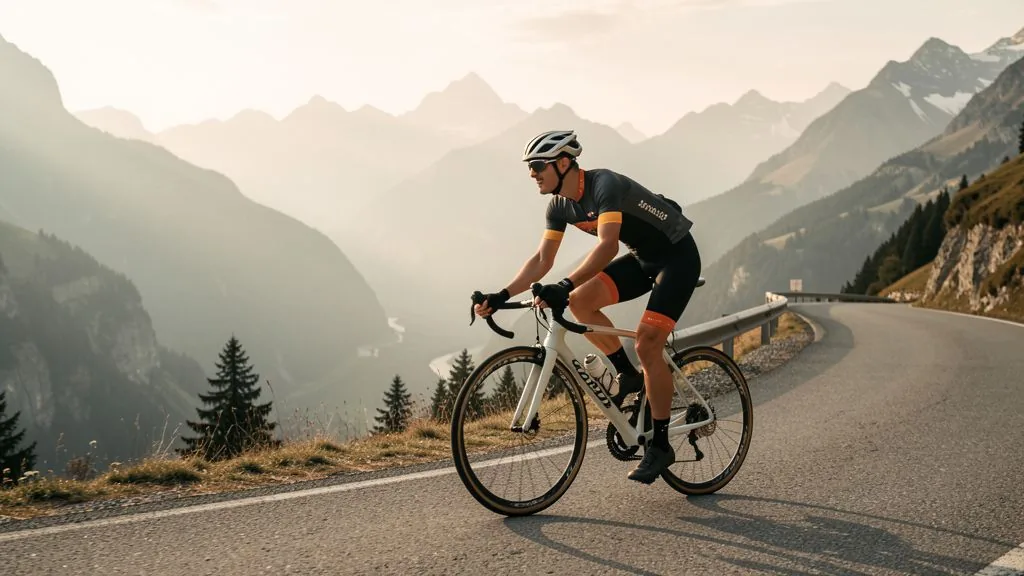
For many ambitious cyclists the first group ride comes as a shock: suddenly ten bikes are 60 centimetres apart, someone shouts about a pothole, and your heart rate is higher than in any interval session — despite the "easy" group announcement. Yet the group is the biggest free performance gain cycling has to offer: sitting cleanly in the slipstream at 35 km/h saves you roughly 25 to 30 percent of your power. That is more than any aero wheel, carbon frame and position tweak combined. The technique is learnable — in this order.
Why drafting saves so much
Air resistance rises with the square of your speed and dominates the power requirement above 20 km/h: at 35 km/h a 75-kilogram rider alone in the wind needs about 250 watts just to push through the air. Directly behind another rider, 50 to 80 centimetres back, that demand falls to around 175 watts, and to roughly 150 watts on positions three and four of the line. The rider in front trails a cone of still air behind them that you can use for metres.
Three rules follow. First, drafting always pays except on genuinely steep climbs below about 15 km/h, where air resistance is small and a safe gap becomes unrealistic. Second, the benefit grows with speed: at 20 km/h it is around 15 percent, at 45 km/h more than 35 percent. Third, short turns beat long ones — twenty minutes at the front costs more than four five-minute pulls, for the same share of the work.
The evidence is solid: heart rate in the slipstream drops by five to twelve beats, and lactate values at identical speed are markedly lower. If you want to grow your base block in winter without diluting your intensity distribution — see the 80/20 principle — the group ride is the simplest solution: long, easy kilometres with a real stimulus for the aerobic system.
Understanding the positions in the line
A group normally rides two abreast, with both sides rotating independently. The benefit is not evenly distributed, and that is the key insight for newcomers:
- Position 1 (the front): Full load, around 250 watts. This is where the work, the navigation and the traffic awareness happen. Beginners do not belong here yet.
- Position 2 (on the wheel): The best recovery in the whole line, about 175 watts. It is also the most demanding spot, because you have to absorb every change of pace.
- Positions 3 to 6 (the line): Storage positions at 145 to 165 watts. Easy to hold, because the slipstream cone is still fully effective here.
- Last position (the tail): Popular with beginners but overrated. The draft is thinner, the concert of brake lights ahead overwhelms you easily, and if you get dropped you are on your own in the wind. Ride in the middle of the line before you sit at the back.
The practical consequence: your heart rate in a group is far lower than on a solo ride at the same speed. If you want to keep your stimuli clean, plan group rides deliberately as base sessions and hold back on the climbs instead of overcooking it at the front on the flat. A look at your heart rate zones helps you place the effort correctly.
The five hand signals that keep you safe in a group
In a good group nobody talks — they point. There is a practical reason: at 35 km/h a shout is often swallowed by wind and traffic noise, while a hand signal stays visible. These five are enough to start with:
- Arm extended sideways: A change of direction or a turn. The arm points where the group is going — the riders behind repeat the signal down the line to the last position.
- Flat hand pumping up and down: Beware, bad surface. Potholes, root damage, cobbles.
- Hand pointing down, slightly angled: Obstacle directly in front of me. Anyone who cannot read the signal rides straight over it — and ends up in the ditch.
- Index finger raised, circling: We are passing a person, a tractor or an obstacle. Alongside it: the left arm waves forward and down to keep the line compact.
- Arm up, hand bent downward over the shoulder: Slowing down. The rider in front is easing off, the line rolls to a stop.
Four more rules come without hand signals, and they matter just as much: do not ride with your front wheel level with the rear wheel of the rider ahead — ride offset behind it. Take your foot out of the pedal when you are standing beside someone instead of letting it swing round. Do not brake abruptly but with a measured hand — which is why you put your hands on the drops before every corner. And do not stare at the rear wheel ahead of you; look two to three bike lengths further up the road. That is where the group sits in your field of view, and you will register every change of pace before it becomes a problem.
The rolling through-and-off, explained in one movement
The most elegant technique is the rolling turn: after your pull at the front you ride on for about ten seconds, then let yourself drift back. The whole sequence has five steps:
- 1. Check: A quick glance over the shoulder, first left, right if needed. No sideways movement without a look.
- 2. Ride level: Draw very slightly, then briefly up level with the rider beside you — never drift inward across their line.
- 3. Ease back: Do not brake; just take the pressure off the pedal for a moment. It costs only a few watts and lets you fall back smoothly.
- 4. Close the gap: On your way back the gap to the front grows, because the group is moving forward faster than you are drifting backwards. That is exactly what you want, and it prevents the feared uncontrolled slide.
- 5. Re-attach: Arriving at the back you still carry momentum. Accelerate gently, bring your front wheel alongside the last rider's rear wheel and settle in. Meanwhile your successor kicks half a stroke faster — that holds the group together and prevents a rubber-band effect.
Practise this two-up or three-up on a quiet road before you use it in a large group. If you end up leading alone — on a small group ride or on a tandem — deliberately ride at the wind edge so the group behind still gets the same benefit.
The 8 rules for your first group ride
For a beginner, three attitudes matter more than technical fine points: caution, communication and predictability. Anyone who keeps these eight rules does not stand out — and that is precisely the goal.
- Expect waves on position 2: The front does not ride at perfectly constant power, but at a slightly fluctuating speed. You absorb that by not pedalling but "coasting".
- Ride on the drops at the front: Uphill and when leading, the hands belong on the drops so you can brake and corner with proper control.
- Drink, eat and undress from the back: Reaching for the bottle, a gel or your jacket means moving to the back — never out of the line at speed.
- Do not let the rear wheel drift: In the slipstream your pedal stroke gets shorter and rounder — gentle crank movement stops your rear wheel slipping into the wind edge.
- Say so if you are getting dropped: A quick "I'm coming off" stops anyone behind you riding into your braking manoeuvre.
- Watch the road surface: Drafting also means you cannot see the holes and gravel in the asphalt. The reaction comes from the group, but the caution stays your job.
- Hold your line: No snaking, no bouncing of the bike. Your line is the only thing the rider beside you can predict.
- Rather skip it if the group is above your level: Getting dropped costs more safety than it buys excitement. One slower loop will not make you, but repeated routine will.
Common mistakes in group riding
Most crashes in cycling groups are not caused by high speed but by small lapses of attention that add up. Avoid these five and you will ride comfortably in any group:
- Riding too close. Thirty centimetres looks great on television but leaves you no reaction margin. Fifty to eighty centimetres is the standard, and more is never wrong. An extra half metre costs you two watts and may save your front wheel.
- Staring at the wheel ahead. Anyone fixated on the rear wheel only notices a change of pace once it has happened. Your eyes belong two to three bike lengths up the road, with the wheel ahead in your peripheral vision.
- Braking instead of easing. Abrupt braking sends a braking avalanche down the line. Simply releasing the pressure on the pedal slows you without forcing anyone behind you onto the brakes.
- Not communicating. Dropping off the line without a word forces the rider beside you into an evasive manoeuvre. Half a sentence is enough.
- Going all out on every ride. Group rides are for collecting base kilometres. Anyone overcooking it at the front on the flat has nothing left in the climb and endangers the line behind them.
Drafting, TSS and your training
Group riding has a consequence for training control that many riders overlook: your real load in the slipstream is much lower than the speed suggests. Forty kilometres in a group at 36 km/h feel like a stroll but produce less TSS than twenty-five solo kilometres into the wind. Rate both on the same scale and you will systematically overestimate your base volume.
For context, look at the load model: the Training Stress Score explained shows how Peakora turns power, duration and intensity into a comparable number. A group ride is logged with a reduced factor — and if you honestly enter your drafting kilometres, your weekly summary suddenly shows how much base work you really did.
The reverse also holds: a drafting ride is no substitute for an interval session. Hard time at the front of a group is rarely longer than a few minutes at a stretch — the gran fondo training guide explains why long, uninterrupted threshold blocks remain essential for race form. The pillar page Radmarathon training bundles every building block from the base build to race nutrition.
Frequently asked questions about group rides
How much energy does drafting save in cycling?
At 35 km/h you need around 250 watts riding alone into the wind. Directly on the wheel the demand drops to roughly 175 watts, and to about 150 watts further back in the line — 25 to 40 percent less power for the same speed.
How much distance should you keep in a group ride?
About 50 to 80 centimetres to the wheel in front when drafting, and considerably more in crosswinds or downhill. For your first group rides 1.5 metres is perfectly acceptable — extra distance is never rude.
How do you take a turn at the front of a group ride?
After your pull, glance back briefly, ease slightly to the side and let yourself drift back level with the rider beside you. Your successor accelerates just a little to close the gap as you arrive at the back — which costs you less energy in total than staying at the front.
What are the hand signals in group cycling?
The five essential ones are an arm extended sideways for the direction of travel, a flat hand pumping downwards for potholes, a waving flat hand for gravel or cobbles, a raised finger circling above the head for overtaking, and an arm bent over the shoulder for slowing down.
Does Peakora account for group rides in the training plan?
Yes. A drafting group ride is logged as its own activity with a reduced TSS factor, because your actual power output in the slipstream is far lower than a solo ride at the same speed.
Plan your cycling with Peakora
Structured intervals, base kilometres and honest load tracking — your gran fondo plan in the app. Start free, no credit card required.
Start for free