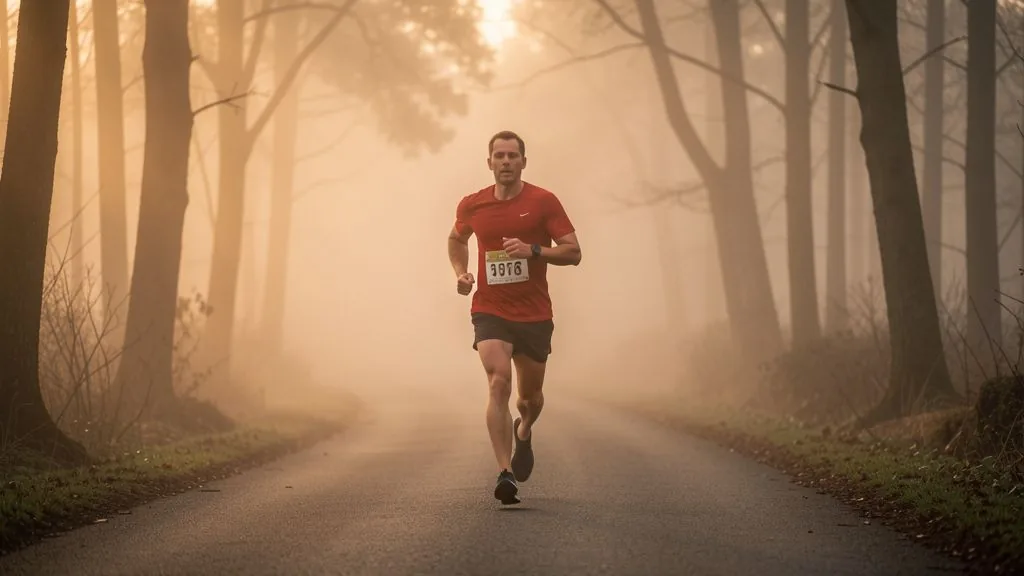
When breathing gets tight on a run, most people blame their fitness. For roughly one in five endurance athletes something else is going on: a narrowing of the airways that only occurs during exertion — exercise-induced bronchoconstriction, often called exercise-induced asthma. It is easy to recognise, straightforward to treat and, for the vast majority of those affected, no reason to give up training or racing.
What exercise-induced asthma is — and what it is not
Exercise-induced asthma is not a disease in its own right but a symptom complex: the bronchi narrow in response to physical exertion. Diagnostically it becomes tangible through a number — forced expiratory volume in one second (FEV1) falls by at least ten percent compared with baseline in a provocation test. That figure separates a genuine airway response from simply being "out of breath".
The distinction from chronic asthma bronchiale matters. There, a persistent inflammation of the airways causes ongoing hypersensitivity with symptoms even at rest. Exercise-induced bronchoconstriction, by contrast, can occur in perfectly healthy people — particularly endurance athletes with a high ventilation rate. The two can coexist, but they do not have to.
Who is affected
The numbers are higher than most expect. Depending on sport and environment, roughly 10 to 20 percent of all endurance athletes are affected. Among swimmers and winter athletes the share rises to 30 to 50 percent because of chlorine and cold air, and in elite athletes individual studies report even higher figures. So this is not only about people with diagnosed asthma — it also affects those with an allergic background such as hay fever, or with a chronically irritated bronchial system after years of training in cold or dry air.
Why the airways close during exercise
The mechanism is well understood. During running, ventilation quickly climbs to 60 and even beyond 100 litres per minute — far more than in almost any other sport. That large volume of air has to pass the mucous membranes of the airways, which warm and humidify it. In cold, dry air and with heavy pollen, the mucous membrane is heavily stressed: its surface dries out and cools down.
The decisive step happens after the effort ends. The airways rewarm, and the blood vessels in the mucosa dilate rapidly. This rewarming triggers swelling and the release of inflammatory mediators such as histamine and leukotrienes. The smooth muscle in the bronchial walls contracts — the cross-section narrows and exhalation becomes the problem. That is why the tightness typically does not strike at the fastest moment, but after the effort is over.
This is also where prevention starts: anything that keeps the airways warm and moist — a gentle start with calm breathing and nasal breathing, a moderate pace in the cold — reduces the stimulus that sets off the reaction.
The symptoms and their typical timeline
Exercise-induced bronchoconstriction has a very characteristic time curve, and that is precisely its diagnostic value. Symptoms begin five to fifteen minutes into exercise, peak five to ten minutes after the session ends and fade on their own within 30 to 60 minutes.
- Chest tightness: a pressure described more as a "band around the chest" than muscular fatigue. Many runners misread it as a bad pace or poor fitness.
- Wheezing: an audible whistle or rattle, usually on exhalation. It is a strong clue but may be absent — up to a third of those affected present with a dry cough as the leading sign.
- Dry cough: persistent after exercise, without mucus and without an infection. A cough after every hard session is often the only visible hint.
- Breathlessness out of proportion: difficulty breathing that does not match the pace and disappears again on the next easy run.
- Perceived inability to inhale deeply: a feeling of not getting enough air in, paired with a creeping drop in performance over weeks.
Two other conditions are easily confused with it: a side stitch, which sits one-sided in the peritoneum and has nothing to do with the breathing rhythm, and allergic rhinitis such as hay fever, which mainly affects the nose and eyes. Exercise-induced bronchoconstriction always sits in the lower airways and follows the timeline described above.
How the diagnosis is established
Self-diagnosis is unreliable — and getting it checked is straightforward. The gold standard is an exercise provocation test with a respiratory physician: after a controlled 6- to 8-minute treadmill or cycle protocol, FEV1 is measured repeatedly over 30 minutes. A drop of at least ten percent from baseline counts as a positive finding.
Alternatives include a methacholine challenge or eucapnic voluntary hyperpnoea (EVH) — the latter is especially useful for athletes because it reproduces the high ventilation rates of training more closely. A FeNO test additionally reveals eosinophilic airway inflammation and helps answer whether anti-inflammatory treatment is needed.
And the finding can go the other way: in a quarter to a third of presumed sufferers, testing finds no narrowing at all but vocal cord dysfunction (inducible laryngeal obstruction, ILO) or a breathing pattern disorder. These feel very similar but have nothing to do with the bronchi. That is why self-medicating with an asthma inhaler that does nothing is pure lost time — a proper diagnosis saves months of trial and error. How much you can steer through breathing itself is covered in breathing while running.
Treatment in four building blocks
Exercise-induced bronchoconstriction is among the most treatable sports complaints there is. Treatment rests on four pillars.
- Short-acting bronchodilator inhaler (SABA): salbutamol or a related agent inhaled about 15 minutes before exercise opens the bronchi for two to four hours. For occasional exercise-induced bronchoconstriction without chronic inflammation, that is already the full solution. Important: practise the inhalation technique with a spacer — a poorly applied dose largely lands in the throat instead of the bronchi.
- Anti-inflammatory baseline therapy: with frequent symptoms, chronic asthma or confirmed eosinophilic inflammation, an inhaled corticosteroid (ICS) belongs in the plan. It does not act acutely but lowers airway sensitivity over two to four weeks — and it is the treatment that genuinely changes the long-term course.
- Leukotriene receptor antagonists: with allergy-triggered exercise-induced bronchoconstriction, montelukast as a tablet can add benefit, especially for pollen or cold triggers.
- Antihistamines and rhinitis treatment: a clear nose noticeably lowers breathing resistance. Treating allergic rhinitis almost always improves exercise symptoms too — the nose is the first filter of the air you breathe.
A note on anti-doping rules: all the asthma agents above appear on WADA's monitoring or permitted lists. Salbutamol is permitted up to a daily dose of 1,600 micrograms but requires a TUE (therapeutic use exemption) for competitive athletes. Before every race, clarify the status with your doctor and the organiser — that applies to elite sport as much as to ambitious age-groupers racing nationally.
Training with exercise-induced asthma: the practical rules
Exercise-induced bronchoconstriction demands no different training methodology — but a different order of build-up and tighter control of the stimuli. Four rules have proven themselves.
Warm up first, then go hard. The most important lever of all. Ten to fifteen minutes of easy running with a short hard sequence — say three to four strides over 30 seconds — produce a so-called refractory period: after a first stimulus, the bronchial response is markedly blunted for 40 to 90 minutes. Going straight into intervals after the warm-up produces fewer symptoms than a build-up with no hard stimuli at all. This mechanism is exactly why races with a careful warm-up often go better than training runs — see warm-up for running.
Control intensity, do not force it. In cold weather, during pollen season or in dry air the bronchial system reacts more sensitively. On such days, dosing a session by workload makes more sense than by pace: the load metrics TSS, CTL, ATL and TSB and perceived exertion (RPE scale) capture the actual physiological load, while pace suggests a much lower intensity when breathing is compromised.
Train your exhalation. Bronchoconstriction mainly affects exhalation. Breathing techniques with a prolonged exhale, a calm 3:2 or 2:1 rhythm and nasal breathing on easy runs keep the airways calmer and more consistent. Targeted respiratory muscle training can also lower the perceived work of breathing.
Know your triggers and work around them. Cold, dry air, particulate matter, chlorine, high pollen counts and infections are the most common triggers. A scarf or a thin mask over mouth and nose warms and humidifies the air, which is highly effective below freezing. If you know the pollen calendar, move hard sessions into the lowest-pollen hours — usually early morning or after rain.
Responsible limits
Exercise-induced bronchoconstriction is treatable but not harmless when left untreated. The most common mistakes are ignoring symptoms out of misplaced ambition and downplaying medication. With an acute attack that does not respond to rescue medication within 15 minutes: stop, rest — and with persistent breathlessness, bluish discolouration or the feeling of being unable to speak, call emergency services. A well-managed athlete does not end up in such situations. But anyone who regularly needs rescue medication is not well managed and belongs with a doctor, not at the next interval session.
If symptoms persist despite treatment, that signals insufficient baseline therapy, a rhinitis-driven worsening, or an entirely different cause such as ILO or an immune system issue with chronic infection. Then it is the diagnostics that need rebuilding, not the training — see overtraining and warning signs to separate this from purely fatigue-driven patterns.
Frequently asked questions about exercise-induced asthma
What is exercise-induced asthma when running?
Exercise-induced bronchoconstriction (EIB) is a narrowing of the airways triggered only by physical exertion. It is measured as a drop in forced expiratory volume in one second (FEV1) of at least 10 percent compared with the resting value. It also occurs in people without chronic asthma.
How do I recognise exercise-induced asthma?
Typical signs are chest tightness, wheezing, a dry cough and breathlessness out of proportion to the effort. Symptoms start five to fifteen minutes into exercise, peak five to ten minutes after finishing and subside within 30 to 60 minutes. Confirmation comes from a provocation test with a respiratory physician.
Can I run a marathon with exercise-induced asthma?
Yes. With correct treatment any performance level is possible, and a large share of endurance athletes with exercise-induced bronchoconstriction train and race without limitation. What matters is a proper warm-up protocol with short hard efforts, a planned medication routine and dosing intensity by workload rather than pace.
Is exercise-induced asthma common in runners?
Yes. Depending on the sport and environment, roughly 10 to 20 percent of endurance athletes are affected, and considerably more among swimmers and winter athletes. In elite athletes some studies report more than 30 percent, because the high ventilation rate chronically irritates the airways.
How Peakora handles airway issues
Peakora plans from workload rather than rigid templates: if a high-pollen day drags your numbers down, the engine lowers intensity through actual load instead of pace — the plan stays valid and the stimuli stay correctly dosed. The terms around load, form and breathing control are collected in the training glossary, with the broader framework for building a season on the marathon pillar page.
Train by workload, not by feel
The Peakora engine steers intensity and volume from TSS, form and recovery — and stays sensibly dosed even on days with thin air. Start free, no credit card required.
Start free