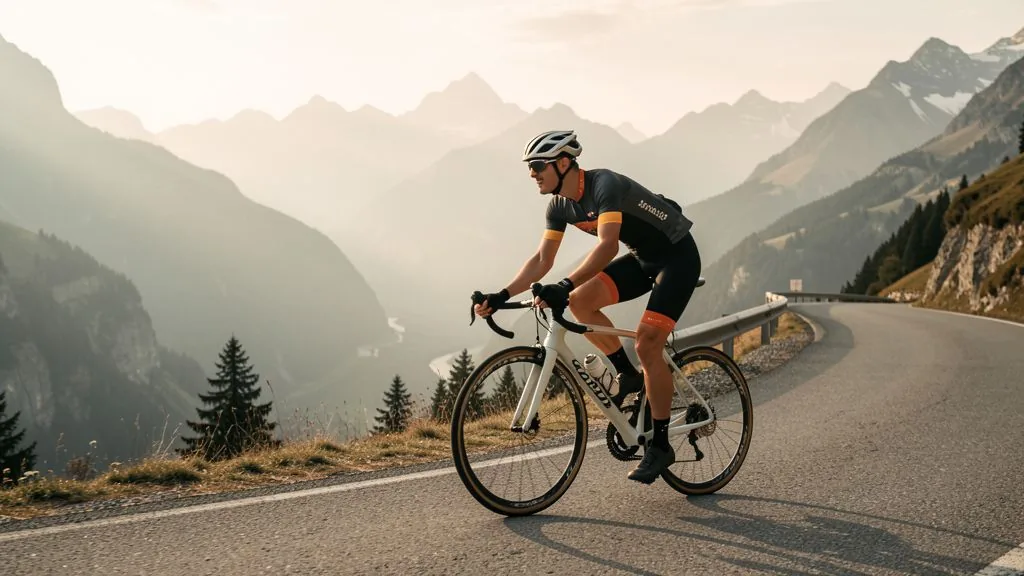
E-bikes have a reputation problem among endurance athletes: they look like a shortcut. They are not. A pedal-assist bike is a training tool with an adjustable load — you can ride 90 minutes in exactly zone 2 without a single climb dragging you over threshold, and you can collect four hours of volume without being flat the next day. Treat the motor as an instrument rather than a replacement for effort, and you gain training time that would otherwise be lost.
What the motor actually takes away — and what it doesn't
The number that matters is not motor output, it is your own pedal power. On the same route at the same speed, rider power on a pedal-assist bike typically sits 40 to 60 percent below that of a road bike. At 25 km/h on flat ground the motor assists right up to the cut-off, and beyond it you push 22 to 25 kilograms of system weight on your own.
What that means for the training stimulus: heart rate drops by roughly 10 to 20 beats per minute compared with the same loop on a road bike. That is precisely where the value lies. A road ride that drags you to 85 percent of maximum heart rate on every climb lands at 70 to 75 percent on an e-bike — right in the zone where capillarisation, mitochondrial biogenesis and fat oxidation happen. The stimulus is not weaker, it is more precise.
What the motor genuinely removes: neuromuscular peak load, surges, the ability to ride above threshold, and the power numbers you read your form from. That is why an e-bike complements a training plan instead of replacing it.
The three e-bike types and their training value
Not every e-bike is equally useful. For training purposes what matters most is how much control you have over the assist:
- Pedal-assist 25 (trekking, city): assist up to 25 km/h, 250 watts nominal, mid-drive motor with a torque sensor. The workhorse for base work and commuting. A torque sensor is essential — it scales assist in proportion to pedal pressure instead of suddenly delivering full power the way a pure cadence sensor does.
- E-MTB: also 25 km/h, but 80 to 90 newton-metres of torque and climbing-friendly gearing. On forest roads in eco mode it is an excellent strength-endurance machine: low cadence, high pedal pressure, 60 to 90 minutes of continuous load. On technical trails it becomes technique practice rather than endurance training.
- Speed pedelec (45 km/h): requires registration and a helmet, and is not allowed on cycle paths. Limited training value: at 35 to 40 km/h cruising speed you are almost entirely in the air-drag regime, yet you can rarely stretch real rides beyond 90 minutes. Interesting for commuters, too fast for structured training.
One point that is often overlooked: an e-bike weighing 22 to 25 kilograms rides differently. Braking distances are longer, corners need more foresight, and out-of-the-saddle efforts feel sluggish. Plan the first ride deliberately without a training goal.
Controlling intensity without a power meter
Most e-bikes have no power meter. That is not an obstacle, but it does require a different approach. Three signals are enough:
- Heart rate: the most useful signal. Base means 65 to 75 percent of maximum heart rate, so at a maximum of 185 that is roughly 120 to 139 beats per minute. Check the numbers in the first half hour and correct via the assist level, not via speed.
- Talk test: you can speak in full sentences without gasping. That is the simplest zone 2 check there is — and especially useful on an e-bike, where headwind distorts how hard the breathing feels.
- Assist level as the dial: instead of varying speed, vary the level. Eco for flat ground, tour for rolling terrain, off for climbs when you want to set the stimulus deliberately. This is the big advantage over a road bike: you adapt the load to the topography instead of being driven by it.
If you also use a chest strap, watch for cardiac drift: if heart rate rises by more than five percent at constant power across the session, that signals heat, dehydration or accumulating fatigue — not too little assist.
Five concrete sessions
These sessions work on any pedal-assist bike with a torque sensor. Assist levels refer to the usual eco/tour/sport/turbo scale.
- 1. Base ride, 120 minutes: eco throughout, flat to rolling terrain, heart rate 65 to 75 percent, cadence 80 to 90. The goal is consistency, not average speed. This session replaces the long easy run or the road bike base loop.
- 2. Climbs in eco, 90 minutes: four to six climbs of four to eight minutes, motor off or in eco, cadence 60 to 70, heart rate up to 85 percent. Recover fully on each descent. That is strength endurance without the joint load of hill running.
- 3. Active recovery, 45 to 60 minutes: tour level, heart rate below 65 percent, flat route, no climbs. After a hard weekend or as a second session on the same day. The motor turns it into what active recovery should be: movement without additional stress.
- 4. Brick session for triathlon, 100 minutes: 75 minutes on the bike in eco, the last 20 of them in tour, then straight into a 15 to 20 minute run. The stimulus is in the transition, not in bike speed. Details are in the article on brick training.
- 5. Commuting volume, 2 × 25 minutes: the commute in tour or sport, ridden deliberately as a zone 2 block. Two legs a day adds up to 250 to 300 minutes of weekly volume that would otherwise be missing entirely — the single biggest practical benefit of an e-bike.
One warning about combining purposes: these sessions are training, not transportation. Anyone who merges the 120-minute base ride with shopping, the school run and photo stops collects time in the saddle but no continuous stimulus. For base work, uninterrupted duration is what counts.
Where the e-bike replaces the road bike — and where it doesn't
The honest assessment, sorted by training goal:
- Aerobic base: equal to better. You can hold intensity exactly and need not fear the one climb that ruins the session.
- Building volume: better. Anyone who only gets out twice a week realistically doubles weekly volume with a pedal-assist bike — and volume is the strongest single driver of endurance performance.
- Recovery: better. Forty-five minutes in tour level costs far less than any road bike session while still providing blood flow and movement.
- Race pace and threshold: unsuitable. Above 25 km/h the motor cuts out, and in the air-drag regime you lack the power ceiling. Threshold intervals belong on the road bike or the indoor trainer.
- Surges and sprints: unsuitable. The motor smooths out exactly the neuromuscular peaks you want to train.
- Race preparation: only as a supplement. The final four to six weeks before a bike race or gran fondo belong mostly on the road bike — otherwise you lose the feel for speed, position and drafting.
For winter training structure, the e-bike fits well into the build phase while the indoor trainer delivers intensity. Together they make a week with plenty of base work and little time lost to weather.
Example week: winter, eight hours of available time
A cyclist targeting a spring gran fondo, with two children and an office job. The e-bike is the commuter, the road bike comes out at weekends:
- Monday: rest day.
- Tuesday: 2 × 25 minutes commuting in tour (zone 2), plus 45 minutes on the indoor trainer with 4 × 4 minutes at sweet spot.
- Wednesday: 90 minutes on the e-bike with five climbs in eco mode, cadence 60 to 70.
- Thursday: 2 × 25 minutes commuting in tour, no further session.
- Friday: 60 minutes active recovery, tour level, flat.
- Saturday: 3 hours road bike, 45 minutes of it at target pace.
- Sunday: 2 hours easy road bike or 120 minutes e-bike in eco, depending on weather and legs.
That is about 8.5 hours — four of them on the e-bike, without a single session feeling like filler. The key point: without the pedal-assist bike it would be 4.5 hours, because the commute would happen by car or train.
Common mistakes
- Always riding in turbo. The top level delivers 250 watts and more of assist — which means you train essentially nothing. Turbo makes sense on steep ramps with luggage, not for base work.
- Treating the motor as licence for intensity. Anyone who climbs a hill in sport mode and reaches 88 percent of heart rate has not done base training, but an unstructured hard session.
- Neglecting cadence. On an e-bike a cadence of 60 to 65 creeps in easily, because the motor does not punish the low frequency. For base work 80 to 90 is better — for strength endurance on climbs, 60 to 70 is a deliberate choice.
- Misjudging range. A 500 Wh battery lasts 80 to 120 kilometres in eco, often only 35 to 45 in turbo. Plan sessions by time and level rather than distance, or you end up with an empty battery and a heavy bike.
- Abandoning the road bike entirely. The switch feels convenient and happens fast. After eight weeks without the road bike the feel for speed is gone, and the first gran fondo becomes a surprise.
How Peakora handles e-bike sessions
Peakora plans sessions by load, not by sport — which is why an e-bike base ride lands in the same category as an easy road bike session and counts towards the weekly total via TSS. In practice: you log the session with duration and perceived effort (RPE), and the engine classifies it accordingly. Because the CTL/ATL/TSB trend maps build-up over weeks, you can see immediately whether the extra commuting volume accelerates your progress or pushes you into overload.
That is particularly useful in winter: the plan knows your time budget, and you can swap a road bike base session for an equally long e-bike session without breaking periodisation. Fundamentals on volume and intensity distribution are in the cycling training section.
Frequently asked questions
Can I build endurance on an e-bike?
Yes. Motor assist lowers the intensity, not the training stimulus. Ninety to 150 minutes in zone 2 on an e-bike train the cardiovascular system and fat oxidation the same way a road bike does, with less mechanical load on knees and back.
How many calories does e-bike riding burn?
Roughly 60 to 80 percent of a comparable road bike ride. Ninety minutes in a low assist level works out to about 400 to 600 kilocalories depending on body weight and terrain.
Which assist level suits base training?
Eco or level 1. The target is a heart rate of 65 to 75 percent of maximum for at least 90 minutes. Higher levels make sense for recovery and commuting, not for building aerobic capacity.
Why does the motor cut out at 25 km/h?
Because EU law limits pedal-assist bikes to 25 km/h and 250 watts of nominal power. Above that you push the bike alone — at 22 to 25 kilograms of system weight that is real resistance, and speeds beyond 27 km/h are hard to hold.
Does an e-bike replace road bike training?
No. It is equal or better for base work, volume and active recovery, but unsuitable for race pace, surges and power intervals. The final four to six weeks before a bike race belong on the road bike.
Related reading on the blog: winter cycling training, base training and strength training for cyclists. Terms like TSS, CTL and zone 2 are explained in the Peakora glossary.
Plan your cycling training with Peakora
Base work, intensity and recovery matched to each other — even when the commute is all the time you have. Start free, no credit card required.
Start for free