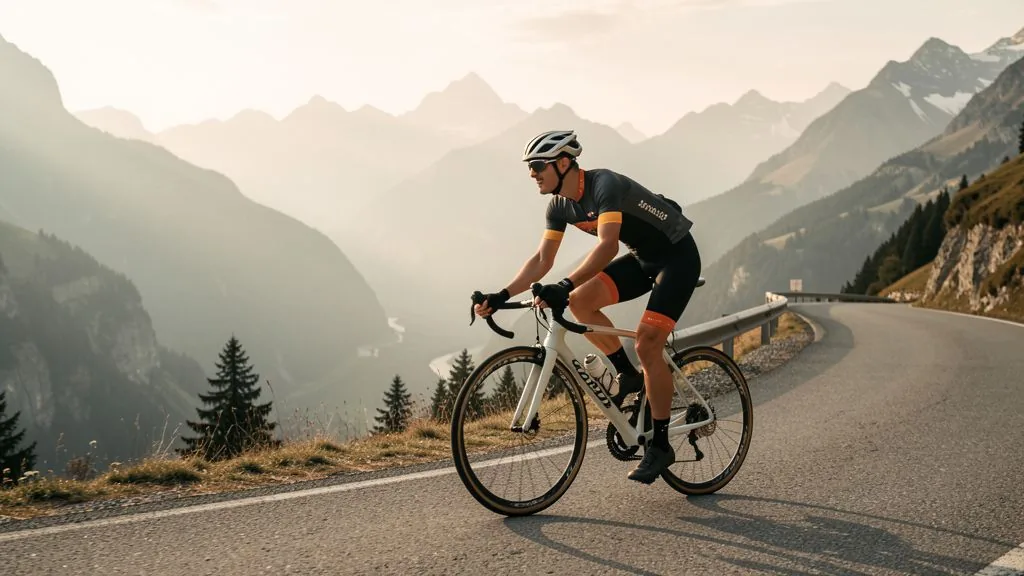
Ten years ago disc brakes on a road bike were dismissed as a fashion imported from mountain biking. Today virtually every new mid-range and high-end road bike comes with them — and the debate is settled. Still, it is worth looking closely: disc brakes are not superior in every respect, they cost weight and they demand a different service routine than rim brakes. This overview gives you the numbers, the intervals and the five problems that show up most often in practice.
Why disc brakes won the argument
The decisive advantage is not peak power in the dry — there, good rim brakes are nearly equal. It is consistency. A disc brake acts on the hub, not on the rim sidewall. That makes it independent of whether the rim is wet, dirty or slightly out of true. In the rain rim brakes lose 30 to 50 per cent of their deceleration depending on pad and rim material, while hydraulic discs bite almost unchanged. For early-season gran fondos, descents in changeable weather and slow traffic, that is where the difference shows up.
Two more factors accelerated the switch: the rim is no longer consumed as a wear part, and tyres up to 32 mm fit without restriction because no brake body has to reach around the tyre. After a trial phase the UCI finally approved disc brakes in road racing in 2018 — from that point the direction was clear.
Rim brake vs. disc brake: the direct comparison
The honest verdict looks like this:
- Dry braking power: practically equal. Good rim brakes with a clean rim deliver more than enough force to lock the rear wheel with 200 to 300 watts at the lever.
- Wet braking power: clear win for discs. This is the biggest practical gain, especially on long descents and in traffic.
- Modulation: win for hydraulic discs. Far less lever effort is needed, which reduces hand fatigue on long descents.
- Weight: win for rim brakes, and a clear one. A complete disc system weighs 300 to 400 grams more than rim brakes — the sum of hubs, rotors, calipers, hydraulic hose and a stiffer fork.
- Aerodynamics: slight edge to rim brakes, worth a few watts. Irrelevant for recreational riders, relevant for time trials.
- Maintenance: rim brakes win on effort, discs win on interval. Rim brakes need more frequent adjustment; discs need bleeding and pad changes instead.
- Wheel changes: rim brakes win (quick release, instantly centred) versus through-axles and the occasional rotor rub.
Bottom line: if you train on flat roads in fair weather, you lose nothing with rim brakes. If you ride in the mountains, are out in autumn or want a bike with 28 mm tyres, discs gain you something tangible. For context on how much braking matters on mountain passes, see the article on descending technique on a road bike.
Maintenance: the realistic intervals
Disc brakes are lower-maintenance than their reputation suggests, but they are not maintenance-free. The following intervals have become established in practice for road bikes with hydraulic systems:
- Brake pads: 2,000 to 4,000 kilometres in summer, 800 to 1,500 kilometres in winter and with frequent wet riding. Check them visually every 500 kilometres — that takes 30 seconds while you are cleaning the bike anyway. Replace once less than 0.5 millimetres of lining remains, backing plate included.
- Rotors: 8,000 to 15,000 kilometres. Wear shows as a step towards the hub or as thickness below the minimum — for most manufacturers 1.5 millimetres against 1.8 millimetres when new. Measure with calipers, do not guess.
- Brake fluid: change every 12 to 24 months. Mineral oil lasts longer; DOT 4 absorbs water and should be checked annually. A moisture tester takes two minutes.
- Bleeding: only when needed, meaning a spongy lever feel. On a cleanly assembled system that can last two to three years.
- Clean the rotors: every 300 to 500 kilometres with isopropyl alcohol. Greasy fingerprints on the rotor are the most common cause of squealing and lost braking power.
Anyone who folds these five points into their regular annual road bike service will have no surprises. Order matters: after every pad change the pads must be bedded in again. To do so, accelerate to about 25 km/h ten to fifteen times and brake hard — but not to a stop — down to walking pace. This process transfers an even layer of pad material onto the rotor. Without bedding in, up to 30 per cent of braking power is missing at first and the risk of glazing rises sharply.
The five most common problems and their causes
- Squealing or howling. Almost always contaminated, glazed or never-bedded pads. Second most common cause: a slightly bent rotor that no longer sits centred in the gap. Clean and bed in again first, then check the rotor with a truing tool or carefully with an adjustable wrench.
- Rubbing without touching the lever. A sticky or slowly retracting piston, often after contamination or after too much fluid in the system. Mobilise the pistons with isopropyl alcohol and cycle them out several times.
- Spongy lever feel. Air in the system or old, water-saturated brake fluid. Bleed the system; with DOT 4 also replace the fluid. A spongy lever in the mountains is a safety problem, not just a comfort issue.
- Lever travel drifting under heat. On long descents the fluid heats up. If it has absorbed water, the vapour expands and pushes the pads out. Fix the cause, do not ignore it — the classic pass roads with switchbacks and continuous braking are exactly the test case.
- Gap too tight after a wheel change. Through-axles must be torqued correctly or the rotor sits crooked. Use the manufacturer's torque figure, usually 12 to 15 newton metres, and preload the axle slightly before tightening.
Cost: what a disc bike really costs you
The surcharge on new bikes is usually 150 to 400 euros against the rim brake version — and spare parts cost more too. A set of pads is 15 to 30 euros per end, a rotor 25 to 60 euros, a workshop bleed service 40 to 70 euros. Over five years with two pad changes per year and one rotor replacement, you land at roughly 250 to 400 euros in running costs.
Against that stands a real advantage: rim wear disappears entirely. With rim brakes a brake track wears out in 15,000 to 30,000 kilometres depending on weather, and replacing a good rim costs 60 to 150 euros plus a rebuild of the wheel. On a heavily used bike that largely offsets the price difference — especially since rim wear is usually noticed late, and by then often means replacing a whole wheel.
When disc brakes are the wrong choice
There are two situations where rim brakes can still be the better option. First: the pure hill-climb or criterium bike, where every gram and every tenth of a watt matters and brakes are barely used. Second: the winter training bike exposed to salt water — here pad wear with discs is enormous, while a cheap wear rim is easy to replace and you end up with a shelf full of rotors.
What is never possible is a retrofit. A frame without mounts for a caliper and through-axles cannot be converted to disc brakes — welding aluminium or carbon frames often ends in a crack. If you buy used and want discs, look for the complete bike, not a frameset to upgrade.
For training planning the brake type makes no difference — for safety on long road rides and gran fondos it does. How to build climbing into your training systematically is covered in the article on hill training for cyclists.
Frequently asked questions about disc brakes on road bikes
Are disc brakes better than rim brakes on a road bike?
In the wet and on long descents, yes. Hydraulic disc brakes stop almost as hard in rain as in the dry, while rim brakes lose 30 to 50 per cent of their stopping distance there. In return they add 300 to 400 grams and require more maintenance.
How often do I need to replace brake pads on a road bike?
For road use, disc brake pads last roughly 2,000 to 4,000 kilometres; in winter and wet conditions often only 800 to 1,500. Replace them when less than 0.5 millimetres of lining remains or braking power drops noticeably.
Why are my disc brakes squealing?
Usually the pads are contaminated with oil, glazed over or were never bedded in. Other causes are a slightly bent rotor, a leaking piston seal or grease on the rotor surface. Cleaning with isopropyl alcohol and bedding the pads in again solves most cases.
Can I convert my road bike to disc brakes?
No, a frame without mounts for a caliper and through-axles cannot be converted. A rebuild only makes sense if the fork and frame already have disc mounts — otherwise a new bike is cheaper than any workaround.
Plan structured rides with Peakora
Training plan with periodized build-up, power and climbing work plus automatic recovery management — for gran fondo, triathlon and road bike training. Start for free, no credit card required.
Start for free