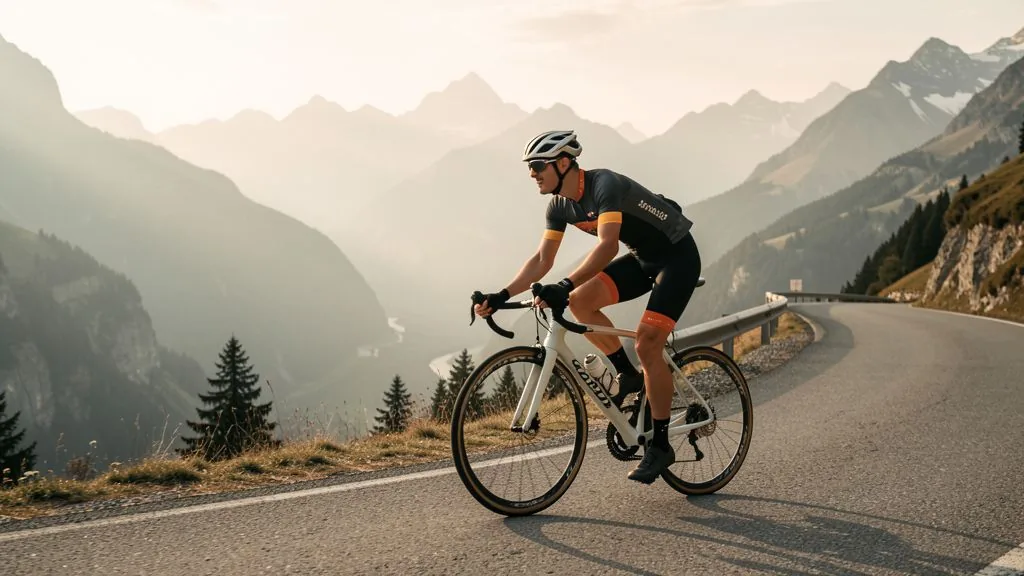
Summer heat is not a comfort issue for cyclists, it is a performance issue: above 30 degrees an unacclimatised body loses five to eight percent of its sustainable power, and a draft-legal race at 35 degrees quickly turns into a question of whether you finish at all. The good news is that heat is trainable like any other capacity. Two weeks of acclimatisation roughly halves the loss. This article covers what actually happens physiologically, how to prepare systematically, how much you really need to drink — and which signs mean you should get off the bike.
Why heat costs power — the physiology
In the heat your body has two jobs at once: producing power for the bike and getting rid of heat. Both compete for the same blood. The skin needs perfusion to dump heat to the environment — at 30 degrees and hard effort, up to a third of cardiac output goes to the skin instead of the legs. The heart has to work harder to deliver the same mechanical output, and heart rate at a given wattage rises by ten to twenty beats. If you steer by heart rate you ride slower without noticing; if you steer by power you overshoot and pay for it later.
Then there is sweat: at 30 degrees you can easily lose 1 to 2 litres per hour on the bike depending on intensity and body size. Every litre of sweat is energy the body must spend and fluid missing from blood plasma. As plasma volume drops, blood gets more viscous, the power-to-heart-rate relationship drifts, and from roughly two percent dehydration sustainable power falls measurably. The underlying mechanism on long efforts is explained in cardiac drift during endurance exercise.
Acclimatisation: the only real lever
Heat acclimatisation is one of the best-supported adaptations in endurance sport. Over ten to fourteen days the following happens: plasma volume rises by up to ten percent, sweating starts earlier and is more dilute — you lose less sodium per litre of sweat. At the same time skin blood flow at a given cooling demand falls, which unloads the heart and keeps core temperature lower. In numbers: the initial six to eight percent power loss typically shrinks to two to four percent.
A concrete protocol looks like this:
- Duration: ten to fourteen days, not less. Almost nothing happens in two or three days; after one week you have roughly half the effect.
- Stimulus: 60 to 90 minutes daily at 30 degrees or more, base to mid-intensity. The point is heat stress, not threshold work.
- Not every day: two or three sessions per week deliver part of the effect, daily accelerates it clearly. But never two hard heat sessions back to back — the body needs 24 hours to adapt.
- After the stimulus: cool shower, electrolytes, drink enough. Adaptation happens in recovery, not during the ride.
- What substitutes for it: a relaxed walk in the midday heat, long sauna sessions, a hot bath after training. Less effective, but not useless.
Once acclimatised, you lose the adaptation after roughly two to three weeks without heat exposure. For a race in late July, start acclimatising by mid-July — not in race week. How heat training is periodised in a plan is described in heat training for endurance athletes; the principles apply identically on the bike.
Drinking: the numbers that actually matter
The old rule "drink before you get thirsty" is as wrong as its opposite, "only drink when thirsty". Both cause problems on long summer rides: too little fluid in the first two hours, or — through overcompensation — hyponatraemia, because plain water dilutes blood sodium. The only value that really helps you is your own sweat rate. Measure it like this: weigh yourself naked before the ride, ride 90 minutes while noting how much you drink, then weigh again. Weight lost in kilograms plus litres consumed gives total sweat loss; divided by 1.5 it gives the hourly rate.
Realistic reference values for cyclists at 25 to 32 degrees:
- 500–750 ml/h at easy pace and average body weight — the most common range.
- 750–1,000 ml/h at high intensity, high temperature or heavy sweating.
- Above 1,000 ml/h only with a confirmed high sweat rate; then sodium intake is mandatory, not optional.
- Sodium: 300–700 mg per litre of drink. Two bottles of plain water per hour leaves you short on salt, and that is exactly what produces the cramps many riders mistake for a training deficit.
In practice: two large frame bottles (2 × 750 ml) cover roughly 90 minutes to two hours. Beyond that you need refill points or a hydration pack — for a gran fondo in high summer, feed station density is part of route planning, not a detail. What belongs in the bottle is covered in homemade sports drink, the electrolyte question in detail in electrolytes in endurance sport.
Cooling: where it actually helps
Cooling does not work where it feels nicest, but where the largest amount of heat is removed. The most effective measures in descending order:
- Neck and nape: the biggest cooling effect per unit of effort. A handful of water on the neck changes perceived temperature immediately and measurably.
- Forearms and wrists: high surface blood flow, easy to reach. At races with feed stations, pour water over the forearms, not the head.
- Ice-cold drinking water: cold water in the stomach cools the core more slowly than expected, but helps subjectively a lot and improves how much you drink.
- Helmet and jersey: light colours, open vents, no backpack covering your back. A wet jersey only cools while air passes over it — in a traffic queue it does nothing.
- Ice vest before the start: at hot races with a start that leaves you standing around 20 minutes before the gun, an ice vest or an ice-filled neck tube is the best investment. It lowers core temperature before the effort begins.
Pacing and power in the heat
The most important rule: in the heat you ride by power, not by feel — and you deliberately start too slow. The reason is physiological: core temperature rises with a delay of 15 to 20 minutes. In the first 30 minutes at 32 degrees you often feel great because the heat load has not arrived yet. Anyone who rides their normal target wattage in that window will not have it available after 60 minutes.
Concrete adjustments for a race at 30 degrees and above:
- Uphill: 5–8 percent below planned wattage. Heat production peaks on climbs because speed, and therefore airflow, drop.
- Flat and windy: 3–5 percent below. Airflow helps, but not indefinitely.
- Descending: this is where you can gain time. Wind cooling is maximal, effort minimal — the phase where heat costs least.
- Heart rate: ignore it as a control variable, watch it as a check. If it rises more than 10 beats at constant power, that is a dehydration signal, not a fitness signal.
Without a power meter, steer by breathing: full-sentence conversation is base, single words is tempo. In the heat that boundary shifts downward — the same breathing rhythm means more relative load at 32 degrees. How the zones work in principle is in heart rate zones and pace vs. heart rate.
Warning signs: when you have to stop
Heat illness rarely comes on suddenly. It announces itself, and most cyclists ignore the first two stages because they refuse to accept the loss of power. The escalation levels:
- Stage 1 — heat stress: heart rate rises at constant power, heavy sweating, concentration slips. Action: reduce power by 10 percent, drink more, find shade.
- Stage 2 — heat cramps: calves, thighs or abdomen seize up. Action: stop, shade, drink fluid with sodium, stretch gently. Do not ride on — cramps are a systemic alarm, not a muscle problem.
- Stage 3 — heat exhaustion: dizziness, nausea, headache, cold sweat, weakness. Action: stop immediately, legs up, cool the neck, groin and armpits, take electrolytes. Do not continue alone.
- Stage 4 — heat stroke: confusion, absent sweating, altered consciousness, hot dry skin. This is an emergency. Call for help immediately, cool aggressively, give fluid only if the person is clearly alert.
Two rules that prevent injuries: first, a power drop of more than 15 percent at unchanged perceived effort is a reason to stop, not a motivation topic. Second, anything you ride alone in the heat belongs on a route with water, shade and mobile reception. Where the line between "hard" and "dangerous" sits is also described in hypothermia in endurance sport — from the other end of the temperature scale.
Heat and racing: the practical checklist
- Two weeks out: start acclimatisation, 60–90 minutes in the heat daily. Do not begin in race week — all you get then is fatigue.
- Three days out: slightly increase fluid and sodium intake, no alcohol. For a hot race the fluid balance at the start matters more than any carb-loading nuance.
- At the start: two full bottles, one with sodium. Drink 400–600 ml before the start, but no more — a full bladder costs more than it delivers.
- Feed stations: use every single one, even without thirst. In the heat the race is decided by hourly fluid intake, not by average speed.
- Jersey and helmet: light, tight, well ventilated. No backpack at a hot race, no dark jersey.
- After the finish: replace 150 percent of the loss over the next two to three hours, with sodium. Morning weight is the check.
For a race in Austria or Italy in July that means concretely: the training block before it must contain the heat the race demands. Anyone who trains twelve weeks in cool mornings and then starts at 34 degrees has left their form at home. How to build such a block is in the gran fondo training guide (German); the terms around power, TSS and form are in the Peakora glossary (German).
How Peakora accounts for heat in your plan
In the Peakora engine heat is not a special case but a factor in load management: the app converts your sessions into TSS, and a ride at 32 degrees scores harder at the same wattage than one at 18 degrees — so your CTL rises faster than raw power suggests. This is exactly where many plateaus come from: riders who hold their wattage targets through summer accumulate more fatigue than planned and then wonder why form stalls.
In practice the plan gives you an adjusted target wattage for hot days and an upper limit on session duration. If you also log fluid intake and body weight before and after a session, you can see the link between fluid loss and your form curve — and decide whether your problem sits in the training or in the bottle.
Common mistakes
- Acclimatising in race week. That only produces fatigue. Acclimatisation takes ten to fourteen days and belongs in the build, not the taper.
- Drinking water only. Above one litre of sweat per hour, plain water drops your sodium level. Two bottles of water at 34 degrees is a recipe for cramps.
- Riding by heart rate. In the heat heart rate runs 10–20 beats high. Holding your normal zones means riding clearly too slow and then wondering about the finish time.
- Drinking too much at once. A litre in ten minutes lands in the stomach, not the blood. Better 150–200 ml every 15 minutes.
- Trying to solve heat with willpower. The body has a hard limit around 40 degrees core temperature. You cannot train it away, only delay it — with acclimatisation and cooling.
- Riding only at night and ignoring the race. Anyone who consistently trains around the heat in summer loses exactly the adaptation they need on race day.
Bottom line: heat is trainable
The power loss in heat is real — four to eight percent at 30 degrees and above is the norm, and nobody rides it away. But almost all of it can be addressed: ten to fourteen days of acclimatisation halves the loss, a measured sweat rate with matching sodium intake prevents the second-half collapse, adjusted pacing avoids the early overreach in the first 30 minutes, and neck cooling plus light clothing buys you time where it is cheap.
If you also know how heat load shows up in your form curve, you stop planning against your body and start planning with it. That is the difference between a hot training day where you collect progress and one where you pay for it with three days of recovery.
Frequently asked questions
How much power do I lose cycling in the heat?
At 30 degrees and above it is roughly 4 to 8 percent of sustainable power depending on acclimatisation, and considerably more above 35 degrees. Most of the loss comes not from the legs but from extra skin blood flow and the higher heart rate it forces.
How much should I drink when cycling in the heat?
500 to 1,000 millilitres per hour, depending on sweat rate and temperature. Measure your sweat rate by weighing yourself before and after a 90-minute ride — replace roughly 1 litre per kilogram of weight lost.
How long does heat acclimatisation take?
Ten to fourteen days with 60 to 90 minutes of moderate work in the heat daily. You start sweating earlier and with more dilute sweat, and plasma volume rises. After about two weeks you have 70 to 80 percent of the full effect.
What should I do about heat cramps on the bike?
Stop, get into shade, drink slowly and take in fluid with sodium. Cramps usually signal fluid and electrolyte loss, not a lack of stretching. With dizziness, confusion or absent sweating, stop immediately and cool down.
Is indoor trainer work useful for heat adaptation?
Only in controlled doses. A trainer is the hottest environment you can build because there is no airflow. As a 45 to 60 minute heat stimulus it works; for long sessions in summer, ride outside instead.
Train with the weather, not against it
Peakora scores every session with heat, elevation and your form curve — and explains every adjustment. Start free, no credit card required.
Start free