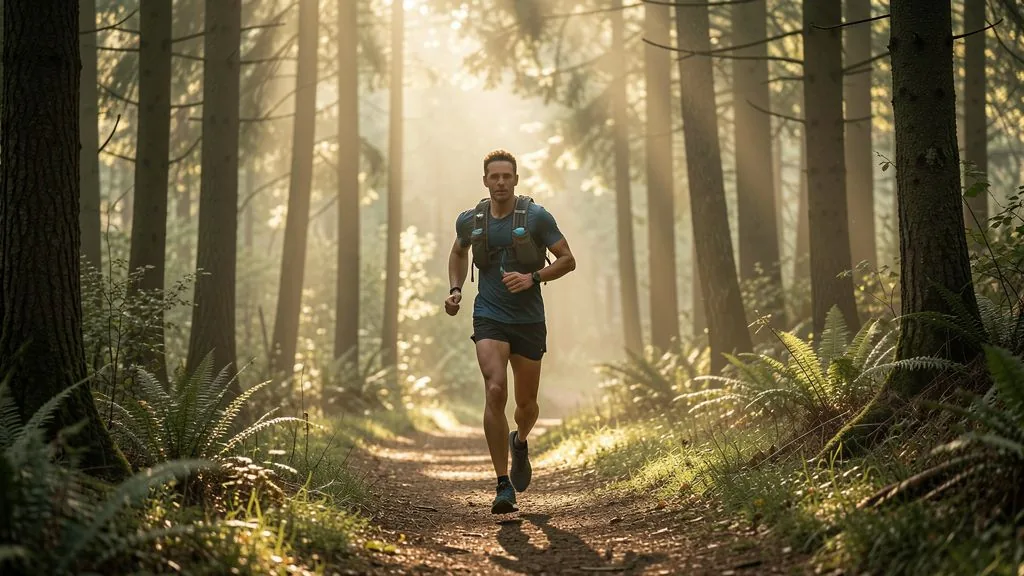
Cross triathlon is the off-road version of the sport: swimming in a lake, mountain biking on trails, running over roots and rocks. It sounds like a niche, but it is the fastest-growing part of triathlon — and the one that brings road triathletes back to earth most brutally. A strong rider on asphalt can lose two minutes per kilometre off-road, and not because of fitness but because of technique. This article shows how to actually structure training for XTERRA and off-road races.
What makes cross triathlon different
The standard XTERRA distance: 1.5 kilometres of swimming, 30 to 35 kilometres of mountain biking, 10 kilometres of trail running. Strong amateurs finish between 2:30 and 3:15 hours — shorter than an Olympic-distance triathlon, but at a far higher intensity through the technical sections. Smaller series offer short distances from 750 metres, 15 kilometres and 5 kilometres; the few long-distance events reach 3 kilometres, 60 kilometres and 20 kilometres.
Three differences shape the entire training plan:
- The bike split is technical, not aerodynamic. On asphalt, drag decides; off-road, line choice, cornering skill and descending speed decide. Aerodynamics matter less because you rarely hold a constant position for more than a few minutes.
- Heart rate lies off-road. Short hard climbs and long easy descents produce a jagged trace. Anyone steering by heart rate overcooks the climbs and does not recover on the descents. Off-road you are better off working with RPE and climb duration as the governing variables.
- Fuelling is harder. On an MTB you rarely have a free hand for a bar; technical sections demand both hands on the bars. Liquid nutrition in a hydration pack and gels in the jersey pocket are not a convenience in cross triathlon, they are the only workable option.
Swimming: open water beats pool times
Swimming in cross triathlon is usually a lake or reservoir start without waves, but with cold water — a wetsuit is standard and often mandatory below 22 degrees. The course follows buoys that are considerably harder to spot off-road than in a pool. The ability to sight briefly every 15 to 20 strokes therefore matters more than turn speed.
For training: two pool sessions per week with a technique focus form the base, plus one open-water session per week from spring onwards. Anyone who trains only in a pool regularly loses two to four minutes in the race — not through lack of fitness, but through detours, lost orientation and the shock of the first 200 metres in traffic.
Mountain biking: skill before watts
The bike split accounts for 55 to 60 percent of total time and is where most cross triathletes lose their race. Three abilities count:
- Cornering. Outside-inside line, weight on the outside pedal, eyes well ahead. A cross triathlon course has 40 to 80 corners; losing 1.5 seconds in each gives away more than three minutes.
- Descending. Active position with a low centre of gravity, cranks level, eyes on the line rather than the obstacle. Descending rewards courage and vision, not strength. The article on downhill running describes the running version of the same principle.
- Punchy efforts on short ramps. Off-road courses consist of series of 30-second to 2-minute climbs. That is exactly what short hard repetitions train — the basis is in the article on sprint training on the bike.
The typical weekly structure for ambitious amateurs: one long MTB session at the weekend (2.5 to 4 hours, ideally on race-like terrain), one skills session focused on descents and corners (60 to 90 minutes), one interval session with short hard efforts (60 minutes). Optionally a steady road or indoor trainer ride for pure aerobic volume.
Running: trail instead of asphalt
The 10 kilometres in cross triathlon run 10 to 20 percent slower than on the road — more on heavy courses. Three factors explain it: the surface (energy lost to sinking in and balancing), the climbs, and the pre-load from the bike split.
Training consequence: at least half your running kilometres should happen off-road, and not only on smooth forest roads. Root sections, rocky stretches and steep climbs belong in the programme because they train foot stability and the eccentric load on the legs. Anyone training exclusively on asphalt pays for it in the race with cramps in the second half of the run.
Two key sessions per week: a long trail run with 300 to 600 metres of climbing, and a tempo run off-road (e.g. 4 × 6 minutes uphill at race pace with jog recoveries). The latter simulates exactly the load that awaits you after the bike split.
Transitions off-road
T1 and T2 in cross triathlon are longer and messier than on the road: peeling off a wetsuit on grass or gravel, MTB shoes with a coarse sole, helmet, possibly cycling glasses. T2 adds dirty legs, a mud-covered bike and often a longer run from the bike rack to the run exit. Two minutes of transition time is not unusual.
What helps: skip gloves, or choose thin full-finger gloves that still work when wet; shoes with quick lacing; a towel only for wiping your feet before the run shoes; and above all twice-weekly dry rehearsals of the sequence. The detailed procedure is in the article on T1 and T2.
Gear: what actually matters
- Mountain bike: 100 to 120 millimetres of travel, disc brakes, tubeless at 1.8 to 2.2 bar. A gravel bike works on dry, simple courses — on roots and steep descents it lacks grip and travel.
- Tyres: knobby up front, fast-rolling at the rear is a workable compromise. Soft compounds wear out quickly on forest roads.
- Wetsuit: often mandatory in cross triathlon, usually a model with more buoyancy in the upper body for the short, intense swim.
- Trail shoes: lugged sole with 4 to 6 millimetre lugs, but not overly aggressive — maximum profile costs energy on forest road sections.
- Fuelling: a hydration pack or two bottles of liquid nutrition, gels in the jersey pocket. Solid bars are practically impossible to eat on technical sections.
A 12-week build at a glance
- Weeks 1–4 (base): build volume, plenty of easy terrain. Two pool sessions, two MTB sessions (one long, one skills), three runs, one of them long on trail. Goal: technical confidence, not speed.
- Weeks 5–8 (threshold build): short hard efforts on climbs, tempo runs off-road, longer open-water sessions. First brick sessions: 2 hours MTB + 30 minutes running.
- Weeks 9–11 (race specific): sessions at race intensity, full brick days, testing fuelling off-road. Two race-day simulations including transitions.
- Week 12 (taper): reduce volume by 40 to 60 percent, keep short sharp efforts. Details in the article on tapering.
Peak week volume lands between 10 and 14 hours — somewhat less than Ironman preparation, but with a much higher share of technical work. Anyone coming from road triathlon should not simply transfer bike kilometres: an hour of trail rides differently from an hour of asphalt, and the load on shoulders, forearms and trunk is considerably higher.
Common mistakes road triathletes make
- Too much asphalt, too little trail. The classic: 90 percent of sessions on road and trainer, then being surprised by a course full of roots. Off-road is trained off-road.
- Treating descents as recovery. Downhill is where time is won or lost in cross triathlon, not where you recover. Anyone braking on descents loses twice: time and momentum for the next climb.
- Steering by watts instead of terrain. Constant watts are physically impossible off-road. A sensible range is 85 to 120 percent of race-duration power on climbs, correspondingly easier downhill.
- Testing gear only in the race. New tyres, new hydration pack, new shoes — in cross triathlon every untested equipment change backfires immediately, because on technical sections you have no capacity left for problem-solving.
- Neglecting the trunk. Two to three hours on an MTB load the neck, shoulders and lower back considerably more than road riding. Two short core sessions per week are not an add-on in cross triathlon, they are a prerequisite.
How Peakora plans cross triathlon
The Peakora engine recognises cross triathlon as its own sport with three disciplines and its own load logic: instead of counting bike kilometres by road standards, it calculates MTB sessions with a higher intensity factor, because riding off-road is technically and metabolically more expensive than the same duration on asphalt. Brick days are planned as their own session type and weighted differently in the weekly total than two separate workouts. And because heart rate fails as a governing variable off-road, the plan uses RPE targets instead of heart rate zones on skills days — the details are in the article on RPE training. Anyone who also wants to build aerobic base systematically will find the structure in the article on half Ironman training.
Frequently asked questions about cross triathlon
Is cross triathlon suitable for beginners?
Yes, with prior running experience and confident swimming. The real hurdle is the technically demanding mountain bike course. Plan at least a year of regular MTB training before you start at XTERRA distance.
How long is a cross triathlon?
The XTERRA standard distance covers 1.5 km swim, 30 to 35 km mountain bike and 10 km trail run. Short distances start at 750 m, 15 km and 5 km, while long distances reach 3 km, 60 km and 20 km.
Which bike do I need for cross triathlon?
A mountain bike with 100 to 120 mm of travel, disc brakes and knobby tyres. A gravel bike only works on dry, technically easy courses, because roots, rocks and steep descents demand grip and suspension travel.
How do I train MTB descending?
By descending real trails frequently, not through strength training alone. Two skills sessions per week on varied terrain with focus on line choice and the active position. In cross triathlon descents decide more time than climbs.
Can I train for cross triathlon without a swim club?
Yes. Open-water experience and sighting matter far more than club training. One open-water session per week in a wetsuit plus two pool sessions focused on technique are enough for the XTERRA distance.
Your off-road training plan
Peakora plans swimming, mountain biking and trail running as one system — with brick days, skills blocks and load management that treats off-road differently from asphalt. Start for free, no credit card required.
Start for free