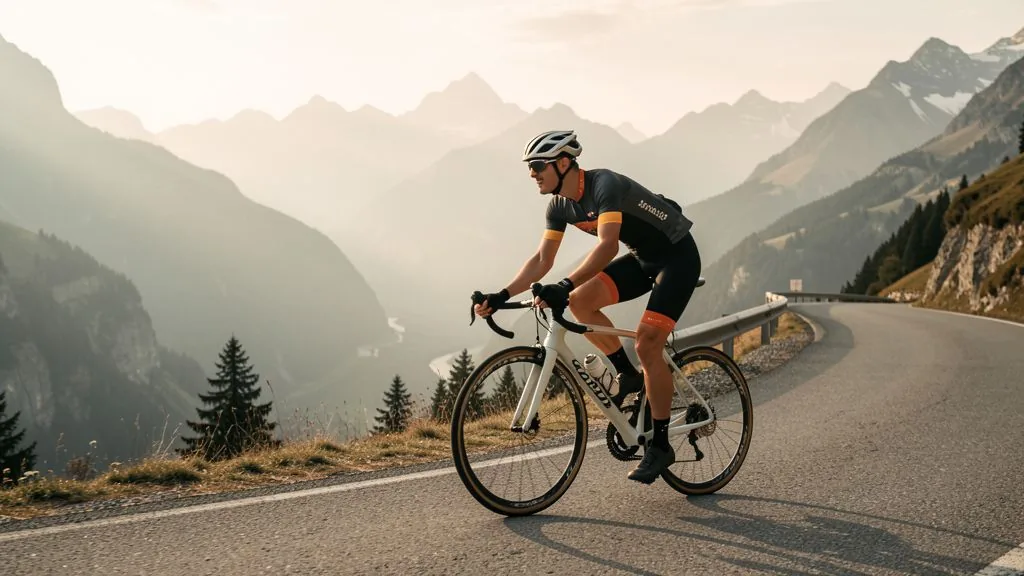
Gearing is the most neglected and most frequently mis-specified part of a road bike. Most bikes ship with a racing cassette — 11-28 with a 52/36 chainset — because it looks good on the spec sheet. What most riders then do is grind a cadence that is too low for their power. The wrong gearing does not cost you watts; it costs you the ability to turn the watts you have into speed. And it decides whether you still want to ride after three hours in the mountains.
What a gear ratio actually is
A gear ratio is simply chainring teeth divided by sprocket teeth. Fifty teeth at the front and eleven at the back gives 4.55 — one crank revolution turns the rear wheel four and a half times. Thirty-four front and thirty-four rear gives 1.0 — one crank revolution, one wheel revolution.
Because the ratio alone says nothing about actual speed, riders calculate gear development: metres travelled per crank revolution. Multiply the ratio by the wheel circumference. A 28-inch wheel with a 25 mm tyre measures about 2.10 metres.
- 50/11: 4.55 × 2.10 m = 9.55 m development. At 90 rpm that is 51.6 km/h.
- 50/28: 1.79 × 2.10 m = 3.75 m. At 90 rpm, 20.3 km/h — the classic tempo gear on the flat.
- 34/28: 1.21 × 2.10 m = 2.55 m. At 70 rpm, 10.7 km/h.
- 34/34: 1.0 × 2.10 m = 2.10 m. At 70 rpm, 8.8 km/h.
Those four numbers explain almost every gearing argument. Amateurs practically never use the biggest gear — 51 km/h is not something many riders hold for minutes. The easiest gear, by contrast, decides your cadence on a climb and therefore your muscular fatigue.
The calculation that matters: cadence on a gradient
On a climb your speed is not a choice, it is the result of power, weight and gradient. At eight percent with 3 watts per kilogram — a realistic threshold for a trained amateur — a rider with 80 kg system weight travels about 11 to 12 km/h. That is 190 metres per minute.
Divide those 190 metres by the gear development and you have your cadence:
- 34/34 (2.10 m): 90 rpm — comfortable.
- 34/28 (2.55 m): 74 rpm — workable, but the legs notice.
- 36/28 (2.70 m): 70 rpm — borderline over a long climb.
- 39/25 (3.28 m): 58 rpm — strength work instead of endurance work.
That is the whole point. Same power, same gradient, same legs — but the difference between 90 and 58 rpm decides whether you can still hold 3 W/kg after twenty minutes of climbing or are already hanging on in a strength effort. Below 60 rpm muscular fatigue rises markedly faster, because each revolution demands more force per muscle fibre.
The three components: chainrings, cassette, derailleur
Gearing consists of three parts that have to work together. Changing only one of them rarely gets you where you want to be.
- Chainrings (front): The big lever. 53/39 (traditional), 52/36 (semi-compact), 50/34 (compact), 48/32 (sub-compact) and, increasingly, single-ring 1×12 setups. The jump between the two rings should not exceed 16 teeth, otherwise shifting under load becomes unpleasant.
- Cassette (rear): Determines your easiest gear and how closely the steps are spaced. 11-28 is tightly spaced and built for flat racing, 11-34 covers alpine terrain, 11-36 is standard on gravel and endurance bikes.
- Derailleur: Must have enough capacity. Capacity = (big ring minus small ring) + (biggest sprocket minus smallest). With 50/34 and 11-34 that is 16 + 23 = 39 teeth. A derailleur rated at 33 teeth — the classic short cage — cannot do it: the chain will sag in small/small or tear in big/big.
On modern 12-speed groups this is rarely a problem: Shimano 105 Di2 and Ultegra handle 39 teeth, SRAM AXS in the Wide version up to 43. Anyone still on 11-speed or mechanical should genuinely do the capacity arithmetic before buying a cassette.
Which combination for which terrain
Rather than asking about brands, ask about terrain and about your power. These four profiles cover what most riders actually do:
- Flatland and criteriums: 52/36 with 11-28. Tight spacing so you always have the right gear in the bunch. The easiest gear at 2.70 m is enough for short ramps.
- Hilly home roads: 50/34 with 11-30 or 11-32. This is the all-rounder that 90 percent of amateurs ride better than the racing spec.
- Alps, gran fondo, long climbs: 50/34 with 11-34, and 48/32 with 11-36 for lower power or heavier system weight. That keeps cadence above 70 even at twelve percent.
- Gravel and bikepacking: 1×12 with a 40 or 42-tooth ring and a 10-44 or 10-52 cassette, or sub-compact 46/30 with 11-36. With luggage, every tooth on the biggest sprocket counts.
A word about ego: running an 11-28 and fighting a climb at 55 rpm is not toughness, it is a material decision made badly. There is no rule saying a road bike needs a close-ratio cassette — there are only riders throwing away their cadence.
Cadence as your compass: what you actually turn
The decisive question is not "which cassette is best" but "what cadence do I ride in my terrain?" Measure it. Most bike computers record cadence, and a look at the averages from your last five rides says more than any table.
- Below 75 rpm average: You are pushing gears that are too big. Either the cassette is too closely spaced or you shift too rarely — often a sign that the terrain needs more range than the bike offers.
- 80 to 90 rpm: Where most endurance riders are most efficient. If you sit here, the gearing fits.
- Above 95 rpm average: Usually a sign of too easy a gear at too high a frequency — costs energy through breathing over long rides, but less problematic than too low.
The distribution matters more than the average. An average of 82 can mean 92 on the flat and 58 on the climbs. That climbing figure is the number you choose the cassette for. How to place cadence properly in your training is covered in Cycling cadence.
Five widespread misconceptions
- "A carbon cassette saves weight you need on climbs." An 11-28 carbon cassette weighs around 130 grams, a steel 11-34 about 260. Those 130 grams are worth less than two seconds per minute of climbing at eight percent. The easier gear gives you a multiple of that.
- "An 11-34 rubs the front derailleur." Only if the chainline is off or the derailleur is not adjusted. Set up correctly, 50/34 with 11-34 is completely quiet today — Shimano and SRAM widened the chainring spacing for exactly this.
- "A short cage shifts more precisely." It shifts faster because the cage travel is shorter — but only as long as it does not exceed its capacity. An overloaded derailleur shifts worse than a correctly sized long one.
- "I need 53/11 for sprinting." 53/11 is 10.1 metres of development, i.e. 60 km/h at 100 rpm. Almost nobody in the amateur ranks ever uses it. That gear is catalogue decoration.
- "The cassette has to match the groupset or it won't fit." It has to match the freehub body (HG, XDR, Micro Spline) and the derailleur capacity. Within the same groupset the cassette brand is irrelevant — only spacing and tooth counts matter.
Worked example: rebuilding for an alpine gran fondo
A realistic scenario: rider, 78 kilograms, 3.2 watts per kilogram at threshold, currently on 52/36 with 11-28. The goal is a gran fondo with 3,500 metres of climbing and sections up to fourteen percent. The easiest gear today is 36/28, or 2.70 metres of development — at twelve percent and 9 km/h that is 55 rpm. Not enough for three hours of climbing.
The rebuild: compact 50/34 chainrings at the front, 11-34 cassette at the back. New easiest gear 34/34 at 2.10 metres, which is 71 rpm at the same speed. Plus a mid-cage derailleur with at least 39 teeth of capacity. Material cost: chainrings 60 to 120 euros, cassette 40 to 90 euros, derailleur 60 to 150 euros depending on the group. The effect is not different fitness, it is a different distribution of fatigue: you reach the end of the day with intact legs instead of standing out of the saddle for the last two climbs.
Timing matters: this kind of rebuild belongs in a build phase, not the week before the race. New chainrings and a cassette need 100 to 200 kilometres of settling before shifts are clean. Changing your gearing four days before the start means racing the most important day of the season on a drivetrain you do not know. How to schedule that kind of work around training blocks is covered in the annual bike check.
Frequently asked questions about bike gearing
What cassette is best for an amateur rider?
For most amateurs an 11-32 or 11-34 cassette with a compact 50/34 chainset is the best choice. That keeps gradients up to about twelve percent ridable at 70 rpm without giving up top-end gears on the flat.
What is gear development on a road bike?
Gear development is the distance covered per crank revolution, in metres. It is chainring teeth divided by sprocket teeth, multiplied by the wheel circumference of about 2.10 metres.
Is 34/34 low enough for climbing?
For gradients up to about ten percent 34/34 is enough for most riders. Steeper climbs or lower power push cadence below 60 rpm — then you need 34/36 or a 32-tooth inner chainring.
Does a bigger cassette cost noticeable weight?
No. The difference between an 11-28 and an 11-34 cassette is roughly 80 to 120 grams. On a climb that is worth less than one second per minute of climbing — the easier gear gives you far more.
Do I need a new derailleur for a bigger cassette?
Not always, but often. What matters is derailleur capacity: it must cover the chainring difference plus the sprocket difference. With 50/34 and 11-34 that is 39 teeth, which a short-cage derailleur cannot handle.
How Peakora factors gearing in
Gearing does not change your fitness — it changes how much of that fitness you can access in your terrain. That is why the Peakora engine converts every session into Training Stress Score and compares it with your actual elevation gain: a rider pushing the same watts through a climbing block but grinding permanently below 60 rpm accumulates disproportionate muscular fatigue and reaches overtraining sooner than one with appropriate cadence.
At the same time, cadence is only one part of the equation. A gran fondo build depends above all on long climbs staying in the right intensity band — gears that are too big push you into too high a heart rate, gears that are too easy remove the threshold stimulus. Choose your gearing by gear development, know your heart rate zones, and you have the two numbers that let you ride any pass under control instead of suffering by feel.
Plan your climbing season with Peakora
Elevation, intensity and load automatically aligned to your goal — including periodisation and tapering. Start free, no credit card required.
Start for free