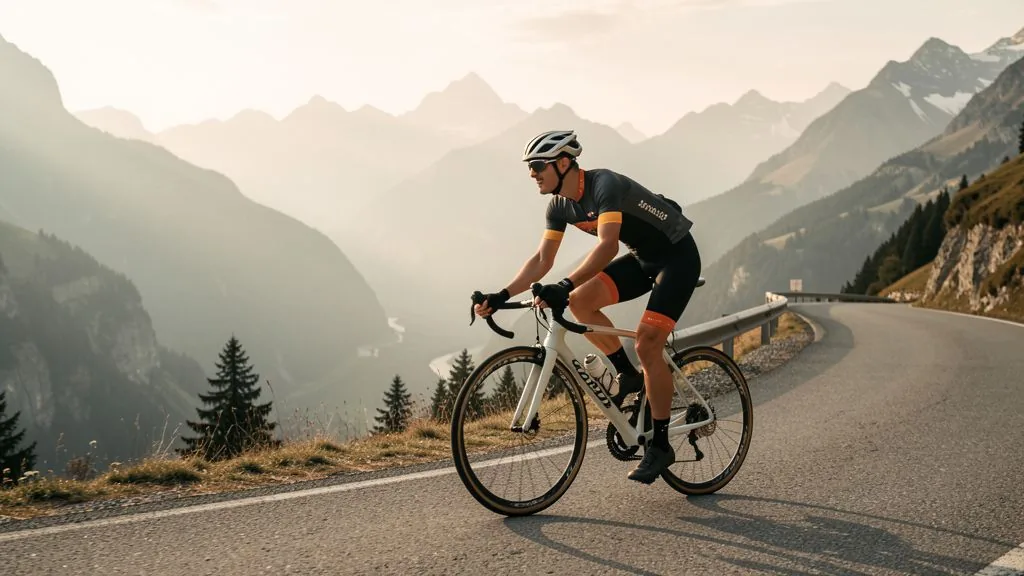
Back pain is the most common reason endurance athletes cut their riding short — more common than knee pain, more common than saddle discomfort. The frustrating part: it usually has nothing to do with the back itself, but with a combination of position, missing trunk strength and too fast a rise in load. The upside — this is almost always solvable within a few weeks, without giving up cycling.
Why the back gets loaded on the bike at all
Unlike running, the back carries no impact load on the bike — the spine is not compressed. The load is a different one: your upper body leans forward, the arms take part of the weight, and the back muscles have to stabilise isometrically for the rest. At 80 revolutions per minute that is over 4,800 small holding impulses an hour. These muscles fatigue — and a fatigued holding muscle reports as pain long before anything is actually "broken".
Then there is geometry: the further forward and the lower you sit, the harder the back muscles work and the more pressure sits on the discs and small vertebral joints. An aggressive race position is aerodynamically valuable, but it quickly costs more than it gains if you cannot hold it. After two hours the back sags, the arms straighten — and that is exactly when the pain starts.
The five most common causes
Before you change position or training volume, an honest allocation is worth it. In practice nearly every case maps to one of these five causes:
- Too long, too low a position: The most common trigger. If the drop (the difference between saddle and bars) exceeds 5 to 8 cm or the bike is simply too long, the back muscles cannot hold the position over time. This hits riders with little cycling background hardest — buying a race bike with pro geometry.
- Missing trunk and hip strength: People who sit a lot at work often have weak hip extensors and an unstable trunk. The stabilising work then shifts into the lower back muscles, which are not built for it — they fatigue after 60 to 90 minutes.
- Tight hip flexors and hamstrings: Tight hip flexors pull the pelvis forward into an anterior tilt and exaggerate the arch on the bike. Tight hamstrings pull it the other way, into a posterior tilt. Both raise pressure on the lumbar spine.
- Too fast a load increase: Jumping from 40 to 100 km in a week — in spring, or before a gran fondo — overloads the passive structures. The back often reacts first. The rules of load management apply on the bike too.
- A stiff thoracic spine and poor scapular control: An immobile thoracic spine forces the neck and lower back to compensate for the missing mobility. That explains why back and neck pain so often show up together on the bike.
Position: the three most effective changes
A bike fit is the most thorough solution, but three measures you can usually make yourself, and they already resolve a large share of the symptoms:
- Shorten the stem by 1 to 2 cm: This reduces reach and immediately unloads the lower back. A shorter stem costs around 20 to 40 euros — the cheapest investment with the biggest effect.
- Raise the bars by 1 to 2 cm with spacers: Every centimetre less drop reduces back flexion. On the flat you lose only a few watts, on climbs practically nothing — and over long rides you save far more energy than the aerodynamics cost.
- Level the saddle: A nose-down saddle makes you slide forward constantly, which keeps the trunk muscles working nonstop. Saddle height and fore-aft also belong to the check: too high and too far forward increases back flexion.
Then the conscious part: change your grip position every five to ten minutes between the tops, the hoods and the drops. Every change of position unloads different muscles and extends your pain-free ride time considerably. And do not underestimate passive comfort — a wider tyre works like suspension. Details in the article on setting tyre pressure.
A 15-minute strength programme for the back
The most durable fix is trunk and hip strength. Not as a one-off "core workout", but twice a week with progressive load. That is exactly the difference: on the bike the back needs endurance under load — holding work over time, not maximum strength. A proven addition is strength training for cyclists, which also improves pedalling economy.
- Plank: 3 × 30 to 60 seconds. Progressive time increase before new exercises. Trains the front trunk chain and the holding capacity used directly on the bike.
- Side plank: 3 × 20 to 40 seconds per side. The lateral trunk holds the line on every pedal impulse and protects the lumbar spine.
- Dead bug: 3 × 8 to 10 per side. Teaches the trunk to keep the pelvis stable while arms and legs move — exactly the demand of pedalling.
- Hip thrust: 3 × 8 to 12. Strengthens the glutes as the main extensor; a strong hip takes on the work that otherwise migrates to the back.
- Light deadlift: 3 × 6 to 8. Trains the back of the chain — erectors, glutes and hamstrings, the true "cyclist chain".
- Rows or pull-ups: 3 × 8 to 10. For the upper back and scapular control, so the head and arms have a stable base.
Schedule the programme on a day that carries no key stimulus — 24 to 48 hours from the hard session is ideal, not the day before the long ride. Five minutes of activation as a warm-up before the strength session is enough.
Dose the load instead of gritting your teeth
The most common mistake after a painful ride is the second most common overall: stopping entirely, or pushing on with full force. Both are wrong. The pragmatic route is adaptation — shorter rides, a more comfortable position, more position changes — combined with the strength programme. The sports-medicine pain rule helps with the decision: pain up to 3 out of 10 that does not increase during the ride is an acceptable signal to adapt. If the value rises during the effort, turns radiating, or lasts longer than a day after the ride, that is the line.
For load management the same principle applies as in every other endurance domain: at most 10 percent volume increase per week, with a deload week after every third week. What the deload week looks like in practice is covered in that article. Anyone who changes position and training volume at the same time can no longer tell what helped — so always adjust one variable at a time.
Common mistakes
- Treating only the back. Massage and heat relieve in the short term but do not fix the cause — missing strength and wrong geometry.
- Skipping strength training. The classic among ambitious cyclists who "only ride". That is exactly what keeps the symptoms alive.
- An overly aggressive fit. A too-stretched, too-low position that holds for only ten minutes costs more time than a comfortable one you can hold for two hours.
- Ignoring warning signs. Radiation into the leg, numbness or weakness are not "a tight muscle" and belong in medical assessment.
- Two building sites at once. A new position and a big jump in volume simultaneously — then it is unclear which change worked.
How Peakora prevents back pain
Peakora steers your cycling load via TSS, CTL and TSB and keeps volume progression within a safe range — the most common trigger of back issues is structurally avoided. If your form stagnates or the 24-hour recovery monitor reports a sustained load spike, you automatically schedule a deload week instead of adding more. The adaptive planning treats strength training as a fixed part of cycling and distributes sessions so trunk and hip work do not land the day before the key ride. And if you have to cut back because of back trouble, the engine records the reduced time and continues your fitness curve cleanly — rather than letting it break off.
Frequently asked questions
Why does my lower back hurt when cycling?
Because your trunk has to do the holding work while your legs pedal: at 80 rpm the back muscles stabilise the upper body more than 4,800 times an hour. If strength is missing or the position is too long and too low, this muscle group fatigues after 60 to 90 minutes — the pain is then a fatigue signal, not an injury.
Can a better bike position fix back pain?
In most cases, yes. The three most effective changes: shorten the stem by 1 to 2 cm, raise the bars by 1 to 2 cm with spacers, and level the saddle. A moderate position costs only a few watts on the flat but saves a lot of energy in the back over long rides.
Which exercises help with back pain when cycling?
Mainly trunk and hip strength: planks with progressive hold times, side planks, dead bugs, hip thrusts, light deadlifts and rows or pull-ups for the upper back. Twice a week for 15 to 20 minutes is enough — progressive load matters more than frequency.
Should I keep cycling with back pain?
With a dull, fatigue-related ache, yes — but shorter, in a more comfortable position, and you should start the strength programme. With sharp, radiating or shooting pain, numbness or weakness in the legs, stop and get it assessed by a doctor.
When should I see a doctor about back pain?
Always with pain radiating into the leg, numbness, tingling or weakness, with pain after a crash, with night pain, and with unexplained weight loss or fever. A pure positional ache without radiation is usually benign and solvable through position and training.
Your back-friendly cycling plan with Peakora
Personalised load management via TSS, CTL and TSB, integrated strength training and a recovery monitor that spots overload before it hurts. Start for free, no credit card required.
Start for free