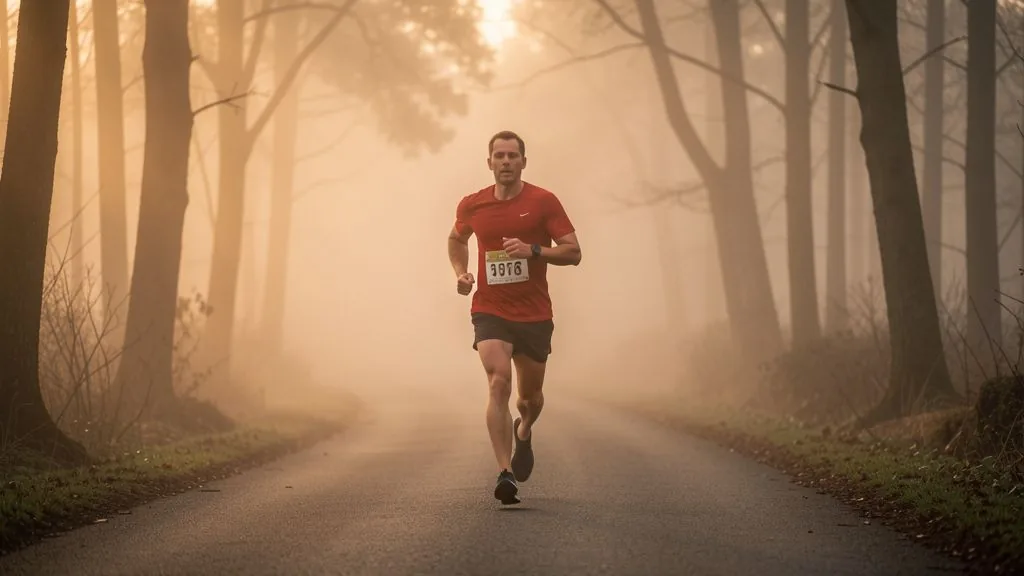
Endurance athletes spend almost all of their training time outdoors — and usually exactly when the sun is highest or the body is sweating hardest. Two to three hours a week in full sun add up over a season to a UV dose far beyond what dermatologists consider safe. For endurance athletes, sun protection is not a beauty topic but part of training planning.
What UV radiation does to the skin
Sunlight contains two relevant components. UVB has short wavelengths, penetrates only the upper skin layer and causes sunburn — visible a few hours later. UVA has longer wavelengths, reaches down into the dermis, causes no sunburn but accounts for most of the skin ageing, pigment changes and damage to the cell's genetic material. Both contribute to the development of skin cancer: UVA through indirect damage from free radicals, UVB through direct DNA damage in the form of thymine dimers.
The decisive factor is the cumulative dose. A single sunburn in early years measurably increases the risk of basal cell carcinoma; repeated tanning without burning is no longer considered safe today, only less harmful. Sport adds another factor: the skin is softened by sweat, stressed by friction from clothing and straps, and shows increased blood flow in the days after training — the same UV dose then has a stronger effect.
The sweat factor: why athletes absorb more UV
- Sweat washes the protection away. After about 40 to 60 minutes of hard effort, a significant part of the applied sunscreen is rubbed off or has shifted. Studies on exercise load show protection losses of 20 to 50 percent depending on the product and how much you sweat.
- The amount is rarely right. The SPF applies to 2 mg of sunscreen per cm² of skin — around 30 ml for a whole body, nearly a full handful. Typical application is about a quarter of that, which effectively collapses SPF 50 down to SPF 12.
- Reflection from below. Water reflects up to 30 percent of UV radiation, bright asphalt and sand 15 to 25 percent. More arrives under the face, on the chin, nose and ears than expected — areas many runners never cream at all.
- Altitude and time of day. UV intensity rises about 10 percent per 1,000 metres of altitude. Between 10 am and 4 pm, summer intensity in central Europe is several times the morning or evening value.
- Medication and supplements. Certain antibiotics, antirheumatics and St John's wort significantly increase light sensitivity. Anyone taking these needs consistent protection regardless of skin type.
The right product for long sessions
Three properties decide whether a product works in sport. First, the spectrum: "UVA" must appear in a circle or in the shape of the letter on the packaging, and UVA protection must be at least a third of the UVB protection. Second, water resistance — useful in sport products, but read it carefully: under the test standard, "water-resistant" means that after two 20-minute water immersions half of the protection remains. Third, the formulation. A gel base absorbs faster and sweats out less, a water-resistant film lasts longer, and creamy products with a high fat content can run into the eyes when you sweat.
The difference between mineral and chemical filters matters. Mineral filters (zinc oxide, titanium dioxide) sit on the skin and reflect the radiation — they work from the moment of application and are the safer choice for sensitive skin or a tendency to contact allergies. Chemical filters absorb the radiation and convert it to heat; they need 15 to 20 minutes of lead time and are thinner, which is more comfortable under sportswear. For sessions under two hours a product with SPF 30 is enough; for all-day outings, high-altitude routes or fair skin, SPF 50 is the more pragmatic choice.
One point that is still underestimated in sport: clothing with an ultraviolet protection factor (UPF). A densely woven long-sleeve shirt reaches UPF 30 to 50 permanently and without any application error. A tightly woven jersey, a cap with neck protection and glasses with a UV-400 filter together remove more radiation than any reapplication routine you will realistically follow in training. The only places clothing cannot reach are the face, ears, hands and lower legs — exactly where the lotion is worth it.
In practice: a sun protection routine for training day
- Apply 20 minutes before the start. Chemical filters need the lead time, and the product should absorb before the sweat arrives. Get dressed afterwards and only then head out.
- Do not estimate the amount. About half a teaspoon for face, ears and neck; two finger-lengths for each arm and each leg (the "finger trick": two strips of sunscreen along the index and middle finger per body part).
- Hard-to-reach spots first. Neck, ears, the hairline at the back, the backs of the knees, the top of the feet and the area under the straps are forgotten most often — precisely the areas most commonly affected in endurance athletes.
- Plan reapplication, do not leave it to feel. For sessions over 90 minutes a small tube belongs in your pocket or at the transition spot. In triathlon: apply before the swim, reapply in T1, and once more for the run after T2.
- Shift the start time if you can. The most effective measure costs nothing: move a long session from midday to early morning or late afternoon. In the summer months that roughly halves the UV dose.
- Shade as the base layer. Woodland trails and shady cycling routes reduce UV exposure by 50 to 90 percent. If you regularly run in the forest, you structurally absorb less radiation than someone doing the same route along a canal or in open fields.
Vitamin D: the double effect of the same radiation
UVB is responsible for vitamin D synthesis in the skin — the same radiation that must be shielded against sunburn activates the body's own production via 7-dehydrocholesterol. That is no reason to skip protection: synthesis starts within a short window of 10 to 20 minutes on exposed skin, well before sunburn appears. After that the skin produces no more vitamin D, only damage.
For athletes in central Europe this means: in the summer months the brief daily exposure usually covers the requirement, in the winter half of the year hardly. Since endurance athletes do much of their training indoors, in the morning or in the evening, the actual UVB dose is often lower than assumed. The details on measured values and supplementation are in the article on vitamin D in endurance sport.
Skin checks: what athletes should look at themselves
Endurance athletes have high sun exposure on fully visible and barely visible areas at the same time — including the shoulders, the back, the calves and the neck. Two simple habits help: first, have your back looked at regularly by a second person, or photograph the area with your phone. Second, check using the ABCDE rule: Asymmetry, Border (blurred edges), Colour (several shades within one mole), Diameter over 5 millimetres, Evolution (a change over weeks).
Anyone who regularly sees skin changes in exposed areas where shape, colour or sensitivity change should book a dermatology appointment rather than observe. A mole check with a high UV load in your training history is not a luxury, but rational training planning with a long horizon.
Common mistakes in sun protection for sport
- "I'm tanned, I don't need protection." A tan is worth roughly SPF 3 to 4 and protects only against UVB, not UVA. It is a damage response, not a shield.
- Once in the morning and then all day. The half-life of protection on sweaty skin is far below that of a sunny day. If you plan a long ride, one application will not get you through.
- Sun protection only when the sun is out. Up to 80 percent of UV radiation passes through light to medium cloud cover. Overcast summer days are one of the most common causes of unexpected sunburn.
- Mistaking straps, jersey and visor for protection. Thin-fabric jerseys often deliver only UPF 5 to 15, and an open visor leaves exactly the spots most exposed.
How Peakora accounts for sun exposure in your plan
Sun exposure changes the load measurably: a long session in full midday sun costs more than the same session at 15 degrees in the morning — higher heart rate at the same pace, higher fluid and electrolyte requirement, longer recovery. The Peakora engine assesses every session via Training Stress Score and the 24-hour recovery monitor, and adapts subsequent sessions when the load total climbs. If you place a long session in the sun, you will see the next morning in form (TSB) and resting heart rate what it really cost. The matching fluid planning via the fueling calculator and the basics of hydration while running are the second part of the same calculation.
Frequently asked questions about sun protection in sport
Does sunscreen actually work during sport?
Yes, but only in the right amount. The lab-tested protection level assumes two milligrams of sunscreen per square centimetre of skin. In practice most people apply about a quarter of that and end up well below the stated SPF.
How often do I need to reapply sunscreen while running?
On sweaty sessions every 90 to 120 minutes. Sweat, friction and towelling remove a large part of the product. A water-resistant sport formula lasts longer but does not replace reapplication.
Which SPF makes sense for sport?
For longer sessions outdoors at least SPF 30, and SPF 50 in intense midday sun or for fair skin. Higher numbers do not protect proportionally more, but they extend the window before you need to reapply.
Does clothing protect better than sunscreen?
Yes, in terms of reliability. With clothing there is no application error and no need to reapply. A densely woven long-sleeve shirt sits at UPF 30 to 50 and therefore above what most athletes achieve with lotion.
More on the topics that shape the same training day is in the training glossary and in the articles on heat training and injury prevention.
Plan your training with Peakora
Load management via TSS, a 24-hour recovery monitor and automatic plan adaptation — even when heat and sun make the session harder. Start for free, no credit card required.
Start for free