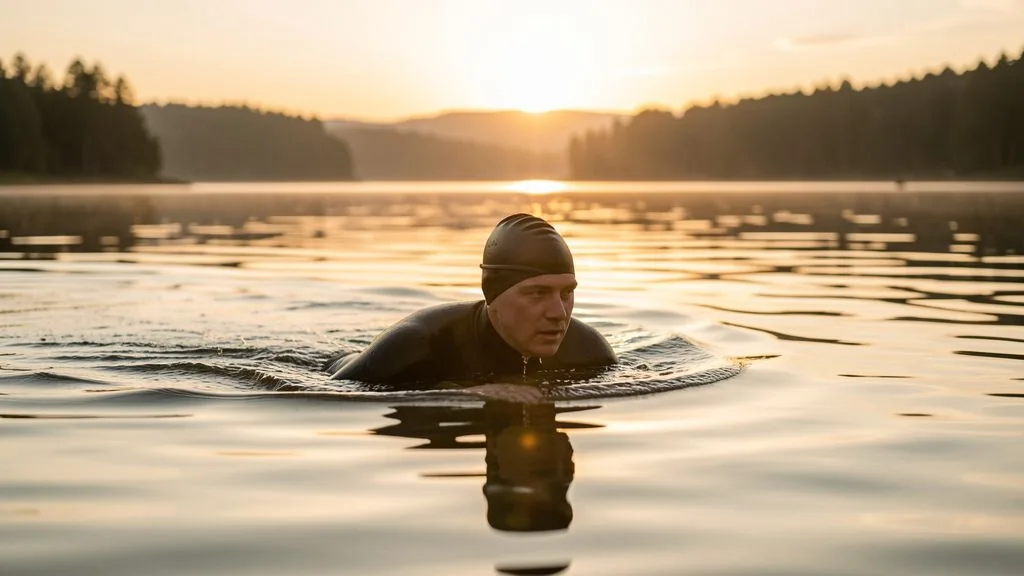
In the water only one thing counts: how much water you move backwards with every stroke. If you are too slow, you usually look for the fault in your technique — yet part of the solution lies on dry land. Strength training for swimmers does not mean building bulky muscle that drags in the water. It means training pull power and, above all, the ability to transfer that force into the water. This article shows why dry-land strength makes swimmers faster, which exercises really matter — and how to protect the shoulder, the most injury-prone joint in the sport.
Why dry-land strength works in the water
The physics is simple: water resistance rises with the square of speed. A stronger stroke means more water accelerated per pull — and therefore more propulsion at the same stroke rate. But it is not only about maximum force: it is about applied force, the amount you get from the arm into the water without the shoulder giving way or the trunk rotating away.
The research supports this. Dry-land strength training measurably increases pull force and improves performance in sprinters and short-distance swimmers — especially in the start, the turn and short sprints, where acceleration decides. For long-distance swimmers the gain is smaller, because body position, glide resistance and technique account for a larger share of the total time. Someone swimming 1,500 metres freestyle in open water benefits less from maximum pull force than a 50-metre sprinter — but even there, core stability and shoulder health act as performance factors. How technique and pull power interact is explored in the article on improving freestyle technique.
Pull power comes from the core, not just the arm
A common misconception: strength training for swimmers means arm training. In fact propulsion comes from a chain — from the latissimus and shoulder through the trunk to the counter-rotation of the hips. The arm is only the last link. Anyone who cannot stabilise this chain loses part of the arm force to body rotation instead of turning it into propulsion.
That is exactly why the core and anti-rotation belong in the strength programme. A swimmer who works with the kick and stays stable swims a straight, efficient stroke. The latissimus, the biggest force source of the stroke, only works fully when the trunk and pelvis form the counterpoint. Core and back work is also covered in core training for endurance athletes.
The four key lifts
You do not need a huge equipment arsenal. Four movement patterns cover what matters for the stroke, the transfer and shoulder health.
- Pull-ups (or lat pulldown): the overhead pulling movement — exactly the direction of the stroke in the water. It strengthens the latissimus, the main force source in freestyle. If you cannot yet do pull-ups, start assisted or with the pulldown and work your way up.
- Overhead press (shoulder press): strengthens the shoulder in the overhead position and improves joint stability. Important for swimmers, whose shoulder constantly works at extreme angles in the water.
- Rowing (bent-over or cable): the counterpoint to pressing. It strengthens the upper back and the scapular muscles and restores the balance between pulling and pushing — the best protection against shoulder malposition.
- Anti-rotation with the core (Pallof press, side plank): trains precisely the ability to control rotation in the water instead of giving in to it. This exercise is the direct link between core and propulsion.
As a complement, a targeted rotator-cuff exercise is worthwhile — external rotation with a light band or cable. It protects the shoulder and is more important in hardly any other sport than swimming. Progression works as always: raise the load slightly every two to three weeks, never lift load and volume at the same time.
Dosing and timing in the training plan
Two strength sessions a week are enough to improve pull power and stability. The sessions fit best on days with lighter swim training or after it — not right before a hard water session, because a fatigued shoulder then worsens technique. A 24 to 48-hour gap from an intense session is the rule of thumb.
The dosing follows the same principle as for other endurance athletes: three to four sets of three to six reps with demanding but clean technique, and slightly higher reps with controlled movement for the core. In the competition phase you cut back to one maintenance session a week, and in the last one to two weeks before an A race you stop entirely — the shoulder needs fresh power before the race, not soreness. If you plan within a year-round periodisation, the basics are explained in the training lexicon.
Avoiding shoulder injuries
Swimmer's shoulder is the most common overuse injury in the sport — and badly dosed strength training can feed it. Three rules keep the risk low. First: do not neglect the rotator cuff. Training only lats and chest shifts the muscular balance and pulls the head of the upper-arm bone forward. Second: raise the load slowly. A new strength programme does not double the load in two weeks. Third: pain lasting more than 24 hours is not a training result but a warning sign — then you reduce rather than push on. The most common swimmer's shoulder complaints and their causes are explored in the article on shoulder pain in swimming.
The five most common mistakes
- Training only the lats. Without pressing and rotation work a shift arises that loads the shoulder. The balance between pulling and pushing is decisive.
- Forgetting the core. Without anti-rotation the arm force dissipates in rotation. The core is the link between arm and propulsion.
- Training before the water session. The fatigued shoulder swims badly. Strength after training or on its own day.
- Progressing too fast. Tendons and the shoulder capsule need weeks, not days. Build the load slowly, form before weight.
- Ignoring pain. A warning sign that lasts beyond one session means reduce — not push through.
Frequently asked questions about strength training for swimmers
Does strength training help swimmers?
Yes — dry-land strength training raises maximum pull force and improves propulsion per stroke, especially over short to middle distances. Studies show performance gains above all in the dive start, the turn and the acceleration phase. For long-distance swimmers the benefit is smaller, because technique and body position in the water matter more than raw force alone.
Which exercises matter most for swimmers?
The three core lifts are pull-ups (an overhead pull that transfers straight to the stroke), a core rotation like the Pallof press, and overhead pressing for shoulder stability. Add rowing for the upper back and a rotational element for the rotator cuff. The core is decisive, because in the water body rotation transfers force from the arm to the body.
How often should swimmers train strength?
Twice a week is enough. The sessions fit best on days with lighter swim training or after it — not before a hard water session. In the competition phase you cut back to one maintenance session, and in the last two weeks before an A race you stop entirely. Complete beginners start with one session a week for four weeks.
How do I avoid shoulder problems in strength training?
By training the rotator cuff and scapular control, not just the big latissimus. Avoid excessive overhead loading with poor technique and raise the load slowly. A warm, activated shoulder before the session and a 24-hour pain-free outcome are the two most important control rules.
Plan swimming and strength with Peakora
Structured plans for triathlon and endurance sport — with strength blocks that fit sensibly into your week. Start for free, no credit card required.
Start for free