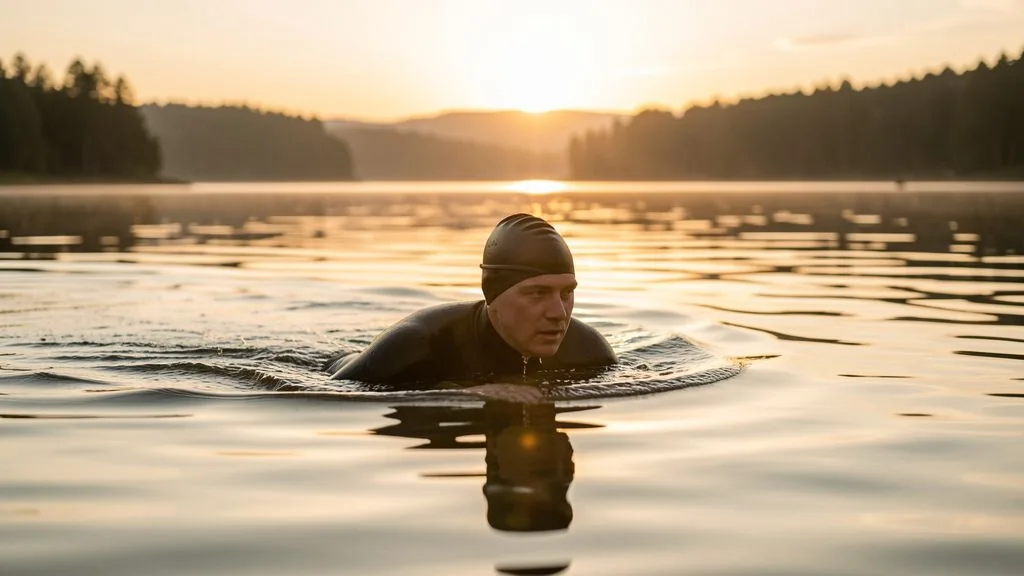
The sprint triathlon — 750 metres of swimming, 20 kilometres of cycling, 5 kilometres of running — is the perfect entry into multisport: short enough to fit around a normal week, long enough to deliver a genuine race experience. With four to six hours of training per week and eight weeks of preparation, you will not just finish — you can actively race it. Here is the complete plan.
The sprint distance at a glance
The three legs sound harmless; the combination is not. 750 metres of swimming takes beginners 15–20 minutes, the 20-kilometre bike 35–50 minutes and the 5-kilometre run 22–30 minutes. Add two transitions, which easily cost first-timers three to five minutes combined. A realistic target for your first start: somewhere between 1:15 and 1:45 hours — anything faster is a bonus.
What matters for planning: the bike makes up roughly half of your total race time, but the run decides the race. Go too hard on the bike and you will be walking parts of the final five kilometres. That is why the bike gets the largest share of training volume (about 40–45 %), followed by the run (30–35 %) and the swim (20–25 %) — even though the swim is emotionally the biggest source of anxiety.
Starting point: what you should bring
Eight weeks is enough if you arrive with a base level of fitness: able to swim 750 metres without stopping (resting at the wall is fine), ride 60 minutes comfortably and run 30 minutes continuously. If one of these is missing, plan for twelve weeks or start with a preparatory build phase — our guide for running beginners helps you build the run base.
The weekly framework: 4–6 hours spread across six to seven sessions. That means two swim, two bike and two run sessions — one of them a brick combination — plus one rest day. More is not needed for a first sprint: consistency across eight weeks beats any heroic weekend.
The gear list is surprisingly short: goggles and a swim cap, a road-legal bike with a helmet, running shoes — done. At most mass-participation races a wetsuit is mandatory below a water-temperature limit and forbidden above it; rent one for your first race instead of buying. A race-number belt and elastic laces cost under 20 euros combined and easily save a minute in transition.
The 8-week build in detail
The plan follows the classic 3:1 wave principle: three weeks of loading, one deload week. This lets the body adapt instead of accumulating fatigue — the mechanism behind it is explained in our article on supercompensation.
- Weeks 1–3 (base): Technique and aerobic foundation. Swimming with a technique focus (bilateral breathing, body position), bike and run almost entirely easy — 80 % of your time below the aerobic threshold, as described in the 80/20 principle. One short quality stimulus per week, e.g. 4 × 2 minutes brisk on the bike.
- Week 4 (deload): Cut volume by 30–40 %, drop the intensity. The week feels "too easy" — exactly right.
- Weeks 5–7 (specific): Race pace enters the plan: threshold intervals on the bike (2 × 10 minutes), tempo blocks in the run (3 × 1 km at goal pace) and the weekly brick. From week 6, swim once or twice in open water if your race is open-water — technique tips in our open-water swimming guide.
- Week 8 (race week): Halve the volume, keep short race-pace touches, last session 48 hours before the start. The principle is a mini version of tapering.
The four key sessions
- Brick (bike → run): 30–45 minutes of moderate cycling, straight into 10–15 minutes of brisk running. Heavy legs in the first five minutes are normal — this session is exactly what trains that feeling away. More in our article on brick training.
- Threshold bike: After 15 minutes of warming up, ride 2 × 10 minutes "comfortably hard" (you could still speak short sentences), with 5 minutes easy in between. Threshold work is the single biggest lever on your 20-kilometre time.
- Open-water session: 2 × 400–600 metres continuous, focusing on navigation: lift your head and sight every 6–8 strokes. Pool-only swimmers typically swim a 10–15 % detour on race day.
- Run intervals: 4–6 × 400 metres faster than goal pace, with 90 seconds of jogging recovery. Short, sharp, low injury risk — and they give you pace awareness for the final five kilometres.
Example week from the specific phase (week 6)
- Monday: Rest day.
- Tuesday: Swim 45 min — technique plus 6 × 100 m brisk.
- Wednesday: Bike 60 min with 2 × 10 min threshold.
- Thursday: Run 40 min easy + 4 strides of 20 seconds.
- Friday: Swim 30 min easy or open water.
- Saturday: Brick: bike 45 min moderate + run 12 min brisk.
- Sunday: Run 45–50 min easy or bike 75 min relaxed.
Total: just under 5 hours. The order is deliberate — the hard days (Wednesday, Saturday) are at least 48 hours apart.
Race day: pacing, transitions, nutrition
Pacing: Swim the first 200 metres deliberately easy — the chaos of the start lifts your heart rate anyway. On the bike: controlled hard, not maximal. A useful rule of thumb is 80–85 % of your threshold power, or a pace at which you could still speak in sentences. Start the run slower than feels necessary for the first 500 metres — your legs need that time to switch from cycling to running.
Transitions: Rehearse T1 and T2 at home: pulling the wetsuit off while standing, helmet on before touching the bike (a rule, not a tip), a race belt instead of fumbling with a shirt. Two minutes in transition is two percent of your total time in a sprint — more detail in our article on T1 and T2 — the fourth discipline.
Nutrition: For a race under two hours you do not need a complex fueling plan: a carb-rich breakfast 2.5–3 hours beforehand, one bottle with 30–40 g of carbohydrates on the bike, done. No experiments on race day.
Common mistakes in your first sprint triathlon
- Starting the swim too fast. Sprint to the first buoy, panic-level heart rate, damage control for the rest of the race. Seed yourself in the back third of your wave and swim the first 200 metres below what feels natural.
- Riding the bike like a time trial. The 20 kilometres are half your race time — but the race is decided on the run. Ride at 95 % and you will give back more at the end than you gained up front.
- Skipping brick sessions. If you have never trained bike-to-run, the changeover will shock you on race day. One brick per week from week 5 is non-negotiable.
- New gear on race day. New wetsuit, new shoes, new gel — everything belongs in training, not in the race.
- Too much volume too late. Squeezing "one more long ride" into week 7 imports fatigue exactly when freshness should be building. Trust the plan.
How Peakora builds your sprint plan
In Peakora you set your goal, race date and weekly hours — the engine builds the wave structure with base, specific and race weeks, places bricks and threshold sessions automatically and adapts the plan when life gets in the way. Whether you are sick for a week or on holiday, your plan recalculates around it.
Frequently asked questions about sprint triathlon
How long does a sprint triathlon take?
For beginners, between 1:15 and 1:45 hours. Expect 15–20 minutes of swimming, 35–50 minutes of cycling and 22–30 minutes of running, plus two transitions. Competitive age groupers finish under 1:10.
How many hours of training per week do I need?
4 to 6 hours per week is enough for a solid finish. Split them into two sessions per sport plus one brick. More volume matters less on this distance than consistency across eight weeks.
Do I need a road bike for a sprint triathlon?
No. Any road-legal bike with working brakes is allowed — a hybrid or mountain bike is fine for your first race. A road bike saves roughly two to four minutes over 20 kilometres, but it is not a requirement.
What is a brick workout?
A combined session of cycling followed immediately by running. It trains your legs to switch from circular pedalling to a stride pattern. Typically: 30–45 minutes on the bike, then 10–15 minutes of brisk running, once a week.
Start your sprint triathlon plan
Peakora builds your personal 8-week plan — with bricks, threshold sessions and a race week matched to your date. Start for free, no credit card required.
Start for free