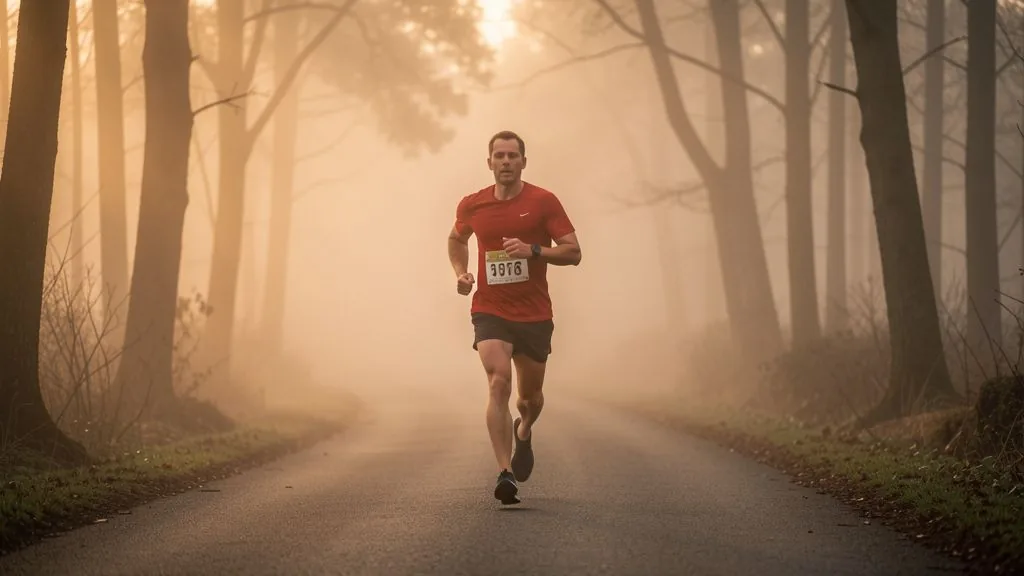
Smoking and endurance sport sounds like a contradiction, yet it is a reality for a share of runners, cyclists and triathletes. Some smoke only at weekends, others have just quit and wonder how much they have "lost". The honest answer: nicotine costs you measurable performance — precisely where endurance sport is decided, in oxygen transport, vascular function and recovery. This article shows what happens physiologically, what quitting actually buys you, and when.
What nicotine and carbon monoxide do to the body
A cigarette contains far more than nicotine: burning tobacco produces carbon monoxide, tar, formaldehyde and hundreds of other substances. Two of them matter for endurance. Carbon monoxide binds to haemoglobin roughly 200 to 250 times more strongly than oxygen. It occupies transport slots your muscles need. At the same time it shifts the oxygen dissociation curve, so tissue releases oxygen less readily. The result: you breathe harder to achieve less — the heart beats faster even though less oxygen arrives.
Nicotine is a vascular toxin. It narrows the arteries, raises resting heart rate and worsens the flow properties of the blood. Under endurance load, cardiac work rises while blood supply to working muscle falls. Both effects add up, and both explain why smokers run out of breath consistently earlier at the same intensity. If you want the fundamentals, see the article on heart rate zones.
What studies show about smokers' endurance
The numbers are remarkably consistent. Maximal oxygen uptake (VO2max) is on average 5 to 10 percent lower in smokers than in comparable non-smokers — considerably more in heavy, long-term smokers. Translated into race times, that is roughly 1 to 3 minutes over 10k, and proportionally more in a marathon. More serious still: the anaerobic threshold — the pace you can sustain for a long time — shifts downward, because muscle has to switch to anaerobic energy earlier. How much the threshold decides your performance is explained in threshold training.
Interestingly, training responds non-linearly: smokers do benefit from endurance training, but the adaptation is blunted. The same training dose produces less capillary growth, less improvement in vascular function and a weaker increase in mitochondria. You train with the same effort but get less return — a permanent performance discount that no training-plan optimisation can offset.
Recovery: the underestimated price
Smoking strikes not only during exercise but above all afterwards. Better sleep and intact recovery are the engine of every training adaptation — see the Peakora article on sleep and endurance performance. Nicotine shortens deep-sleep phases and fragments sleep: you spend longer in bed and wake less restored. At the same time, overnight heart rate variability (HRV) — an established marker of recovery capacity — is systematically lower in smokers. Less recovery at the same load means higher risk of overtraining, more frequent infections and slower adaptation.
Add circulation. You need good microcirculation for nutrients to reach muscle and for breakdown products to be carried away. Nicotine restricts it, so every recovery process runs slower. Some athletes experience this as "I just can't seem to get loose any more" — even though the plan is sound.
What happens when you quit: the timeline
The good news: the body recovers faster than most expect. Quitting is the single most effective measure for endurance performance there is — and the timeline is well documented:
- After 20 minutes: heart rate and blood pressure fall toward baseline.
- After 8 to 12 hours: carbon monoxide in the blood is greatly reduced and oxygen saturation normalises.
- After 24 hours: heart attack risk begins to fall measurably.
- After 2 to 12 weeks: circulation and lung function improve markedly — many athletes notice their first real performance gain here, especially in intervals and on climbs.
- After 3 to 9 months: coughing and breathlessness usually disappear completely, airway mucosa recovers and aerobic capacity rises.
- After 1 to 5 years: heart attack risk approaches that of a non-smoker; endurance performance and training tolerance are practically back to normal.
Practically relevant for planning: schedule your quit 8 to 12 weeks before a key race. In the first two weeks after quitting, performance may subjectively feel slightly worse — the body is adjusting mucus production and airways, sometimes with coughing. That is recovery, not decline. Cut volume by 20 to 30 percent during that phase and rebuild afterwards.
E-cigarettes and nicotine pouches: really better?
Many athletes switch to e-cigarettes or nicotine pouches assuming the problem is solved. That is only half true. E-cigarettes deliver no carbon monoxide and no tar — a genuine advantage for endurance, because oxygen transport is not directly blocked. But the nicotine remains a vascular toxin: it still narrows arteries and raises resting heart rate. Clinically, vapers show worse endothelial function than non-smokers, especially in the hours right after use.
Nicotine pouches and snus avoid the airways entirely but deliver sometimes high nicotine doses without carbon monoxide. Better for the lungs, not for the cardiovascular system. None of these routes is a free pass — all reduce risk compared with classic smoking, but none makes nicotine harmless. An athlete who only vapes during a race block has less breathlessness but still the vascular and recovery penalties.
Passive smoking: the invisible training killer
Passive smoking is underestimated and hits non-smokers too. Regular exposure to cigarette smoke — in a bar, in a car or in a smoking household — lowers lung function and oxygen uptake much like light active smoking. For athletes with asthma or exercise-induced asthma it is especially problematic: smoke can trigger attacks and wreck the training quality of whole weeks. If your resting heart rate stays elevated long after a session, ambient smoke can be one reason. To understand your airway limits better, see exercise-induced asthma.
Practical steps for athletes who smoke
- Before a race: 24 to 48 hours without smoking buys you more than any pacing detail. Carbon monoxide falls fast and vascular function recovers within hours.
- Quit timing: Set your quit 8 to 12 weeks before a key race — not in race week. In the first two weeks, cut volume if needed.
- Adjust the plan: During the transition, cut volume rather than intensity so the weakened recovery doesn't tip into overtraining. A personalised plan reacts to actual recovery — see the article on adjusting your training plan.
- Environment: Avoid passive smoking too. No smoking in the car, at the training venue or at home.
- Use support: Nicotine replacement therapy, behavioural support and medical guidance double to triple quit success compared with going it alone.
The key point: neither resignation nor excuses help. Smoking demonstrably lowers your endurance, but the body has enormous regenerative capacity — and that is your opportunity. Every smoke-free day is a day your training counts fully again. The marathon training pillar page has concrete race preparation, and the training glossary explains terms like VO2max, threshold and supercompensation.
Frequently asked questions about smoking and endurance sport
Can I still run a marathon as a smoker?
Technically yes, but you leave measurable performance on the table. Carbon monoxide blocks oxygen transport, your VO2max is on average 5 to 10 percent below a comparable non-smoker's, and recovery takes longer. You are racing against your own body.
How long does it take for endurance to improve after quitting?
The first effects come fast: within 24 hours the carbon monoxide in your blood drops to a normal level, and within 2 to 12 weeks circulation and lung function improve noticeably. After 3 to 9 months coughing and breathlessness usually disappear and endurance performance rises clearly.
Does smoking before a race help in any way?
No. Nicotine narrows the blood vessels, raises resting heart rate and impairs oxygen delivery to the muscles — the exact opposite of what a race needs. Even the perceived calm of a cigarette is just relief from your own withdrawal.
Does passive smoking hurt my endurance?
Yes, measurably. Regular passive smoking lowers lung function and oxygen uptake much like light active smoking. With asthma or exercise-induced asthma, smoke can trigger attacks directly and ruin the training quality of whole weeks.
Train for what your body can actually deliver
Peakora builds your plan from your form, your training days and your race date — and adjusts it weekly to your actual recovery. Start free, no credit card required.
Start for free