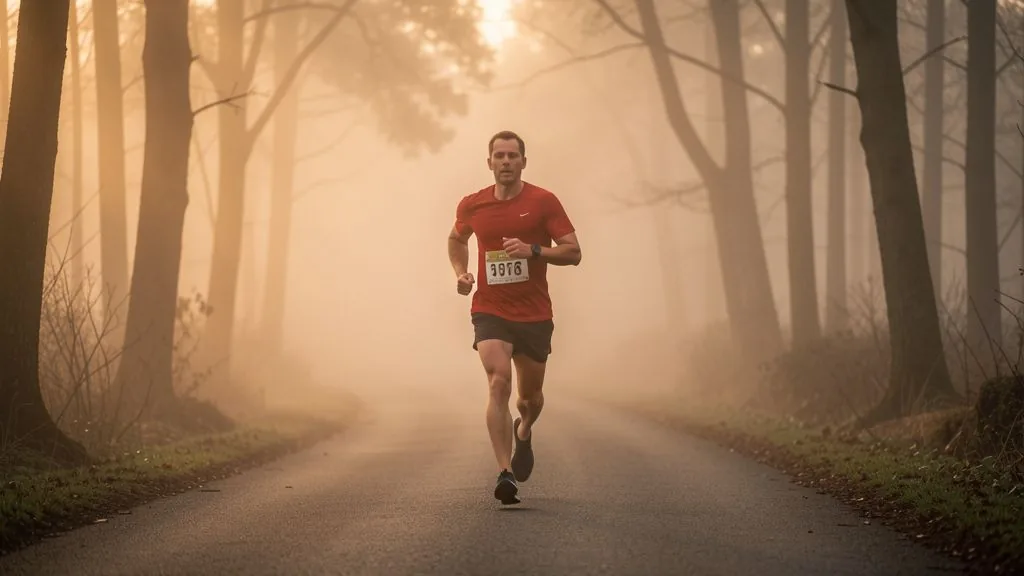
For months everything pointed to that one day: the marathon, the Ironman, the gran fondo. Afterwards many athletes feel the opposite of the expected high — a low. No drive, no appetite for training, sometimes even sadness. This phenomenon is called the post-race blues or post-race depression. It is widespread, well explained, and in most cases temporary. This article shows why the low arises, how long it lasts and which six steps reliably get you back on track.
What are the post-race blues?
The post-race blues describe a temporary mood dip that appears after an important race — often with a delay of one to three days, once the physical sense of recovery has already set in. Typical symptoms: listlessness, irritability, inner emptiness, no appetite for what normally brings you joy, plus a diffuse feeling of "what now?". Sport science and sport psychology have described the phenomenon for decades, even though it is not a diagnosis in its own right.
Important: the post-race blues are not a sign of weakness or a lack of willpower. They are the predictable consequence of a body and a mind being aligned for months to a single, clearly defined goal — a goal that is now achieved. Understand that, and you can actively shape the phase instead of just living through it.
Why the low comes — the physiology behind it
The low has several causes acting at once. The most striking is the hormonal rollercoaster: around a big race the body fires adrenaline, noradrenaline and endorphins at full throttle. These hormones dull pain, mobilise energy and produce a euphoric high — the well-known runner's high. After the race these values fall back to normal level, or below, within hours to days. The sudden disappearance of that cocktail feels like a crash to many.
Add the load response. A marathon taxes muscles, immune system, hormonal system and circulation substantially. Studies show elevated inflammatory markers and creatine kinase values five to seven days after the race, plus a temporarily weakened immune status — the famous infection window of the first days. Blood volume is also briefly reduced after long efforts, which can drive heart rate up at the same pace. All of this explains why the body feels unusually heavy even though there is no injury.
Sleep plays its part too. The night after the race is often restless, the legs hurt, the circulation runs hot. Anyone prone to sleep loss reinforces the low noticeably — how important sleep is for endurance performance shows up most clearly after the big day.
The psychological side: goal achieved — and then?
The second big factor is pure mind. For months there was a fixed structure: daily sessions, weekly milestones, a date in the calendar that shaped every decision. Body and mind orient fully to this fixed point. When the fixed point disappears, the structure goes with it — and with it the basis for the feeling of being needed.
What follows is a meaning gap. Many athletes describe a feeling of "I gave everything — and now?". The distance to everyday life, in which training set the pace, shows up as emptiness. This is especially pronounced in athletes who prepared meticulously for months and afterwards have no immediate answer to the question "where next?".
How long do the post-race blues last?
In the vast majority of cases one to three weeks. Two phases can be broadly distinguished. The first covers days zero to seven: it is predominantly physical and shaped by exhaustion, heavy legs and falling hormones. The second, psychologically driven phase runs from about day seven to day twenty-one: this is about the lost structure, the missing goal and the return to everyday life.
The race distance matters too. After a 10K the low is usually shorter and milder; after an Ironman it is markedly more pronounced and longer. The bigger the gap between the maximum tension of preparation and the calm afterwards, the deeper the hole. Whoever plans the phase in mindfully makes it more bearable and shorter.
Six steps back out of the low
The post-race blues are not fate — you can actively steer how you handle them. These six steps help most reliably in practice.
- Give yourself real recovery — planned, not forced. Actively block the first one to two weeks for regeneration instead of throwing yourself straight into a new programme. Whoever consciously concludes the recovery phase doesn't experience it as emptiness but as part of training.
- Stay in motion — without performance pressure. Walking, easy jogging, swimming, easy-zone cycling. No heart-rate corridor, no time target, no Strava segments. Light activity demonstrably lifts mood and speeds physical recovery.
- Set a new goal — but an easy one. A relaxed build, a fun run in eight weeks, a new field such as gravel or track intervals. Important: don't line up a second season highlight straight away, but a goal that brings joy rather than pressure.
- Build a new weekly structure. The training structure wasn't the problem — the emptiness afterwards was. Fixed times, fixed appointments, even if the sessions are easy runs: structure stabilises mood more than any single session.
- Sleep, food, sun, people. The four pillars against a depressive mood. Enough sleep, balanced meals with protein and carbohydrate, morning daylight and contact with people — especially training partners — work reliably against the low.
- Review in measured, kind doses. Analyse the race, but without self-devaluation. What went well, what would you change? A missed goal is data, not a verdict — the same attitude that counts in setting goals the right way.
What to avoid in this phase
The wrong reactions are at least as important as the right steps. Avoid these five mistakes.
- Training on immediately. Whoever jumps into the next build without a break prolongs the low and risks injury or overtraining.
- Stopping completely. The opposite is just as harmful. Going abruptly from a hundred to zero reinforces the mood dip — movement is a mood booster, not a burden.
- Racing against yourself. Comparing yourself with stronger athletes or with your own personal best during the recovery phase feeds frustration instead of progress.
- Substitute addictions. Some athletes compensate the feeling of emptiness with excess food, alcohol or shopping. Such patterns only mask the low and prolong it.
- Dropping all goals. Having no new goal because "I have to earn it first" opens the downward spiral. A kind, achievable goal is the best medicine.
Post-race blues or overtraining?
The two states can look similar but are different. The post-race blues arise after the peak, when the load is already falling — the body recovers, only the mood lags behind. Overtraining, by contrast, arises from a permanently excessive load over a longer period and shows up as a performance drop with rising effort, persistently high resting heart rate, sleep problems and irritability.
The practical difference lies in the course: the post-race blues improve with recovery within weeks, overtraining often needs months. If you don't improve after four to six weeks of rest, your load before the race was possibly already too high — then the recovery phase alone won't help, but a load check with the form metrics CTL, ATL and TSB will.
How Peakora supports the phase after the race
Peakora makes the transition after the race visible and plannable. Once you have checked off your A race, the engine switches into a defined recovery mode: training load is reduced, a relaxed build follows. Via the form metric TSB you see in black and white how your freshness returns, and recognise when the body is ready for new stimuli. Key terms such as CTL/ATL, TSB and supercompensation are explained in the training lexicon, and you'll find concrete sample plans for marathon, triathlon and gran fondo in the blog.
The key is the transition, not the ending: Peakora makes sure that after the taper there's no silence, but a short deload week and then a new, relaxed build.
Frequently asked questions about the post-race blues
What are post-race blues?
A temporary mood dip after an important race. It arises because the body drops from its hormonal high, the structure of the training plan suddenly disappears and the big goal is achieved. It is normal and usually passes within one to three weeks.
How long do post-race blues last?
Typically one to three weeks. The first days are a physical reaction (hormones, exhaustion), then the psychological phase follows. If the low lasts longer than three to four weeks, or sleep problems, listlessness in daily life and loss of joy are added, it should be assessed medically.
Should I keep training straight after the race?
No — recovery first. After a marathon or Ironman the body needs one to three weeks of easy recovery before new structured training makes sense. Training straight through prolongs the low and raises injury risk. Light movement such as walking or easy jogging is allowed and even helps against the mood dip.
Are post-race blues dangerous?
As a rule, no — it is a normal adaptation response. It only becomes dangerous if you slip into a downward spiral: no new goal, no training, steadily worsening mood. A new, easy build and a next goal four to eight weeks out are exactly what counters it.
From the race into the next build
Enter your race and your recovery in Peakora — the engine guides you through the time after the event and builds your next, relaxed block from it. Start for free, no credit card required.
Start for free