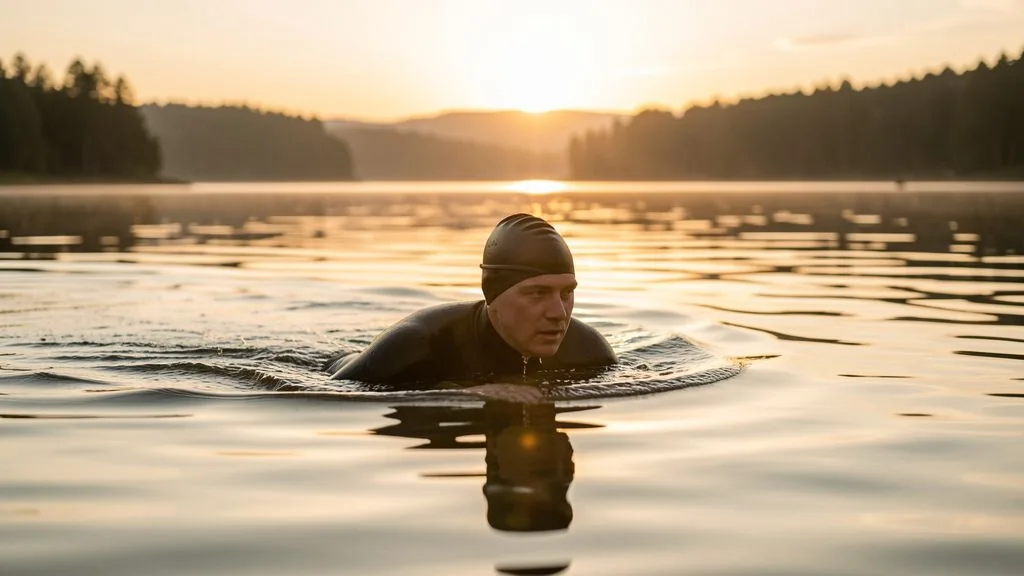
3.8 kilometres of swimming, 180 kilometres of cycling, then a marathon: the Ironman is triathlon's ultimate distance — and preparing for it is a nine-to-twelve-month project. Finishing the long distance doesn't require heroic single workouts. It requires three things: consistency over months, a well-rehearsed nutrition strategy, and smart periodisation. This guide shows what solid Ironman preparation looks like.
The distance in perspective: what you're really signing up for
The numbers are easy to state; their weight is not. Most age groupers are out on the course for 11 to 15 hours. The longest discipline by far is the bike leg, typically 5:30 to 7:30 hours — this is where the race is won or lost, not in the water. The 3.8 km swim takes most athletes 70 to 100 minutes, and the closing marathon runs well over four hours for the vast majority. Your training should mirror this time structure: roughly 50 to 55 percent of training volume on the bike, 30 to 35 percent running, and 15 to 20 percent swimming.
If you're new to triathlon altogether, our triathlon training overview page (German) covers every distance from sprint to long course — and why the Ironman is the end of a progression, not the starting point.
How long does Ironman preparation take?
The honest answer depends on your starting point:
- With endurance experience (marathon finisher, gran fondo rider or half-Ironman finisher): 9 to 12 months of structured preparation is enough.
- Athletic but without an endurance background: Allow 12 to 18 months. Base fitness first, distance second.
- Complete beginner: 18 to 24 months with intermediate goals. An Olympic-distance triathlon after one year and a half Ironman six months before the big day are proven milestones.
The most important sentence in the entire preparation: Ironman fitness isn't built in the final eight weeks — it's the sum of all the weeks before. Illness, holidays and motivation dips are part of the plan. A twelve-month horizon can absorb two bad weeks without the project collapsing.
Training volume: how many hours are realistic?
Weekly hours are the most debated — and most overestimated — number in Ironman preparation. A realistic picture:
- Finisher goal: 9 to 12 hours per week in the peak phase, preceded by months of 6 to 9 hours.
- Ambitious goal (sub-12 hours, strong age-group placing): 12 to 16 hours at peak.
- Qualification level: 16 hours and more — with recovery management to match.
More important than the peak weeks is the rate of progression: increase weekly volume by no more than 5 to 10 percent and schedule every fourth week as a deload week at about 60 percent of normal volume. The Training Stress Score (TSS) makes this progression measurable: in the three biggest weeks before the taper, most age groupers sit between 500 and 700 TSS per week.
Periodisation: the three phases of preparation
Ironman preparation isn't a steady "always more" — it follows a clear phase structure:
- Base phase (months 1–5): The biggest block. Lots of easy training in zones 1 and 2 — following the 80/20 principle, about 80 percent of volume stays at low intensity. Goals: aerobic base, fat metabolism, swim technique work and strength training for tendon resilience.
- Build phase (months 6–9): Sessions get longer and more specific. Threshold and race-pace work are added in measured doses, long rides grow to 4–5 hours, long runs to 2:30–3 hours. Ideally, a half Ironman sits here as a test race.
- Specific phase (final 8–10 weeks): Race simulation takes centre stage: long bricks, training at planned race power or pace, fueling rehearsals under load. Afterwards come 14 to 21 days of tapering — fatigue drops, freshness rises.
Brick sessions: the key workout of long-distance racing
Running off the bike feels alien — heavy, stiff legs and a heart rate above expectation. Your body has to get used to exactly that. Brick sessions (bike followed immediately by a run) are therefore the most specific building block of Ironman preparation:
- Frequency: One brick per week in the specific phase, every other week in the build phase.
- Structure: A long, easy ride (3 to 5 hours), then 20 to 45 minutes of running — easy at first, later partly at planned marathon pace.
- The learning effect: After a few weeks, your pace normalises noticeably faster after dismounting. This is also exactly where you rehearse your race fueling: whatever you eat and drink on the bike, your stomach has to tolerate on the run.
- The transitions themselves deserve practice too — they're not called the fourth discipline of triathlon for nothing.
Fueling: the fourth discipline
Most Ironman DNFs and blow-ups are not fitness problems — they're nutrition problems. Over 11 to 15 hours of effort you burn 7,000 to 10,000 kilocalories; without systematic intake, the crash is pre-programmed. Current guidance for long-distance racing: 60 to 90 grams of carbohydrate per hour on the bike, 40 to 60 grams on the run depending on gut tolerance. Add 500 to 1,000 millilitres of fluid and 400 to 800 milligrams of sodium per hour, depending on temperature and sweat rate.
The crucial point: this has to be trained. The gut is adaptable — athletes who train with 90 g/h for months tolerate it on race day; those who only try that intake in the race risk stomach trouble. For details on carbohydrate strategy see our fueling guide, and for sodium, potassium and magnesium the dedicated electrolyte article.
The five most common mistakes in Ironman preparation
- Riding and running the easy sessions too hard. The classic trap: easy sessions creep up in pace while the hard ones aren't hard enough. The result is constant "grey zone" load that builds fatigue but little adaptation. Stick to the 80/20 distribution.
- Neglecting the swim. If you exit the water completely drained after 100 minutes, you'll ride the first 90 bike kilometres on credit. Technique work and regularity beat volume here — three focused 45-minute sessions a week do more than one tortured 3-kilometre slog. See the basics in our swim technique guide for triathlon beginners.
- Too many test races. Every race costs a training week before (taper) and one after (recovery). Two, at most three, B-races across the whole preparation are plenty.
- Testing fueling for the first time on race day. Gels, drinks and solid food you've never tried under load are a gamble. Everything that goes into your body on race day should have been tested at least five times in training.
- Ignoring sleep and life stress. At 12 or more training hours per week, sleep becomes the limiting factor — sleep is the free performance booster. If you juggle a full-time job and family with 16-hour training weeks, you don't need a harder plan; you need a more realistic one.
How Peakora plans your Ironman preparation
Peakora builds a periodised long-distance plan from your race date, current fitness and weekly time budget: base, build and specific phases are built in, brick sessions and long workouts are scheduled at the right time, and the taper starts automatically 14 to 21 days before the race. The recovery monitor balances load and recovery in parallel — when sleep or resting heart rate signal overload, the plan adapts before ambition turns into a breakdown. And because the AI coach knows your sessions, a question like "Was I pushing too hard this week?" gets an answer based on your actual data instead of generic advice.
Frequently asked questions about Ironman training
How long does it take to prepare for an Ironman?
Plan for 9 to 12 months of structured training if you already have endurance experience. Complete beginners should allow 18 to 24 months and use shorter races such as an Olympic-distance triathlon or a half Ironman as stepping stones along the way.
How many hours per week do you need to train for an Ironman?
In the peak phase, ambitious age groupers train 12 to 16 hours per week; a safe finish usually requires 9 to 12 hours. Consistency over months matters more than the total — a steady 10 hours beats alternating between 6 and 18.
What is a brick session and how often do I need one?
A brick combines a bike and a run session back to back to train the muscular transition between disciplines. In the specific preparation phase, one brick per week is recommended — usually a long ride followed by 20 to 45 minutes of running at race pace.
What weekly TSS is realistic in the Ironman peak phase?
In the three biggest weeks before the taper, most age groupers sit between 500 and 700 TSS per week. The key is gradual build-up: your Chronic Training Load should rise steadily over 8 to 12 weeks, not in jumps.
Do I need a power meter for an Ironman?
No, but it helps enormously. The bike leg covers most of your race time, and a power meter makes pacing far more precise than heart rate or feel — especially in wind and on hilly courses. Without one, pace by heart rate and perceived exertion and test it in training.
Plan your long-distance race with Peakora
Periodised Ironman plan with brick sessions, automatic tapering and recovery monitoring. Start for free, no credit card needed.
Start for free