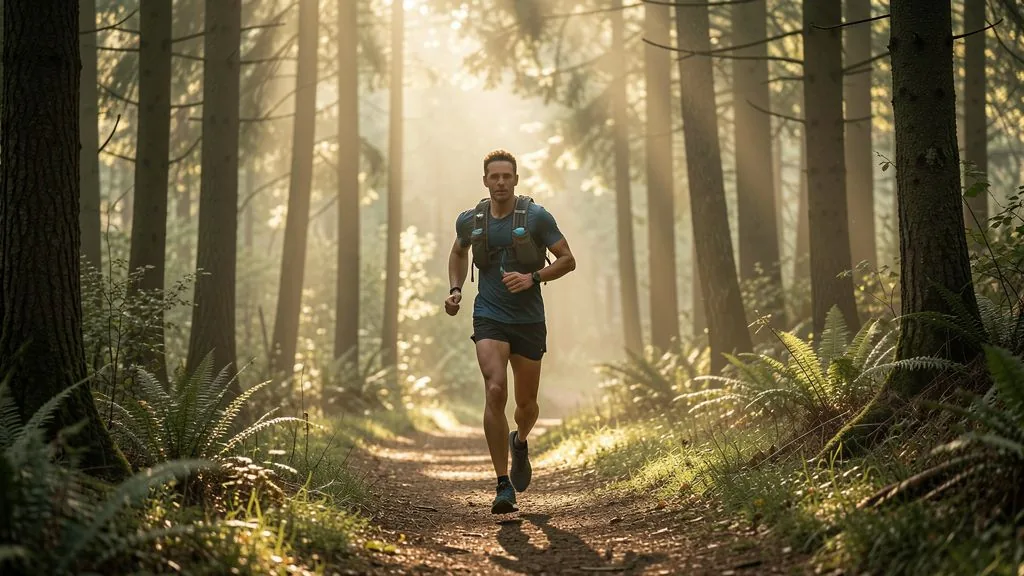
Many endurance athletes treat hiking as lost training time — too slow, heart rate too low, no real stimulus. That is an expensive misconception. A day with 1,000 metres of climbing and five hours on your feet loads the body energetically like a 20-kilometre run, without the mechanical pounding a run produces. Once you understand that difference, you can use hikes deliberately: as a base block, as a substitute for an altitude camp and as controlled strength-endurance work for the legs.
What actually happens physiologically
The decisive quantity in the mountains is vertical work. Lifting 100 kilograms of system weight by 1,000 metres requires about 980 kilojoules of mechanical work. At roughly 25 percent efficiency that is around 3,900 kilojoules of metabolic turnover, or about 930 kilocalories. A 75-kilogram runner burns roughly 750 kilocalories over a flat 10-kilometre run. So 1,000 metres of climbing is energetically more than 12 flat running kilometres, and a normal hiking day with ascent and descent quickly lands at double that.
More interesting than the calories is what happens in the muscle. Over four to six hours at 55 to 70 percent of maximum heart rate you create exactly the kind of stimulus base training is looking for: a high fat oxidation rate, thousands of contractions at low intensity, and shear-stress signals to the capillary bed. It is the same mechanism a long run triggers — just without the vertical forces of two to three times body weight per stride that hit knees and Achilles tendons in running.
That is the practical value: hiking is aerobic base stimulus with reduced mechanical load. For runners with sensitive tendons, for athletes returning from injury and for weeks with high volume, it is a tool most people use far too rarely. How to manage load and recovery around it is covered in the article on recovery in endurance sport.
The conversion: elevation gain into training load
So that a hike does not end up as a blind spot in your training control, it needs a number. Two rules of thumb cover everyday use:
- Energy equivalent: 100 metres of ascent equals roughly 800 to 1,000 metres of flat running. A day with 1,200 metres of climbing and 14 kilometres of trail sits at about 24 running kilometres.
- Time equivalent: One hour of hiking on continuous gradient counts like 40 to 50 minutes of easy running. On flat ground, without gradient, only like 25 to 30 minutes.
If you want precision, work with training load instead of kilometres. A five-hour hiking day at moderate intensity produces a TSS value of 90 to 140 depending on body weight and steepness — more than a normal long run, less than a race. The distribution matters more than the total, though: descending adds almost no cardiovascular load but plenty of muscular damage. A day with 1,200 metres up and 1,200 down is therefore not twice as hard on the heart, but clearly more expensive for the legs than a loop with the same climbing and a cable-car descent.
The underestimated part: walking downhill
On the descent the quadriceps work eccentrically — the muscle gives way under load instead of shortening. For the same external work this contraction mode creates significantly more micro-damage in the Z-discs of the muscle fibres than concentric work. That is why soreness arrives 24 to 48 hours late and hits the front of the thigh and the calves hardest.
For trained athletes this is a welcome stimulus: eccentric loading is the strongest known trigger for tendon and muscle adaptation, and it demonstrably protects against further damage — the repeated-bout effect. After four to six exposures, regular downhill walkers have measurably less soreness. For untrained people the same stimulus is a risk: an unprepared 1,500-metre descent can cost three to five days of lost training and cause real trouble in pre-damaged knees.
Two rules soften this. First, dose the descent: start with 300 to 400 metres early in the season and raise it by about 20 percent every two weeks. Second, technique and gear. Short, frequent steps spare the knee more than long strides, and poles take up to 25 percent of the load off the legs. Details on load tolerance are in the article on hill training for runners.
When a hike replaces a run — and when it does not
Hiking can fully replace an easy aerobic run, but not every session. The line runs along specificity:
- Replaceable: recovery runs, easy base sessions, long runs in high-volume weeks. What counts here is time in the aerobic range, not cadence.
- Partially replaceable: long runs when the target course is hilly. Brisk uphill hiking is more specific than a flat long run because the leg muscles work close to the race gradient.
- Not replaceable: intervals, threshold runs, tempo sessions and anything that demands neuromuscular coordination at speed. VO2max requires an intensity you cannot reach while walking — maximal oxygen uptake during brisk uphill walking sits at 60 to 75 percent of the running value.
In practice a ratio of one hike per four to six runs works well in the base phase. In race preparation the share drops to zero or one session, and in the final two weeks before a marathon leg volume should stay stable — a 1,800-metre elevation day ten days out is a bad idea even if the heart rate looks harmless.
Hiking as a training-camp substitute
If you do not want to book an altitude camp, hikes can deliver part of the effect where you already live. What matters is not absolute altitude but the time you spend at moderate elevation. A weekend with two hiking days between 1,200 and 1,800 metres does not replace altitude acclimatisation — that needs 14 to 21 days — but it delivers a solid base block with high volume at low mechanical load.
The real benefit lies in the combination: regular hiking in autumn and spring builds volume you could only reach through pure running at a higher injury risk. If you are planning genuine altitude work, the dosing is covered in the article on altitude training in endurance sport; the hikes beforehand are the base that camp builds on.
A concrete plan: six weeks to a long hiking day
The following pattern targets endurance athletes with two to four sessions per week who aim for a hiking day of 1,200 to 1,500 metres of climbing and five to seven hours on their feet. Running volume stays constant while the hikes progress:
- Week 1: 2,500 metres of stairs or gradient in short sessions plus one hike with 400 metres.
- Week 2: As week 1, hike raised to 600 metres. First longer descent deliberately walked slowly.
- Week 3: Deload week. One hike with 400 metres only, running volume minus 30 percent.
- Week 4: Hike with 900 metres, five hours. Test the fuelling you plan to carry on the target day.
- Week 5: Hike with 1,200 metres. Schedule one rest day after it, not two easy runs.
- Week 6: Target day. Reduce the preceding week to 400–600 metres instead of adding more.
The most important part of this plan is week 3. Anyone who progresses linearly for six weeks arrives at the target day on tired legs. The deload week is not a concession to comfort, it is the part of the plan where adaptation actually happens.
Fuelling and gear on long mountain days
A five-hour hiking day sits energetically above a marathon but is rarely treated that seriously. The endurance guideline applies here too: 40 to 60 grams of carbohydrate per hour for efforts beyond three hours, up to 80 grams at high intensity. For a 75-kilogram athlete that means 200 to 300 grams of carbohydrate across the day — not one cereal bar but a planned meal plus snacks.
With water the mountain rule of thumb is more conservative than in running: 400 to 600 millilitres per hour, more in heat. Anyone who sweats and drinks only water loses sodium — 500 to 700 milligrams per litre of sweat is typical. For day tours beyond five hours an electrolyte drink therefore makes more sense than plain water. Composition and mixing ratios are in the article on electrolytes for runners and in the glossary under fuelling.
With gear, what counts in the mountains is weight on the foot. A shoe 150 grams heavier per side costs measurable energy over 20,000 steps. For hikes with running sections — jogging the flatter parts uphill — a trail shoe with medium cushioning works better than a heavy mountaineering boot. If you treat the hiking day as a training session, you should dress it like one.
Common mistakes with hiking as training
- Not counting hikes as training: Anyone who files the hiking day under leisure and then runs the interval session the next day trains hard two days in a row and wonders about form dips. Hikes belong in the plan, with elevation and duration.
- Only thinking uphill: The descent is the session that produces soreness and injuries. Ignore it and the bill arrives two days later.
- Starting too fast: Most hikers climb the first 300 metres well above their aerobic range. Stay at a nose-breathing pace and you arrive sooner overall — with the better training effect.
- Underestimating fuelling: Over five hours on your feet, two litres of water and 250 grams of carbohydrate are planning figures, not coincidence.
How Peakora handles hikes
Peakora primarily plans running sessions, but the engine distinguishes between recovery and load days. If you enter a hike manually with duration and elevation, it is recorded as an endurance session and folded into load control via TSS. That prevents the most common mistake ambitious amateur athletes make: a hard session the day after an underestimated mountain tour.
Concretely: if your TSB drops below −20 after a hiking day, the plan shifts the next intensity session by a day instead of cancelling it. Weekly volume stays intact, distribution adjusts. For athletes with hilly season goals — trail, mountain marathon, gran fondo — the build plans in marathon training and gran fondo training fit alongside this.
Frequently asked questions about hiking as endurance training
Is hiking good endurance training?
Yes, for the aerobic base. With 600 metres of climbing or more per day the body works for hours in the aerobic range, which trains capillarisation and fat oxidation. It does not replace speed work, VO2max intervals or running economy — those need specific stimuli.
How many metres of climbing equal one kilometre of running?
The rule of thumb: 100 metres of ascent costs roughly as much energy as 800 to 1,000 metres of flat running. A day with 1,000 metres of climbing and 12 kilometres of trail therefore equals about 20 to 22 flat running kilometres.
Can hiking replace a run?
An easy aerobic run, yes. An interval session, no. Swap at most one or two easy runs per week for a hike, and keep leg volume stable in the two weeks before a race so you do not lose specific adaptation.
Why does descending hurt so much?
Because the quadriceps work eccentrically when braking: the muscle lengthens under load and produces more micro-damage than on the way up. That is why soreness arrives 24 to 48 hours later instead of immediately.
How do I prepare for a long mountain hike?
Four to six weeks out, run stairs or hills twice a week and do one hike per week at 60 to 70 percent of the target elevation. Halve the volume in the final week. Downhill practice is mandatory, otherwise you pay for it the day after.
Every session counts — hikes included
Peakora folds mountain days into your training load and keeps intensity and recovery in balance. Start free, no credit card required.
Start for free