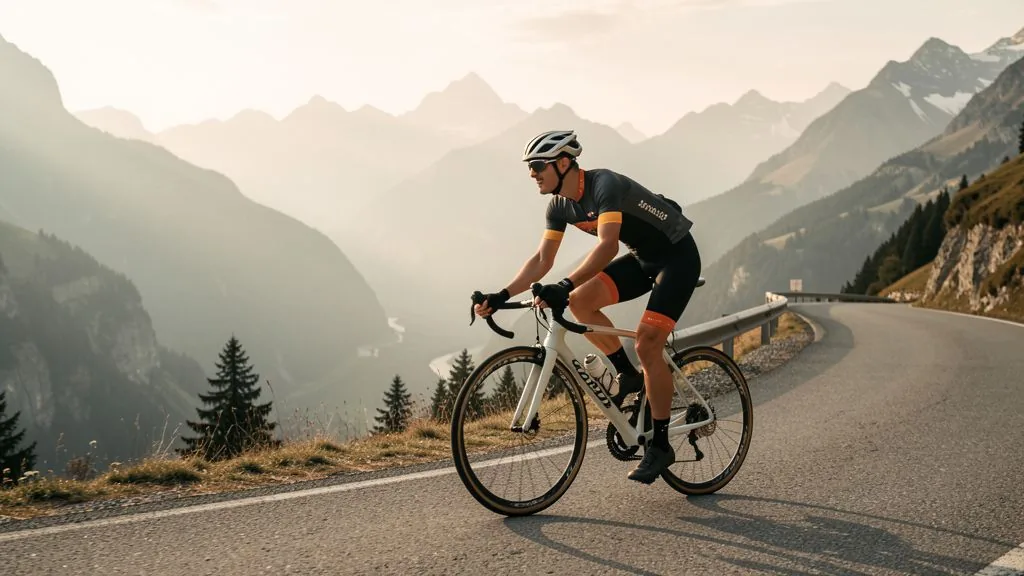
A gran fondo lasts four to six hours. Your glycogen stores are good for about 90 to 120 minutes — after that the body runs on whatever you feed it while riding. Improvise here and you will routinely lose 20 to 30 watts in the final 50 kilometres, often more. This article shows how much you actually need, when to eat, and how to prepare your gut for it.
Why a gran fondo is an eating contest
Of the roughly 2,000 to 2,500 kilocalories a 75-kilogram rider burns in five hours in the mountains, the largest share comes from carbohydrate. Muscle and liver stores together hold around 400 to 500 grams — roughly 1,600 to 2,000 kilocalories. Mathematically that is not even half the ride. If you then eat only half of what you burn, you spend the last two hours on empty: heart rate climbs, power drops, pace collapses. That is why you lose a gran fondo not on the climb but in your jersey pocket.
The three variables: carbs, fluid, sodium
Gran fondo fuelling is three-dimensional, and all three depend on each other:
- Carbohydrate: 60 to 90 grams per hour. This is the lever with the biggest effect, because it refills your stores directly.
- Fluid: 500 to 750 millilitres per hour in moderate conditions, up to a litre in the heat. Too little costs performance, too much causes stomach problems.
- Sodium: 300 to 800 milligrams per litre of drink. It keeps the fluid you drink inside your bloodstream — without sodium it passes straight through.
A practical trick for planning: work with an hourly rate rather than a total amount. That reduces a gran fondo to a single checklist you can simply work through.
A five-hour fuelling plan with real numbers
For a 75-kilogram rider targeting five hours, a worked plan looks like this: 85 grams of carbohydrate per hour gives 425 grams, or 1,700 kilocalories, across the whole ride — on top of your stores. At 650 millilitres per hour you drink 3.25 litres. With 750-millilitre bottles that is a little over four bottles; a course with three aid stations is therefore manageable without outside help.
Translated into kit, that means three to four 25-gram gels per hour, or a mix of one bar and half a litre of sports drink. Here is the maths for a 90-gram-per-hour target:
- One bottle with 80 grams of maltodextrin (around 700 ml) delivers roughly 80 grams of carbohydrate.
- Two 25-gram gels add 50 grams.
- Half a 40-gram bar closes the gap to the 90 grams you are aiming for.
The crucial point is that you only tolerate a high intake rate if you are used to it. The gut absorbs carbohydrate through two transporters — SGLT1 for glucose, with a ceiling around 60 grams per hour, and GLUT5 for fructose. Combine both sugars in roughly a 2:1 ratio and you can push past that ceiling towards 90 to 120 grams per hour. Pure glucose drinks at high doses, by contrast, are a recipe for nausea.
When to eat: consistency beats big portions
The most common mistake is not the amount but the timing. Skip everything for two hours and then try to catch up at kilometre 100 and you overload the stomach and lose exactly the time you were trying to make up. The gran fondo rhythm is: a small unit every 20 minutes, so three portions per hour. Ride the first hour conservatively and start your first portion 20 to 30 minutes after the gun.
Tolerance shifts during the ride. As long as intensity stays low, the stomach handles solid food reliably. Push above threshold — on a climb, in the wind shadow of a group or in the final sprint — and blood flow to the digestive tract drops, so the stomach suddenly works far more slowly. That is why you eat before the climbs and in calm sections, never mid-climb. Ride too hard early on and you will not eat properly afterwards — and you will fade later.
Which fuelling for which distance
- Up to two hours: water plus a drink with 30 to 60 grams of carbohydrate per litre is enough. Solid food is optional, one gel as a reserve.
- Two to four hours: 60 to 75 grams per hour, plus bars and bananas. Ride the first half on solid food, the second on gels.
- Over four hours: 80 to 90 grams per hour. Solid food for the first two to three hours, then mostly liquid — gels, drinks, soft bars.
- Mountain gran fondo: plan intake during the climb too, but in small portions at the lower end of the intensity range. Eating at the summit is difficult; just before it usually works.
Using the aid stations properly
A gran fondo is not a time trial — the checkpoints are part of the plan. Stop briefly, grab bottles and solid food, and only start eating once you are rolling at 30 to 35 kilometres per hour again. That is when stomach and digestion return to normal. Be careful with unfamiliar products: bolting down an unknown bar from a buffet is exactly the mistake that can ruin an otherwise perfect day. Where you can, ride with your own supplies and use the stations mainly to top up water.
Carbohydrate intake is only one part of the picture: sodium, potassium and magnesium matter on long rides, especially in the heat, and belong in any fuelling strategy. And if you are building towards the race through winter, indoor trainer training lets you control and rehearse your intake in steady sessions far better than on the open road.
Train the gut: your stomach has no race day
Every number in this article is theory until you have tested it in training. "Train the gut" is arguably the most underestimated form of training for long cycling races: over weeks, the gut is accustomed to high carbohydrate loads, high fluid volumes and the specific product involved. The adaptations are real — gastric emptying speeds up and the gut absorbs carbohydrate more effectively at the same intake.
How to build it: on every long ride, use exactly your race setup — same products, same intake rate, same drinking rhythm. Increase the amount slightly every two to three weeks, and in week four, build in a check by pushing your intake 20 percent higher for ten minutes. If you digest that, you can adjust the rate for the next ride.
The most common mistakes
- Waiting for thirst. On a gran fondo, thirst is a late signal — by the time it appears you are already several hundred millilitres behind. Drink to a plan, not to feel.
- Experimenting on race day. New products, new gel flavours, new powders are off limits. Everything is tested in long rides beforehand.
- Trying to eat at the summit. Digestion is reduced on a climb. Force your portion there and you risk nausea — eat before or shortly after instead.
- Four hours without solid food. Gels alone leave many riders feeling bloated. Solid food in the first half improves tolerance in the second half.
- Carbs without sodium. Plain water with a high carbohydrate concentration irritates the stomach. The drink needs sodium and a concentration of no more than eight percent.
How Peakora plans your fuelling with you
In Peakora, fuelling is a variable in its own right inside the training plan: the fuelling calculator derives how many carbohydrates and how much fluid you need per hour from your goal time, weight and course profile. For long bike sessions you also get a recommendation-based intake strategy with matching amounts of gel, bar and drink. So you rehearse your intake through winter and start your gran fondo on exactly the same concept — instead of improvising on race day.
Frequently asked questions about gran fondo nutrition
How many carbs per hour do I need for a gran fondo?
For a gran fondo lasting over four hours, 80 to 90 grams of carbohydrate per hour is the target range — provided your gut is trained for it. Beginners should start at 60 grams per hour and build up over several weeks of long rides.
When should I start eating during a gran fondo?
Start 20 to 30 minutes after the gun and then eat a small portion every 20 minutes. If you wait until you feel hungry you are already behind — consistency matters far more than the size of any single portion.
Are gels enough for a gran fondo or do I need real food?
For the first two to three hours, bars, bananas and rolls are well tolerated and more satisfying. From the fourth hour onwards solid food often sits heavy, so switch to gels, drinks and soft bars. Whatever you choose must be tested in training first.
How much fluid and sodium do I need on the bike?
A practical range is 500 to 750 millilitres of fluid per hour with 300 to 800 milligrams of sodium per litre. In the heat and at a high sweat rate the requirement is considerably higher. Measure your sweat rate by weighing yourself before and after a long ride.
Start your gran fondo with a fuelling plan
The Peakora fuelling calculator gives you carbohydrates, sodium and fluid per hour — matched to your goal time and course profile. Start for free, no credit card required.
Start for free