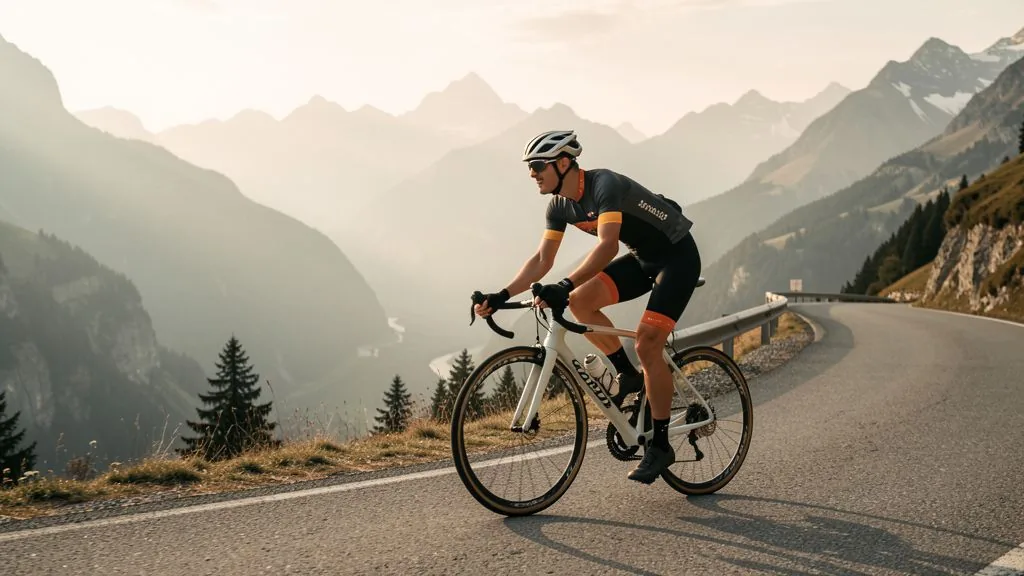
There is one skill in cycling that costs no watts and still saves more time than any new aero wheelset: cornering. A single corner ridden badly on a descent wipes out the lead you built over an hour of climbing. Riders who master corners go faster, ride safer and need not one extra kilometre of training to do it.
Why corners save more time than more power
Uphill your power limits you, downhill your air resistance limits you — and in a corner your technique limits you. On a 500 metre descent with four bends, a clean rider is 60 to 90 seconds ahead of an unsure one. In power terms that is roughly 15 to 20 watts over a full hour. You do not gain that time by pedalling harder, you gain it through confidence, line and vision. The difference comes down to three things: how much speed you carry, when you brake and how early you put power back into the chain.
That is why cornering is training science. It is as learnable as an interval and belongs in every season build — for some riders it delivers more than an extra block in the hills. What sits on the other side of your performance, the engine, is mapped out in the Gran Fondo training plan.
The physics: radius, lean angle and grip
A corner is pure geometry. The force that holds you in the lean comes from the grip between tyre and tarmac. Two quantities decide how fast that allows you to go:
- Radius: double the corner radius and roughly double the speed becomes possible. That is exactly why the ideal line matters so much — it enlarges the radius without changing the corner.
- Lean angle: in a corner you experience two to three times the force of gravity. You can influence lean and therefore grip with your body weight, by leaning into the corner off the saddle instead of clinging on upright.
The real limit is not the physical optimum but sight distance. You must never be faster than you could brake within the road you can see. On a road with oncoming traffic, loose gravel or an unknown course, sight is the hard limit — not your courage and not tyre grip.
A second factor that gets overlooked: tyre pressure. A tyre pumped too hard no longer absorbs imperfections, loses contact and slides sooner. How to set it correctly is covered in setting the right tyre pressure.
Vision: you ride where you look
The most important tool for cornering is your gaze, not the handlebar. Where you look is where you end up — a reflex you cannot switch off. Riders who stare into the corner instead of at the exit will correct their line unconsciously and lose time.
Three rules:
- Look far ahead. Your gaze belongs on the point where you want to arrive — the apex, then the exit. At least 10 to 20 metres further than it feels.
- Rotate your head into the corner. Not just the eyes but the head, by 5 to 10 degrees with the turn. That keeps the movement coordination in balance.
- Relax shoulders and grip. Riders who shrug their shoulders up and clamp the bars steer worse and cannot feel grip. Quiet shoulders are a marker of good cornering.
Vision applies to the rest of the body too: the hips follow the upper body. If you only turn the bars and keep your torso upright, you are not really in the corner but on top of it.
The ideal line: outside – apex – outside
The ideal line is the link between physics and practice. It uses the full width of the road to enlarge the radius — and thereby raises the possible speed. It runs in three steps:
- Approach from the outside. Before the corner ride as far to the outside as possible without touching the oncoming lane. That lengthens the path into the corner and creates radius.
- Turn in late. Do not rotate early at the corner entry, but deliberately wait until you are actually in the turn. That shifts the apex inward and later.
- Apex inside, exit outside. In the middle of the corner your front wheel touches the inside edge, then you carry the line back out again. From that position you can accelerate early — that is exactly where the time is made.
This line has a psychological side effect that helps beginners in particular: because you turn in late and carry wide, you have the exit in view the whole way through. The line that feels unsafe in your head is the controllable one in reality.
Important for public roads: the ideal line is a race technique concept, not a licence. With oncoming traffic, poor sight or in a group, ride so you could stop at any time — and stay on your side instead of using the oncoming lane.
Braking: all of it before the corner
The most common reason for a front wheel washing out in a corner is braking while leaned over. Physically the tyre has only a limited grip reserve: it splits it between cornering force and braking force. Doing both at once works only up to a total. Pull the brake mid-lean and you take force away from grip.
The clean sequence is therefore: brake — turn in — do not brake — accelerate. In practice:
- Brake firmly. Before the corner entry scrub down to the speed you want to exit with, not the speed you arrived with.
- Front-wheel biased. Two thirds to three quarters of braking comes from the front wheel; you meter it with your index finger while the rear only stabilises.
- Longer distance when wet. On wet roads or gravel braking distance increases by 30 to 50 percent, the centre of mass moves further back from the bars and the rear brake takes a larger share.
- Do not drag the brake. A brake dragged through the whole corner is the surest route to a crash. If the corner tightens while leaned over, brake once firmly and release again. A short, firm impulse beats constant correction — that keeps the grip reserve intact.
- Watch carbon rims. With carbon rim brakes, dragging pushes rim temperature above 120 degrees, which changes the pad and the behaviour. Better to brake firmly and briefly every 200 to 300 metres than lightly and continuously.
Riders who master the braking point never need to exceed it in an emergency. That is the real composure in a race: not the latest brake, the most controlled one. How to build the rest of your race tactics on top of it is in road race tactics.
Body position and pedalling through the corner
Body work in a corner is active riding, not passive steering. Four points:
- Weight in the pedals, not the saddle. Standing out of the saddle unloads the bike and lets it work; your legs and arms provide the suspension, not your back.
- Inside pedal up, outside pedal down. That way you do not clip the ground and you push the bike into the turn instead of standing it up.
- Lean into the corner. Part of the weight shift goes through the upper body towards the inside, part through the inside leg. That keeps the bike's lean angle predictable.
- Stay low and quiet. A low position is not reserved for descent specialists — low and quiet means better control and a smaller frontal area.
Cornering practice: how to learn it deliberately
Cornering is not learned on the trainer, only in the corner — ideally systematically. A proven structure for a session:
- Pick a stretch. A descent or mountain pass with two to four kilometres and several consecutive corners, dry, with good sight lines and little traffic.
- Do repeats. Ride the descent 10 to 12 times. Work on ONE element per repeat: vision one run, line the next, braking point the next.
- Get faster systematically. Start at easy speed, then step it up slightly piece by piece. Never go faster on a hunch.
- Always with a partner or group. With an experienced rider ahead showing you the line you learn fastest. Agree a regroup point so nobody is dropped at the bottom.
- Check pressure and grip. In cool or damp conditions lower the pressure slightly beforehand, because grip falls with temperature.
Such a session belongs in the base phase, when volume is the priority. It costs almost nothing metabolically but produces a very high learning effect. The ideal form is a recovery ride with cornering practice inserted. How to dose active recovery correctly is in active recovery.
Common mistakes
- Turning in too early. Shrinking the radius forces a later correction. That costs composure and time.
- Braking in the corner. The classic and most dangerous mistake — taking force away from grip at the exact moment you need it most.
- Clamping the handlebar. A stiff, clenched upper body blocks the weight shift and makes the bike nervous.
- Staring at the head unit. In a corner physics matters more than numbers. Checking your speed at the entry means looking the wrong way.
- Practising without a system. Collecting descents without isolating a single element just repeats the same mistake over and over.
Where cornering fits in your plan
Cornering is not fitness, it is a skill — and therefore a training goal with its own logic. It costs almost no Training Stress Score but is valuable in every phase. In Peakora the engine schedules skill sessions preferably into sessions with an easy target, because the adaptation there runs through movement rather than through performance. When acute load (ATL) rises too fast the engine moves hard intervals back, but skill work can stay — it creates little metabolic stress. Why not every session is a fitness gain, and how fitness, fatigue and form relate, is explained by CTL, ATL and TSB in the training glossary.
For gran fondo riders, cornering is also the factor that reliably saves time in every key descent — and the more common source of error in a group: a rider who is not confident in the line endangers not just themselves but the whole field behind them.
Frequently asked questions about cornering
How do you ride a corner correctly on a road bike?
Approach from the outside, turn in late, hit the apex in the middle of the corner and only accelerate afterwards. All braking happens before the turn-in point — in the lean there should be almost none.
How fast can you take a corner on a road bike?
Speed depends on radius and grip: double the radius allows roughly double the speed. The hard limit is sight distance — you must never be faster than you could brake within the distance you can see.
Why does my front wheel slide out in a corner?
Almost always because of braking while leaned over. The front tyre has only a limited grip reserve: pulling the brake mid-corner takes force away from grip. The second most common cause is too high tyre pressure.
Which pedal stays up in a corner?
The inside pedal stays up while the outside pedal stays down and carries the weight. That way you do not clip the ground and you push the bike into the turn instead of standing it up.
Skill and fitness in one plan
Peakora schedules skill sessions exactly when your form allows them. Start for free, no credit card required.
Start for free