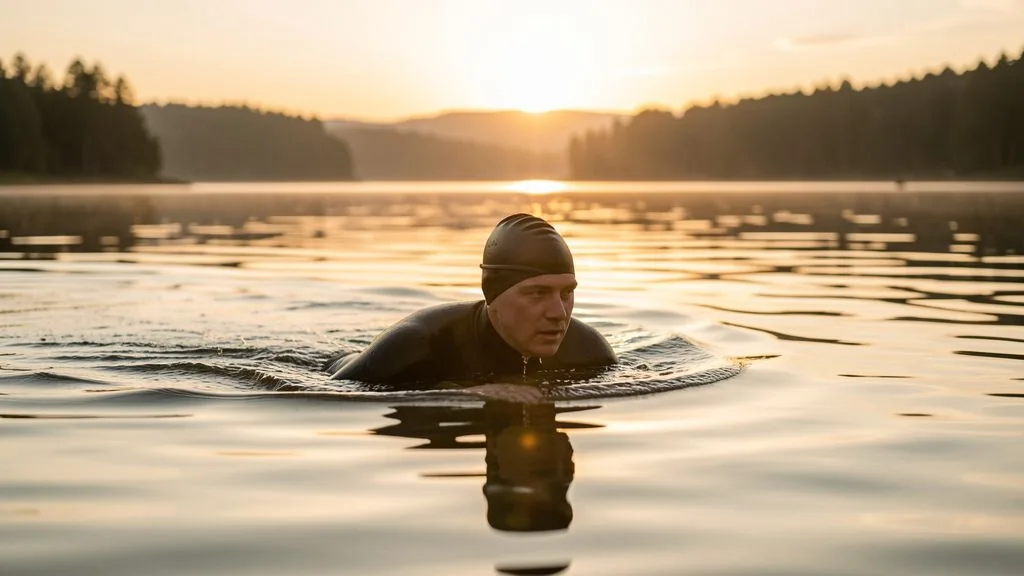
When your shin complains, your knee stabs on every stride, or three straight weeks simply do not allow running miles, there is one training method that delivers exactly what runners need in that situation: aqua jogging, also called deep water running. You run in deep water with no ground contact — same movement pattern, almost no impact forces, and an aerobic stimulus that comes surprisingly close to running on land. For many runners it is the most elegant answer to the question of how to keep fitness alive when running itself is off the table.
What aqua jogging actually is
Aqua jogging is not water aerobics. It is a running movement pattern in deep water: the torso stays upright, the arms swing as they do when you run, and the legs complete a full running cycle — knee lift, lower leg extension, heel pulled back toward the glutes, then the next stride. You either wear a flotation belt that keeps you safely afloat or hold on to the pool edge. What you do not do is touch the pool floor or push off with your feet.
The distance between your feet and the pool floor should be at least a hand's width on every movement. That is the difference from the shallow version done only hip-deep: with ground contact a scuffing, jarring motion appears that loads the pelvic floor connective tissue far more than it helps. Deep water means no impact and no shear, yet a full movement cycle with water resistance in every direction.
What the research says
The most frequently cited evidence comes from a study with well-trained runners who could not do any land training for six weeks because of injury. The deep water group trained four to five times per week with aqua jogging, plus only two easy land runs per week. The result: 5 km race pace was preserved, as was maximal oxygen uptake — performance stayed almost completely intact even though actual running load had nearly disappeared for weeks.
Similar findings come from programmes using an underwater treadmill or aqua jogging for foot and lower leg injuries: endurance values hold and sometimes even improve, and the return to running goes faster because the affected tissue can heal while unloaded. In practice this means that anyone who follows the aqua training discipline at a comparable frequency loses almost no conditioning during a multi-week break. Anyone who treats it as an occasional change of scene loses it just as with any other session done too rarely.
Why cadence matters in the water too
The obvious mistake in the pool: big, slow strides with long pauses underwater. That produces a relaxed paddle rather than a training stimulus. Instead, copy the stride pattern you use on land. Most runners sit at 170 to 180 steps per minute; a cadence of 160 to 170 is a good starting point in the water, because lower gravity lets the legs fall back a little more slowly.
Checking it is simple: count the right leg's steps for 30 seconds and multiply by four. Alternatively, waterproof metronomes attach to a goggle strap and dictate the beat. A metronome turns aqua jogging technique into something you can control: if cadence stays constant, the movement stays clean. To go faster, work with higher knee lift and shorter ground contact times — not with a longer stride, because water resistance limits that anyway.
Torso posture plays a role as well. A slightly forward-leaning upper body, an active hip and a lower back that does not sag are more demanding in water than on land, because the flotation belt does not take over the entire stabilising job. And that is, incidentally, one of the most interesting side benefits: aqua jogging is core and hip training that does not feel like strength work.
Pacing without a watch
The watch fails quickly in water — heat is carried away much more effectively than on land, so heart rate sits roughly 8 to 13 beats lower at the same effort. Anyone aiming for the same numbers as on the road trains far too hard. Pace by feel instead: easy aqua jogging is a pace at which you can speak in long sentences without effort; brisk aqua jogging allows only single words, the classic threshold effort.
For intervals, use time blocks rather than distances, because the "distance" covered in water is barely comparable: 1 minute hard, 1 minute easy — then progressions such as four, six or eight repetitions. A rough conversion rule: ten minutes of moderate aqua jogging is worth roughly one easy running minute in training effect, with a slight shift upward — water resistance is harder than it looks.
How an aqua session is structured
- Warm-up (10 minutes): Easy aqua jogging with a small range of motion to ease heart rate and joints into water resistance. Warm up in the water, not on land.
- Aerobic main set (20–30 minutes): Steady, medium knee lift, breathing controlled. Keep the same cadence you use for easy running.
- Main set with intensity (15 minutes): Four to eight reps of one minute brisk with equal easy recovery. Arms work actively, as if you were running uphill.
- Technique block (5 minutes): Short 15-second efforts with deliberately high cadence — keeps the fast stride pattern present without building fatigue.
- Cool-down (5 minutes): Very easy, then shake out and mobilise the legs briefly. The water cools you down fast, so do not stand around in a wet swimsuit afterwards.
Placing aqua sessions in your plan
There are three typical uses. First, as injury replacement: when a running-related issue — shin splints, a stress reaction, plantar fasciitis, significant sacroiliac problems — rules out running for two to six weeks, aqua jogging replaces the missed sessions almost one for one and keeps the aerobic base. Second, as a cross-training session in hard weeks: if you already ran in the morning, an evening session with no impact adds a stimulus without adding further leg fatigue. The risk of doubling up lies in the sum of weekly stress, so treat it like any other session and count it.
Third, as preparation for water-based sport: working toward a first triathlon, where water is part of the race, aqua jogging comes with a useful side effect — comfort in the water, body position and temperature management. The focus, however, always stays on running simulation, not on swimming. As a rule: two replacement sessions per week are usually enough to hold endurance meaningfully. For marathon-specific sharpening, land training remains the tool of choice as soon as the injury allows.
Common mistakes
- Jogging in hip-deep water. If your toes reach the floor, the scuffing motion appears — and the pelvic floor takes exactly the shear it was supposed to avoid. Always deep water, no ground contact.
- Strides that are too slow. Big, lazy movements without rhythm are endurance training at half effect. If you do not hold cadence, you are not training running in water, just water aerobics.
- Training by heart rate. The lower water heart rate tempts you into working far too hard. Breathing and talk-test pacing are more reliable than any wrist display.
- Dropping land training entirely. Aqua jogging replaces endurance, not running technique and not the connective tissue's impact tolerance. As soon as the injured tissue allows it, a measured amount of land training belongs back in the plan.
- Training too rarely. One or two sessions per week keep no form. Injury replacement needs the same frequency as before — usually four to five sessions.
How Peakora handles it
In Peakora, aqua jogging is deliberately supported as an alternative: if a run is dropped due to discomfort, you log the aqua session with its duration and intensity — the engine converts it into training stress (TSS) with an adjusted load factor. That keeps your fitness (CTL), fatigue (ATL) and the TSB derived from them realistic instead of collapsing because sessions went missing. You can see in plain numbers that fitness is holding through the break, and you know when returning to land training is defensible. Peakora is not a medical diagnostic tool — it does not replace a doctor's assessment, but it keeps the plan meaningfully alive through a forced break.
Frequently asked questions about aqua jogging
What does aqua jogging do for runners?
Aqua jogging keeps aerobic fitness close to land training levels without the impact forces of running. In a classic deep water running study, 5 km race pace was preserved after six weeks of aqua jogging, even though land running was cut back to twice a week.
Can aqua jogging fully replace running?
For a limited period, yes — endurance holds up, but running technique, foot stability and the connective tissue's tolerance of impact need land stimulus. It is very effective for two to six weeks of injury downtime, but not a permanent sole replacement for marathon training.
How deep does the water need to be for aqua jogging?
Deep enough that your feet never touch the bottom, not even on your toes. Your feet stay off the floor on every stride. Only that depth makes the session joint-free and prevents the typical scuffing movement against the pelvic floor.
Why is aqua jogging so hard?
Because water resists every movement and heat is carried away far better than on land. At the same perceived effort your heart rate sits roughly 8 to 13 beats lower. That is why you pace aqua jogging by breathing and feel, not by heart rate.
Plan your training with Peakora
Injury break or hard week — Peakora keeps fitness and plan together. Start free, no credit card required.
Start free