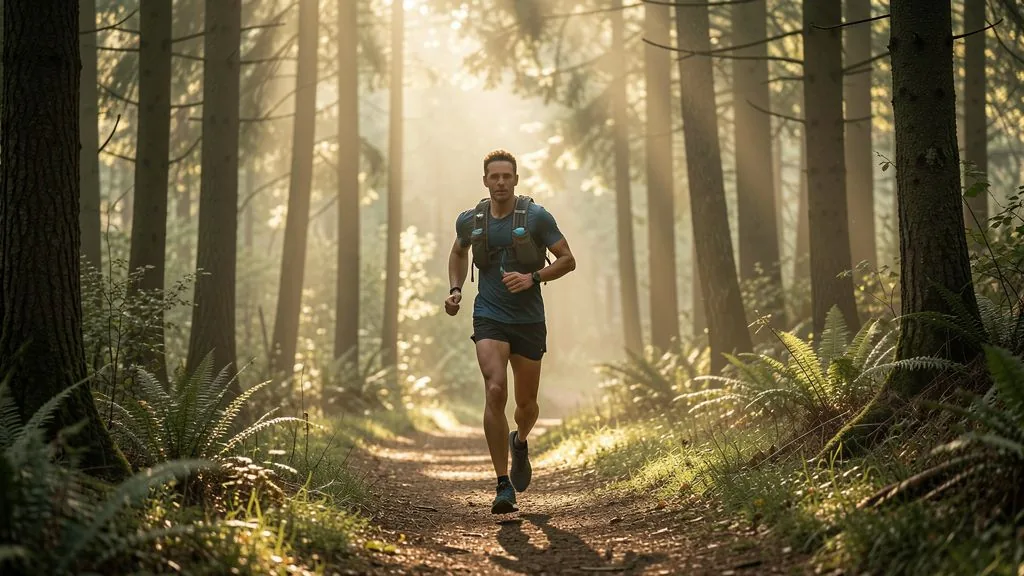
A training run should strengthen your lungs — on some days it measurably irritates them instead. During one hour of hard endurance work an adult breathes in 2,000 to 3,500 litres of air; a marathon moves more than 10,000 litres through the airways. If that air carries fine particulate matter, ozone or wildfire smoke, part of it travels deep into the respiratory tract — exactly where gas exchange and performance are built. The good news: you do not have to cancel training. You only need to know when running as planned is fine, when to cut intensity and duration, and when a treadmill session or a rest day is the more intelligent training decision.
What particulate matter does inside your body
PM is not a single substance but a mixture of soot, mineral dust, tyre wear, ammonium salts and organic compounds. Size decides everything. PM10 (particles up to 10 micrometres) mostly sticks in nose and throat. PM2.5 (up to 2.5 micrometres) reaches the bronchi and alveoli, and ultrafine particles below 0.1 micrometres cross into the bloodstream. Those small fractions turn air pollution into a systemic irritant — they reach not only the lungs but also the heart and blood vessels.
Three pathways do the damage: particles create oxidative stress in the airway lining, they trigger a local inflammatory response, and they reflexively narrow the bronchi. For endurance athletes the third point is the most noticeable. Airways react more sensitively on polluted days, the work of breathing rises, and if you already have exercise-induced asthma or seasonal allergies, tolerance for hard intervals drops sharply. There is a fourth effect few people consider: mucosal and immune recovery runs slower on those days because part of your resources goes into inflammatory defence. The logic is the same as in recovery — a stimulus only counts with the adaptation it allows.
Reading the AQI: the numbers that matter
Air quality indices look complicated because every region uses its own scale. For training you only need one: the US AQI based on PM2.5, which weather apps and air quality services display. It condenses the particulate concentration into a number between 0 and 500, and the bands are comfortingly coarse:
- 0–50 (good): Ideal conditions. Everything runs as planned, including hard sessions and races.
- 51–100 (moderate): Unproblematic for healthy athletes. Sensitive individuals should move the hardest session of the week by a day.
- 101–150 (unhealthy for sensitive groups): Easy aerobic runs remain reasonable, but shorten threshold intervals. Asthmatics, allergy sufferers and anyone coming back from an infection should train indoors.
- 151–200 (unhealthy): Short, easy sessions only, or the treadmill. No tempo work, no long runs.
- 201+ (very unhealthy to hazardous): Cancel outdoor training. Anyone wanting to train that day goes inside.
For converting into particle mass, the rule of thumb is: AQI 100 equals roughly 35 micrograms of PM2.5 per cubic metre, AQI 150 around 55 micrograms. For comparison, the EU annual limit for PM2.5 will sit at 10 micrograms from 2030, the WHO recommendation at 5 micrograms. Cities reach 15 to 30 micrograms on ordinary autumn days — permanent moderate values that are entirely compatible with normal training volume. The peaks are what matter: temperature inversions in valley basins, New Year fireworks, wood smoke in winter, Saharan dust in spring and wildfire smoke in summer reach 100 to 300 micrograms and more.
Ozone: the invisible summer culprit
You can see particulate matter; you cannot see ozone. Ground-level ozone forms from nitrogen oxides and volatile organic compounds under UV radiation, which is why its daily peak sits between noon and 6 p.m. — and why the hottest, sunniest afternoon is the worst time slot for hard endurance work. Unlike particles, ozone irritates the airways chemically and directly: it can cause burning, a cough reflex and measurably reduced lung function, some of it appearing only 6 to 24 hours later. Studies show maximal oxygen uptake falling by roughly 2 to 5 percent when training in high ozone — enough to make a tempo session fail for reasons that have nothing to do with your legs.
The practical consequence for summer is simple: move quality sessions to the early morning. Between 6 and 9 a.m. ozone levels are lowest, temperatures moderate and traffic light. In sustained heat the rule from the heat training guide applies anyway: intensity early in the session, duration short, and adapt a day too early rather than abort a day too late.
Wildfire smoke: when visibility becomes the signal
Smoke from wildfires is its own category, because it carries not only extremely high particulate loads but also carbon monoxide and a long list of organic irritants. PM2.5 levels in smoke can reach ten times a normal summer day. The most practical everyday rule is visual: if you can smell smoke and the horizon is only two to three kilometres clear, particle concentrations are usually high enough to end intensive training. In smoke, conditions are also strongly layered — concentrations can be thinner at ground level than at 10 metres, and smoke pools in valleys and basins far more than on ridges. The AQI map for your region gives you the binding number.
Five rules for training in polluted air
- 1. Check the AQI like the temperature. A weather app with an air quality display is enough. Check the value for your training time, not for right now — PM has two daily peaks, a morning one after inversion nights and an evening one with traffic and domestic heating.
- 2. Cut intensity instead of cancelling. If the value is borderline, swap intervals for an easy run. Inhaled particle dose scales more with minute ventilation than with distance covered — 40 easy minutes cost less than 25 minutes at threshold pace.
- 3. Side streets over main roads. Concentrations directly beside a busy road are clearly higher than 20 to 30 metres further in or on a parallel street. Parks, forest paths and river banks are the first choice on polluted days — measurably, not just aesthetically. In rural areas your own wood stove and the village main road mark the spots to avoid.
- 4. Inside is a full-value alternative. Treadmill, turbo trainer and the gym deliver the same physiological stimulus on heavily polluted days at a fraction of the particle dose. A treadmill session is not a compromise, it is the correct training decision. Just as useful: shift the structure of your week by a day when the weather situation is already forecast.
- 5. Never two hard days back-to-back in bad air. The airway inflammatory response lasts 12 to 24 hours. Two consecutive quality sessions under high values add up, whereas the same two sessions 48 hours apart deliver the same adaptation with far less irritation.
What this means for your training plan
Anyone living in a city, a valley basin or a region with frequent inversions needs a plan that can be arranged around environmental conditions rather than against them. Three building blocks have proven themselves:
- Put quality work in the morning. Between 6 and 9 a.m. ozone, traffic and temperatures are lowest. Schedule your threshold session there and you improvise on fewer days.
- Define fixed indoor windows. One planned slot per week (treadmill, trainer, circuit) that can be pulled forward when needed. An outage then costs no training at all, and weekly load stays stable.
- Build flexibility into the week. When a session is postponed, the following week should not immediately get harder. The principle that weekly load jumps above 20 percent raise injury and fatigue risk applies here too.
This is steered precisely with the metrics Peakora already uses. Instead of executing rigid calendar days, weekly load is distributed across what is actually feasible — sessions can move without the system rebuilding the entire plan, because your fitness curve (see CTL, ATL and TSB) sets the frame. Anyone working along the lines of adjusting the training plan loses practically no fitness from a postponed session — but loses several weeks quickly to forced heroics in smoke and heat.
Frequently asked questions
At what AQI should I stop running outdoors?
From a PM2.5 level of about 55 µg/m³ — the unhealthy AQI band — move hard sessions indoors. Above AQI 150, train inside or skip the session altogether: every minute outdoors is a genuine load on your airways.
Is running in polluted air worse than cycling?
Yes. Runners move 10 to 20 times more air per minute than a seated person and breathe mostly through the mouth at high intensity. The higher your ventilation, the more particles and ozone reach the lower airways — the same route by bike costs far less minute ventilation.
How long do the lungs need after a run in polluted air?
Airway inflammation markers stay elevated for 12 to 24 hours. Never schedule two demanding sessions on consecutive high-pollution days. That recovery is part of training control, not lost time.
Do masks or nasal breathing help when running in smog?
A simple surgical mask only filters coarse particles and gets damp fast when you run. Nasal breathing lowers ventilation and intake somewhat but is no substitute for a filter. The most effective measures remain moving the session indoors or shifting it to a cleaner time of day.
Does air pollution really cost performance?
Yes, measurably. In high particulate and ozone conditions maximal oxygen uptake drops by roughly 2 to 5 percent, and season comparisons found 1 to 3 percent performance differences between training locations with clean versus polluted air.
Your plan adapts to the day, not the other way round
Peakora moves sessions when weather or air quality argue against them and keeps your weekly load stable while doing so — without rebuilding the whole plan. Start for free, no credit card required.
Start for free