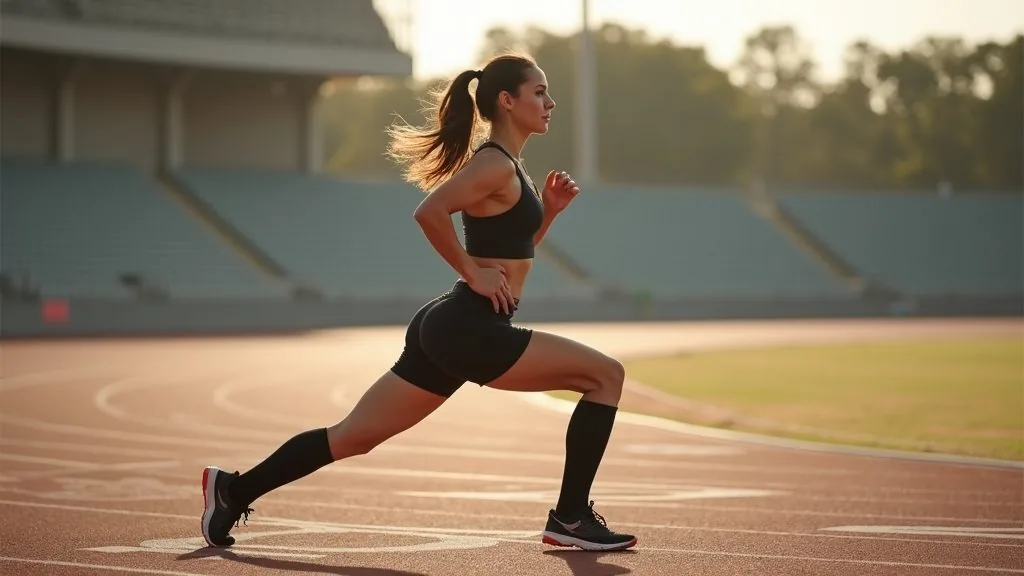
No piece of gear is chosen wrong as often as the sports bra — and few have such a direct effect on comfort, posture and complaints while running. The breast is not a rigid part of the body: with every step it moves in three directions, and without good support by several centimetres per stride, thousands of times per run. This article explains what happens inside the body, how to find your correct size and support level, how compression and encapsulation designs differ, and which mistakes make even the best bra ineffective.
Why the sports bra is not a comfort issue
The female breast has no muscle of its own to support it. It hangs on the skin and on the Cooper's ligament apparatus — a network of connective-tissue strands that anchors the breast to the chest wall. That tissue is elastic, but it was never built to absorb thousands of impact movements per run. Running demands exactly that: with every foot strike a vertical acceleration occurs that sends the breast swinging up and down.
The movement does not happen only vertically. It runs along three axes: vertical (up and down), lateral (side to side) and anteroposterior (forward and back). Biomechanical studies show that vertical displacement rises sharply with pace — a few centimetres at an easy jog, up to around ten centimetres at fast running without support. The entire weight of the breast accelerates and decelerates with every step, up to roughly 180 times per minute. Over an hour-long run that is more than 10,000 impacts.
The consequences are more than unpleasant. First, mechanical strain: repeated tensile loading can permanently over-stretch the Cooper's ligament apparatus — an effect that is not reversible. Second, back pain: unsupported breast movement is often followed by a compensatory posture with a tense shoulder and neck area. Third, chafing: when tissue moves, skin surfaces rub against each other, causing raw spots under the breast and at the straps. And fourth, the psychological side — anyone who feels insecure around the upper body runs more tensely and unconsciously makes running movements smaller.
What the research shows about sports bra function
The evidence is clear and rarely disputed on this point. Even loosely fitting sportswear reduces breast movement — a properly sized sports bra lowers it by about 50 to 60 percent on average, and an encapsulation design with good support by up to around 70 percent in individual studies. An important caveat: reduced does not mean eliminated. Full support is physically impossible when running, but the difference between "barely reduced" and "two-thirds less" decides how a run feels.
A second finding concerns fit as a first-order problem. Surveys suggest most female athletes wear the wrong bra size — over 80 percent in some studies. The typical pattern: band too large, cup too small. This is especially harmful because most of a sports bra's support comes from the underband, not the straps. A band that is too loose cannot stabilise the breast, no matter how well the design is built.
A third point: self-perception deceives. In studies many runners overestimate the fit of their bra, while objective measurements show significant movement. The jumping test in the fitting room (see below) closes this perception gap more reliably than the feeling of a quiet try-on.
Finding your size: the two measurements
A sports bra starts with two numbers you can measure yourself at home. You need a flexible tape measure and — ideally — a second person.
- Underbust (band) circumference: Measure firmly, directly under the breast, parallel to the floor, after fully exhaling. This measurement determines the band size and therefore the most important part of the support.
- Bust circumference: Measure at the fullest point of the breast, also level, without inhaling or holding your breath. The tape should sit against the skin but not dig in.
The difference between the two values gives the cup size (roughly 2.5 cm per letter: 10 cm ≈ AA, 12.5 ≈ A, 15 ≈ B, 17.5 ≈ C, 20 ≈ D, 22.5 ≈ DD/E). An example: a 78 cm band and 93 cm bust would give a difference of 15, a B cup. With sports bras the calculation goes one step further: because the band provides most of the support, you often choose a band number one size smaller than your everyday bra. If you wear 80B in everyday life, a sports bra in 75B is often the better starting size. When the band number drops, the cup usually grows by one letter so the volume stays the same — 80B therefore corresponds more to 75C.
Two checks belong to the measurement. First the band: it should sit level and not ride up at the back — a band that slides upward means it is too loose. Second the straps: they carry only the smaller share of support and must not bear the main load. If you constantly have to pull them up, you do not have a strap problem but a band problem.
Compression vs. encapsulation designs
There are two basic construction principles that feel different and suit different sizes.
- Compression bras press the breast flat against the chest. They are usually light, simple and inexpensive. The advantage: vertical movement is reduced. The drawback: the breast is not held separately, which is less stable for larger cups and can chafe on long runs.
- Encapsulation bras hold each breast individually in its own cup construction, similar to an everyday bra. They offer more support, more even pressure distribution and better comfort for larger sizes and fast running. They are somewhat heavier and more complex to make.
- Hybrid designs combine both approaches: a supporting cup plus a compression layer over it. For most runners with medium and larger cup sizes this is the best compromise.
As a rule of thumb: for small cups (AA–B) and easy runs a compression bra is enough. From a C cup, or for tempo training and racing, an encapsulation or hybrid design pays off — here the construction decides whether the bra delivers what it promises. Combine the choice with how you think about running clothing as a whole: the bra is the first garment on which all other layers sit, so above all it has to fit.
Support levels and material
Sports bras come in three support levels: light, medium and high. Light support fits yoga and walking, medium support easy runs, high support fast running, intervals, racing and every cup size from C upward. When in doubt: for running, medium support is the minimum and high support the safe choice — the impact load is far higher than walking or cycling.
With material, what counts is elastic fibres and construction. A good sports bra needs a high elastane content (10 to 20 percent is common) so it provides support and keeps its shape. Straps of different widths and adjustable closures let you tune the fit. Wide, padded straps distribute the load, while narrow straps dig in with larger cups. There should be no hard edges at the armhole or under the band — any rough detail becomes a chafe point over thousands of contacts. Functional materials wick moisture outward; cotton soaks up and creates a friction problem.
The jumping test in the fitting room
The most important check takes ten seconds and can be done in any changing room: with the bra on, hop in place a few times or take a few sharp steps, then see what the bra does.
- What the test shows: the bra should clearly dampen the movement — not to zero, but visibly. If the breast still bounces or moves strongly in the bra, either the band size is too big or the support level too low.
- Check the band: you should be able to slide two fingers flat under the band. More room means too loose, no room means too tight. The band stays in place while you hop.
- Slipping and chafing: watch for straps that ride up, a band that climbs up the back or edges that already dig in after two minutes. These problems will only worsen on a real run — put it back immediately.
- Freedom of movement: raise your arms overhead, rotate your shoulders, make a running arm motion. Nothing should cut in or twist.
The jumping test is no gimmick. It simulates the impact load of running that a quiet try-on lacks — exactly why many runners discover at home that the bra does not hold up. If you are torn between two sizes in the test, take the smaller band size with the matching cup.
Mistakes that make the best sports bra ineffective
- Using the straps as the main support. Support comes from the band, not the straps. Loading the weight through overly tight straps buys you tension in the neck and shoulder girdle.
- Buying new shoes but wearing a ten-year-old bra. Elastic fibres age. After 6 to 12 months of regular wear or around 40 to 50 washes, elasticity measurably declines — then even a high-quality bra no longer supports.
- Not hopping before buying. Without the jumping test, the fit check does not reveal whether the bra holds up when running. The fitting room is the last chance to avoid a bad purchase.
- Washing in the dryer or with fabric softener. Heat and softener attack the elastic fibres and destroy the support. Always 30 degrees, laundry bag, no dryer.
- One bra for everything. Two or three models in rotation — one for easy runs, one with high support for fast training — last longer and suit different sessions better.
- Treating chafing with cream instead of fixing the cause. Against raw spots under the band, a thicker and thicker application does not help — a properly fitting bra plus a breathable shirt with a clean seam does.
Care and lifespan
A sports bra is a functional piece whose support declines a little with every wash. The rule of thumb: after about 6 to 12 months of regular wear or around 40 to 50 washes, it is time to replace the model — even if it looks flawless on the outside. How to spot the wear: the band has lost its elasticity, the straps ripple, the fabric at the underband is stretched out, or the shape has warped in the wash. Comparing it side by side with a new one often shows the difference shockingly clearly.
Three rules apply to care. First: wash at no more than 30 degrees, in a laundry bag or by hand — heat destroys elastane. Second: no fabric softener, no dryer; softener coats the fibres and takes away their elasticity, dryer heat speeds up wear. Third: wash or at least rinse after every run — sweat and salt attack the fibres, and in a damp environment they lose their tension faster. Rotating two or three sports bras lets each one recover between uses and significantly extends its life.
How Peakora plans training to match your gear
The sports bra is a detail, but a good example of how training planning and gear interact. The Peakora engine knows the difference between easy sessions and high intensity: for a relaxed distance run a medium support level is entirely sufficient, while intervals, tempo runs and races with their higher impact load call for a bra with maximum support. Just as the plan sets the intensity per session, it pays to match your gear to that intensity — not the other way around.
And because complaints in the shoulder and neck area accumulate over a training block, such signals feed into load management. If a particular model causes chafing or tension on longer runs, that points to a fit problem — not a training issue but a gear one that can be fixed quickly. For details on how Peakora brings load, recovery and daily form together, see the basic concepts of training control in the lexicon.
Frequently asked questions about the sports bra for running
Do I need a sports bra for running?
Yes — the breast has no muscular support and moves in three directions with every step. Without support, vertical movement can reach up to ten centimetres per stride at fast running speeds. A well-fitted sports bra cuts that movement by half to two-thirds, making it a health issue in endurance sport, not just a comfort one.
How do I find the right sports bra size?
Measure two values: the underbust (band) circumference and the bust circumference at the fullest point. The difference gives the cup size, the underbust measurement the band size. Sports bras sit tighter than everyday bras — the band must be firm and sit level. If you need high support, you often go one band size down from your everyday size.
Is a compression or an encapsulation sports bra better?
Compression bras press the breast flat — good for smaller and medium sizes on easy runs. Encapsulation bras hold each breast separately and offer more support and comfort for larger cups and fast running. A hybrid bra that combines both elements usually works best.
How often should I replace my sports bra?
After roughly 6 to 12 months of regular wear or around 40 to 50 washes, support fades because the elastic material fatigues. Wash at no more than 30 degrees in a laundry bag, without fabric softener and not in the dryer. Rotating two or three bras significantly extends the life of each one.
Training that matches every session
Peakora plans easy runs, tempo training and racing individually — and keeps load and recovery in view. Start free, no credit card required.
Start free