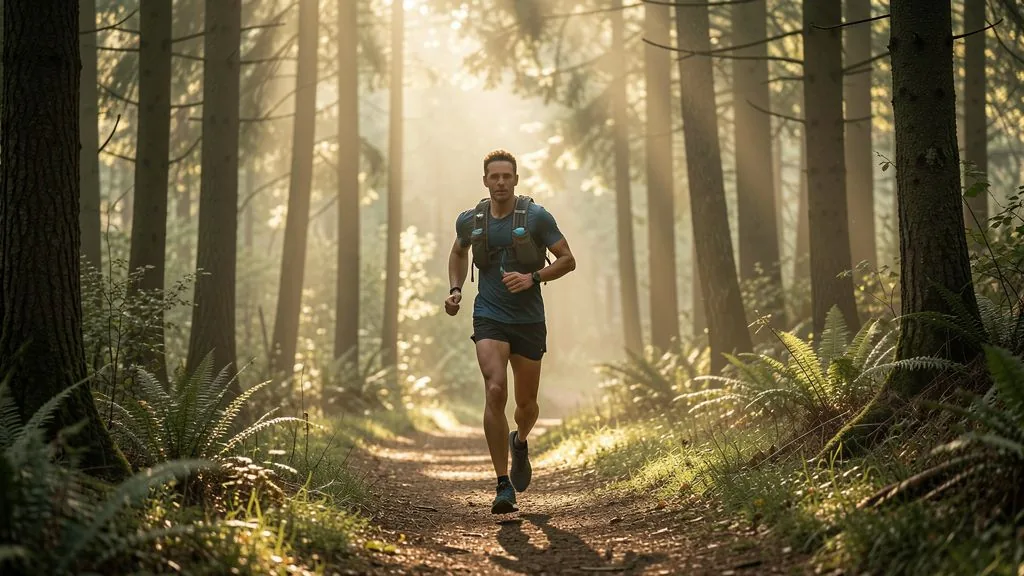
A training partner who never has an excuse, is always waiting at the door and hauls you out of the house even in November rain: running with your dog is the most reliable training motivation there is. At the same time it is a sport for two athletes — and the dog is the less experienced one. Learn the build-up and you will run together for years without issues. Skip it and you are setting up joint and paw problems in your dog that drag on for months.
Why running with a dog works so well
From a training-science point of view, a dog is an almost perfect partner for base work. It knows no intervals, no target pace and no race ambitions — it trots, and that trot sits between 8 and 14 km/h for most medium-sized dogs. That is exactly the zone that makes up 80 % of your volume in 80/20 training: steady, aerobic, conversational.
The second effect is behavioural: a dog waiting for its session turns motivation into obligation. Research on training consistency keeps finding the same pattern — athletes with a binding social factor stick to their plan far longer than those who only answer to themselves. A dog is the cheapest and most pleasant training partner for that commitment.
The third point: running with your dog shifts part of your volume to where you would otherwise cut it. Instead of dropping the session because it gets dark early in winter, you do 45 minutes with the dog — and quietly build your aerobic base along the way.
Which dogs are suited to running?
In principle almost every healthy dog is a running partner — but not every dog for the same distance. The most useful split is by build and breeding history:
- Excellent: sled dog breeds (Husky, Alaskan Malamute, Samoyed), pointers, setters, Dalmatians, Weimaraners, Australian Shepherds, Vizslas. These are distance athletes with big lungs, strong backs and a long trot. Many handle half-marathon distances without trouble.
- Good: most medium-sized mixed breeds, Labradors, Golden Retrievers, Border Collies, Beagles. 10 to 15 km is realistic after a consistent build-up.
- Limited: flat-faced breeds (Bulldog, Boxer, Pug, Boston Terrier). Their airways are not built for distance running — keep sessions short and cool, and no summer racing.
- Not suited: toy breeds with extremely short legs and dogs with heart, joint or back problems (Dachshund, Chihuahua, French Bulldog). Movement is right and important for them — just not as a running partner over kilometres.
The key parameter, though, is not the breed but the age. Dogs should only run seriously once the growth plates have closed: around 12 months for small breeds, at 15 to 18 months for large breeds. Before that the bone structure is still malleable — sustained load at a steady trot causes joint and growth-plate damage that cannot be undone later. Until then: short sessions of 5 to 15 minutes, free running without pulling, plenty of play.
And one obvious step that still gets skipped: a vet check before you start. Heart, hips, back, paws. Five minutes of assessment can save you months of problems.
The build-up: 6 to 12 months, not 6 weeks
A dog is a resilient but slowly adapting athlete. Tendons, ligaments and paw pads need months before they can absorb the load of regular running. Start in spring with a half-marathon in June in mind and by July you have a lame dog.
The proven build-up follows the same logic as for human beginners — only slower:
- Month 1–2 (start): Two to three sessions per week, 10 to 20 minutes of trotting with walk breaks. The dog sets the pace, not the human. The goal is getting used to lead, harness and rhythm.
- Month 3–4 (base): Three sessions, 20 to 35 minutes of continuous trotting, with one 45-minute session per week. After every third building week, an easy week at half volume — the same rule that applies to humans.
- Month 5–8 (build): Three to four sessions, the long one growing to 60–90 minutes. Increase volume by at most 10 % per week, measured in distance or time.
- Month 9–12 (distance): Long sessions up to two hours, once a week. From here half-marathon distances are realistic for well-suited breeds — but keep gallop phases short, because dogs burn far more energy in a gallop than in a trot.
Important: the dog does not join every run and every session. Two to three shared runs per week are ideal during the build-up; on other days it runs free, has play sessions or a rest day. A dog that should stay fit for ten years needs that variation. How much volume makes sense in a week overall depends on your own plan — human load management runs through metrics like Training Stress Score.
Equipment: the bare minimum is three items
Canicross kit is not expensive, but it is not optional either. A dog that pulls and a human holding a collar — that is the classic recipe for cervical and shoulder problems on one side and wrist pain on the other.
- Pulling harness: Ergonomically cut, with a Y-shaped chest strap that leaves the shoulder blades free. It spreads the pulling force across chest and back rather than the neck. A standard walking harness works for short runs but is too thinly padded long term.
- Bungee leash: 2 to 2.5 metres with an integrated elastic section. It absorbs the jerks when the dog suddenly stops or sniffs — sparing both spines.
- Waist belt: The belt transfers the pull to your pelvis and thighs instead of arm and shoulder. That keeps you upright and stable even when the dog really pulls.
Then the seasonal additions: paw protection for gravel and icy stretches, a reflective harness with a light for dark sessions, and in summer absolutely a water bottle plus a folding bowl. For winter a pair of gloves is worth having — a 2.5-metre leash is surprisingly hard to hold in wet hands.
Technique: how to run it safely
Unlike with humans, position matters more than style. The safest configuration is the dog ahead on a taut line with you on the waist belt. That means:
- Shoulders back, pelvis low. Do not lean against the pull — receive it. Tipping your upper body backwards blocks your breathing and loads the lower back.
- Short steps, high cadence. A cadence around 175 to 180 steps per minute stabilises you on uneven ground and reduces impact forces during sudden direction changes — just like regular technique work.
- Establish cues. "Let's go" for speed, "Easy" for trot, "Stop" and "Left/Right". Two to three weeks of consistent practice in quiet surroundings and the dog runs in a structured way — even in a forest full of junctions.
- Skip the handheld lead. A hand on the belt is fine for a quick emergency grab. Guiding on the hand long term overloads shoulder and wrist and cancels out the bungee effect.
And the single most important rule: the dog decides, not you. If it swerves, disappears into the undergrowth or suddenly leaps a ditch — you follow instead of pulling. That is not softness, it is injury prevention for both of you.
Heat, paws and warning signs: the limits
Dogs have a fundamentally different cooling system from humans: they barely sweat through the skin. Cooling happens almost entirely through panting and through the paw pads. That means a dog overheats far faster than its owner in warm weather — and without slowing down, because the drive to move is stronger than the warning signal.
The temperature limits that have proven themselves in practice:
- Below 15 °C: ideal conditions, even for long sessions.
- 15–20 °C: uncritical, but carry water and move longer sessions into the shade or near water.
- 20–25 °C: only short sessions of 30 to 40 minutes maximum, early morning or late evening. Asphalt can exceed 50 °C at midday — do the back-of-hand test on the way to the trail.
- Above 25 °C: no running with your dog. Full stop. Above 30 °C, not even short sessions on hot ground.
The warning signs you need to know: heavy, flat panting with a wide-open mouth, staggering gait, glazed eyes, a bright red to dark red tongue instead of pink, vomiting, loss of balance. Those indicate heat injury that can become life-threatening. First aid: get into the shade immediately, water over neck, armpits and paws, no ice water over the whole body, contact a vet. Heat exhaustion in dogs escalates within minutes.
Besides heat, the paws are the second weak point. After three to four weeks of consistent build-up the pads become tougher; before that a single stretch of gravel is enough to cause injury. Check the paws briefly after every run for cracks, cuts and blisters, and after snow sessions for ice balls between the toes. One more point: growing and young dogs. A dog under 12 to 18 months running the same distance in a trot every day does not compensate the load like an adult — the closed growth plate is the hard deadline, not the training plan.
And the last limit is the heat the sun puts into the dog itself: thick-coated breeds are heavily disadvantaged in summer. If you want to run with a Husky in July, simply adjust the times and the distances downward — or accept a summer break and restart in autumn.
The most common mistakes
Five patterns show up in almost every runner-with-dog beginner:
- Too far too soon: The dog runs along enthusiastically, so the distance doubles weekly. The tendons do not thank you. Stay at a maximum of 10 % volume increase per week and take an easy month every three to four months.
- Wrong equipment: Collar and walking lead while the dog pulls. That is the fastest route to cervical and shoulder problems. A pulling harness with a Y chest strap costs little and solves the problem structurally.
- Using the dog as a pacer: Ambitious runners turn the dog into a pacemaker. For the dog, sustained trotting is not interval training but overload. If you need speed, do it without the dog.
- Every run with the dog: The dog needs two to three shared sessions a week, not six. Otherwise it loses free running and recovery.
- Waiting for the warning sign: By the time the dog slows or pants hard, it is already advanced. In heat and heavy load, the right answer is to run shorter before the dog gets into trouble.
Train the dog as a partner rather than as equipment and running with it becomes the longest-lasting training stimulus available to you in amateur sport. And the only one that hauls you out of bed at six in the morning whether you feel like it or not.
How Peakora handles it
In a Peakora training plan a dog session lands like any other endurance session: in the volume, in the load curve, in the TSB. You log it as an easy session — or, if the dog pulls and you are working, as a slightly elevated load. Because the plan engine anchors the 3:1 rhythm in the periodisation anyway, you get the easy week automatically — for the dog too. A session that is in the plan and has a partner gets skipped far less often than one that only sits in the calendar.
Frequently asked questions about running with your dog
At what age can a dog start running with me?
Only once the growth plates have closed: around 12 months for small breeds, 15 to 18 months for large breeds. Until then, keep sessions to 5 to 15 minutes without pulling load — the bone structure is still malleable.
How far can I run with my dog?
A healthy adult dog comfortably handles 10 to 15 km after six to twelve months of consistent build-up. Sled dog breeds, pointers and Vizslas are also well suited to half-marathon distances. Breed, fitness and temperature decide — not the number in the plan.
At what temperature should I not run with my dog?
Above 25 °C means no running with your dog. Between 20 and 25 °C only short sessions of 30 to 40 minutes maximum, early morning or late evening. Dogs cool almost only by panting and through their paws, and asphalt can exceed 50 °C at midday.
What equipment does my dog need for running?
An ergonomic pulling harness with a Y chest strap, a bungee leash of 2 to 2.5 metres and a waist belt for you. Collars and handheld leads are off limits while pulling — they load the cervical spine and joints. In summer, add a water bottle and a folding bowl.
Plan your dog sessions like real training days
Load management with TSB, automatic deload weeks and a plan that fits your everyday life. Start free, no credit card required.
Start free