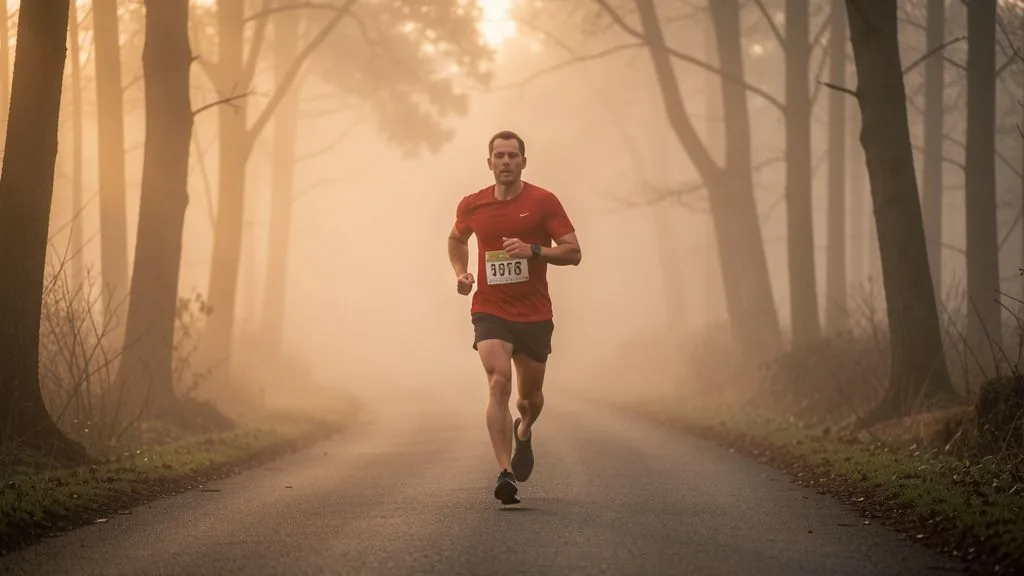
There is this moment after 50, 60, sometimes 80 minutes: the legs run by themselves, the thoughts go quiet, the pace feels easier than it did at the start — and for a few hours afterwards the world is fine. The phenomenon is called runner's high, and it is not imagination. It is a measurable neurochemical state whose mechanism exercise science has fundamentally re-evaluated over the past fifteen years. The good news: you can deliberately create the conditions for it. The honest news: you cannot force it.
What a runner's high actually is
A runner's high is a state with four clearly describable features: elevated mood bordering on euphoria, markedly reduced pain perception, an altered sense of time, and the feeling that your own performance comes effortlessly. Add to that an odd emotional openness — runners report being moved, grateful, or having the impression that their problems have lost weight.
Important for context: this is not intoxication in the sense of losing control. Coordination stays intact, you can keep pushing the pace, talk, make decisions. What fades is the inner critic. That is precisely what separates a runner's high from states of exhaustion in which perception and reaction actually decline.
Research now classifies the phenomenon as a reward and stress-processing response: the body rewards long, steady loading with a signal that files effort away as something positive rather than a threat. Evolutionarily this makes sense — whoever finds running pleasant runs more often.
The endorphin myth
For decades the runner's high was considered an endorphin effect. The logic sounded plausible: beta-endorphins in the blood rise measurably during endurance exercise, and they belong to the same molecule family as opioids. The only problem is the blood-brain barrier. Endorphins are relatively large peptide molecules and barely get from the blood into the brain. A high endorphin level in the blood therefore says little about what arrives in the central nervous system.
That endorphins still play a role is shown by imaging: with opioid radiotracers, increased endorphin binding in frontolimbic regions can be demonstrated after prolonged running — areas that govern mood and pain appraisal. The effect is real, but it does not explain the whole picture. Suppress the opioid component with blockers and most people report weakened, not vanished, euphoria.
Endocannabinoids: the actual explanation
The decisive part of the puzzle is solved by endocannabinoids — the body's own messengers such as anandamide and 2-arachidonoylglycerol (2-AG). They are fat-soluble, cross the blood-brain barrier without difficulty, and bind to CB1 receptors, the same docking sites where THC acts. The name anandamide comes from Sanskrit: ananda means bliss.
In the classic experiment by Raichlen and colleagues, subjects ran and walked the same course — same distance, comparable energy expenditure. Result: after running, endocannabinoid levels were significantly higher than after walking. That explains why brisk walking relaxes but rarely produces euphoria. The same group also showed that animals with an innate drive to run respond similarly to humans — a hint that this reward system is very old.
Two further findings fit the picture: block the CB1 receptors and the anxiety-relieving, mood-lifting effect of running largely disappears. And in mice whose endocannabinoid signalling in the gut was interrupted, the running euphoria failed to appear — the pathway apparently does not run exclusively in the head.
Which intensity and duration it takes
The formula is remarkably unspectacular. A runner's high typically develops at:
- Duration: 45 to 90 minutes. Below 30 minutes the endocannabinoid rise is usually too small to be consciously noticed.
- Intensity: moderate, roughly 65 to 75 percent of maximum heart rate. That corresponds to a pace at which you could still hold a conversation, but not for long.
- Steadiness: constant load without hard pace changes. Intervals are effective training, but they generate stress signals that work against the euphoria effect.
- Familiarity: a known route, little traffic, no navigation stress. Additional cognitive load measurably dampens the effect.
In short: the runner's high is the reward for the easy long run — not for the hard session. Anyone who only runs intervals and wonders why the blissful moments fail to appear is looking in the wrong place.
Why not every runner experiences it
Survey estimates among endurance athletes range between 30 and 80 percent — an enormous spread that mainly shows how differently people define "euphoria". Part of the explanation is genetic: CB1 receptor variants and the activity of fatty acid amide hydrolase (FAAH), which breaks down anandamide, differ measurably between individuals. If you clear anandamide quickly, you feel less.
A second factor is expectation. Placebo research shows that merely being told you are performing a "mood-lifting" activity changes reported mood. That does not make the runner's high imaginary, but it explains why measurable biochemistry and subjective experience can diverge.
The third and most practically relevant factor is habituation. In regular trainers the acute euphoria often flattens — not because the mechanism disappears, but because the reward system responds to repetition with tolerance. What remains is general mood stabilisation. For training practice that is more valuable than the short rush.
What the brain gains in the long run
Beyond the single blissful moment, regular endurance training permanently changes stress processing. Measurable effects include:
- Lower baseline: resting heart rate and the daily cortisol profile improve, and amygdala reactivity to stressors decreases — visible in imaging studies after twelve weeks of moderate training.
- BDNF increase: the neurotrophic factor promotes new synapse formation in the hippocampus, a region that is often reduced in size in depression. This is why exercise is anchored in guidelines as an adjunct therapy for mild to moderate depressive episodes — not as a replacement, but as an effective addition.
- Better sleep quality: deep sleep share and sleep onset latency improve, which in turn supports mood and recovery.
- More self-efficacy: the psychological effect of having completed a hard session transfers to other areas of life — the best-documented long-term benefit of running of all.
Anyone who runs for these reasons depends less on the runner's high. That is the more robust strategy: mood stabilises over weeks, regardless of whether the euphoric moment arrives today.
The downside: when the euphoria becomes a trap
The runner's high has a well-known problematic flip side. When running becomes the primary and only strategy for regulating emotions, a pattern emerges that sport psychology describes as exercise dependence. Warning signs: you run through injury or illness, a skipped run triggers restlessness or irritability, and training dose rises although no goal demands it.
This is not a fringe phenomenon — studies of endurance athletes find clinically relevant signs in roughly 5 to 10 percent. The transition is fluid because the early phase genuinely is healthy. The distinction lies not in the behaviour but in its function: does running regulate everyday life, or does it replace engaging with it?
A second risk is medical. The runner's high reduces pain perception — that is part of its definition. Anyone who uses this effect to run through an emerging pull in the Achilles tendon or shin trades a lovely evening for six weeks off. The pain traffic light stays valid even when your head is happy.
How to improve your chances of a runner's high
- Schedule one long, easy run per week deliberately without a target pace. The long run is the natural opportunity — not the session for pace control.
- Reduce cognitive load. No high-information podcasts, no phone calls in the first hour. Music works differently for different people — some need it to find rhythm, others get distracted.
- Run evenly. A negative split pattern of a few seconds per kilometre is ideal: slow enough at the start that the body does not switch into fight mode.
- Choose the time of day with care. Endocannabinoid levels and mood follow a circadian rhythm; for many people late afternoon works better than early morning.
- Accept when it does not come. Trying to produce the feeling is the most reliable way to prevent it. Observe instead of wanting.
- Do not force it fasted. Head out with empty glycogen stores and you produce stress rather than euphoria — hypoglycaemia feels similar to a runner's high but is a warning signal.
Runner's high in other sports
The mechanism is not running-specific. Endocannabinoid increases after prolonged exercise have been demonstrated in cycling, swimming, rowing, cross-country skiing and even brisk hiking. What matters is duration and steadiness, not the mode of movement — which explains why some people find the same inner calm on a two-hour mountain hike as others do after 20 kilometres of running.
The difference lies in the side effect: running has the highest mechanical stress per minute, cycling the lowest. Anyone forced to pause due to injury can maintain the mood effect through cross-training — an argument that is often underestimated in practice. How to structure that phase sensibly is covered in Cross-training for runners.
Why running also carries you psychologically
Beyond the biochemical effects there is a well-documented psychological one: the effect of rhythm and repetition. Steady movement with a predictable cadence calms the autonomic nervous system — the same mechanism that breathing techniques and mindfulness practice use. Many runners describe the second half of a long run as a kind of moving meditation in which thoughts arrive but do not stick.
Interestingly, the runner's high often turns out stronger in people under high stress than in relaxed ones — and in people with depression it can fail to appear entirely. The reward pathway responds not only to the load but to the contrast with the starting state. Those who are permanently wired feel the difference more clearly.
How Peakora handles the mood effect
A training plan that only looks at numbers ignores an essential part of motivation. Peakora therefore records not only load and form but also how each session felt: how the run went, how you slept, how your mood was before and after. Over weeks these inputs form a pattern showing which sessions carry you psychologically — and which you complete but consistently log as a burden.
This becomes concretely relevant when planning easy runs: if the engine recognises that your long aerobic sessions are consistently rated positive, it deliberately places them as a fixed anchor in the week — regardless of whether a speed block is currently running. Conversely, several negatively rated sessions in a row prompt a recovery week. Bliss cannot be prescribed, but you can make sure the conditions are right regularly.
For terms like endocannabinoids, long run, exercise dependence or recovery week, the Peakora glossary is worth a look. Anyone who wants to understand the training theory behind it systematically will find periodisation summarised under Marathon training.
Frequently asked questions
What is a runner's high?
A runner's high is a state of elevated mood, reduced pain perception and inner calm that occurs after prolonged moderate endurance exercise. It is triggered mainly by the body's own endocannabinoids such as anandamide, not by endorphins.
Are endorphins responsible for the runner's high?
Only partly. Endorphins are large molecules and barely cross the blood-brain barrier. Research today shows endocannabinoids play the central role — they are fat-soluble, reach the brain and act on CB1 receptors there.
How long do I have to run to get a runner's high?
Usually 45 to 90 minutes at moderate intensity, roughly 65 to 75 percent of maximum heart rate. Short hard intervals create different stimuli but rarely this specific feeling of euphoria.
Can you get a runner's high from cycling?
Yes. Endocannabinoid increases are measurable in all prolonged endurance exercise — cycling, swimming, rowing, cross-country skiing or brisk walking. Duration and steady load matter, not the mode of movement.
Is a runner's high dangerous?
The state itself is harmless. It becomes a problem when the euphoria turns into your only way of coping with stress, or when you run through pain signals. Runners who only run to feel better risk overtraining.
Training that feels good — and works
Peakora plans your sessions around load, form and how you feel — with easy runs as a fixed anchor and recovery when it is needed. Start free, no credit card required.
Start free