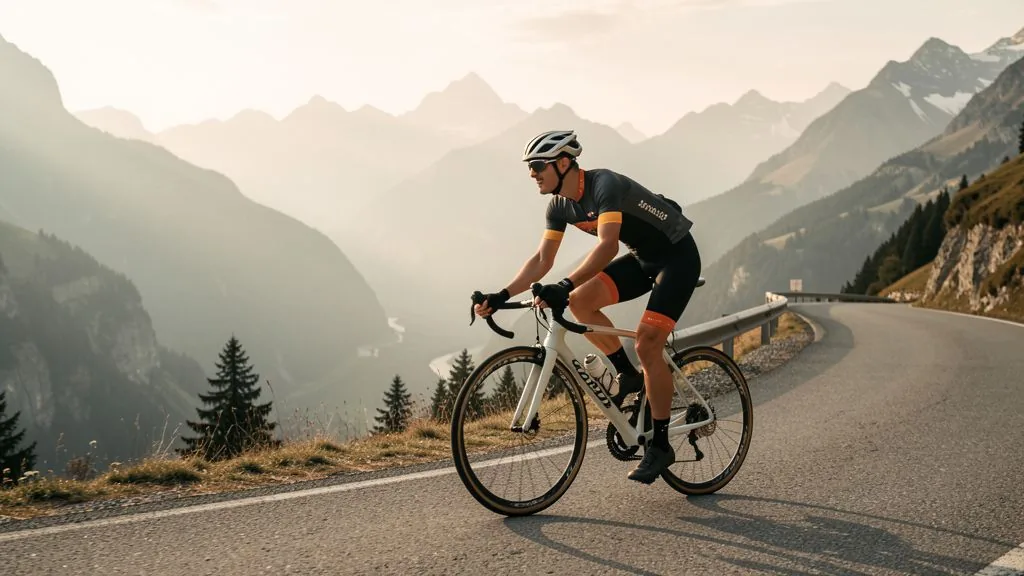
Two runs, one bike leg, no water: duathlon is the most direct entry into multisport — and far more than a fallback for non-swimmers. Run–bike–run has its own physiological demands: the second run on "bike legs" is among the hardest experiences in endurance sport. This guide covers distances, training structure, brick workouts and race tactics for your first duathlon.
Distances and formats: what to expect
Duathlon always follows the same pattern: run – bike – run. Only the length of the three segments changes:
- Sprint distance: 5 km run, 20 km bike, 2.5 km run. Race time for beginners is roughly 60 to 80 minutes. The ideal first race.
- Standard distance: 10 km – 40 km – 5 km. Comparable in demand to an Olympic-distance triathlon, with race times of 2 to 2.5 hours.
- Long distance (Powerman): classically 10 km – 60 km – 10 km; the legendary Powerman Zofingen goes up to 10 km – 150 km – 30 km. Only sensible after several standard-distance races.
- Cross duathlon: running and mountain biking off-road — technically more demanding, but away from road traffic.
The rulebook in brief: your helmet must be on before you touch the bike; drafting is banned at most events (keep your distance, complete overtakes promptly); the transition zone is crossed on foot, pushing your bike by hand.
Why duathlon is the ideal multisport entry
Three reasons make duathlon the best first multisport: First, there is no swimming — the discipline that is the biggest technical and logistical hurdle for most triathlon beginners. Second, the equipment list is minimal: running shoes, a roadworthy bike, a helmet. Third, with two run segments, the sport most beginners already know stays dominant.
There is also a training effect that pure runners often underestimate: the bike leg builds aerobic endurance with far less impact stress. If you are injury-prone as a runner or have hit your weekly impact limit, cycling lets you build capacity without further straining tendons and joints. The principle behind it — an easy base plus targeted intensity — matches 80/20 training, just spread across two sports.
Brick workouts: the key session
The one session that separates duathlon from ordinary run-and-bike training is the brick: cycling, immediately followed by a run — no break, exactly as in the race. The stimulus is not the length but the switch itself. For beginners, a format like 45 to 60 minutes of easy to brisk cycling, followed directly by 15 to 20 minutes of running at your planned second-run race pace, is enough.
Once a week is sufficient, in the final 6 to 8 weeks before the race. Earlier in your build-up you do not need bricks — that phase is about growing your base in both disciplines. Everything about structure, dosing and variants is covered in the article on brick training.
The second run: why your legs feel like lead
The first 500 to 1,000 meters after the bike almost always feel strange: heavy legs, an off stride rhythm, a pace that feels hard although your heart rate says it is moderate. The cause is physiology: on the bike, your quadriceps and hip flexors work through a limited range of motion, and blood is distributed differently than in upright running. During the switch, your cardiovascular system has to reorganize circulation — that takes several minutes.
Three tricks shorten this adjustment phase:
- High cadence at the end of the bike leg: Ride the last 5 to 10 minutes at 90 to 100 rpm in an easy gear. This "decouples" your legs from the pedaling pattern and prepares them for the high stride frequency of running.
- Start deliberately short: Run the first kilometer of the second run 15 to 30 seconds slower than goal pace. Anyone who trusts their feel here almost always starts too fast — and pays for it on the final kilometers.
- Practice the switch in training: The heavy feeling cannot be trained away, but it can be reduced significantly. After 4 to 6 bricks, the transition becomes routine.
Sample training week for beginners (sprint distance)
For the sprint distance, 5 to 6 hours per week are enough, split into three runs and two rides. A proven weekly layout:
- Monday: Rest day. Recovery is training.
- Tuesday: Run quality: 45 minutes with intervals (e.g. 5 × 3 minutes brisk) or a tempo run — the fast run of the week.
- Wednesday: 60 to 75 minutes of easy cycling (zone 1–2). Technical focus: a smooth, round pedal stroke.
- Thursday: 40 minutes easy running plus 15 minutes of strength training for runners — squats, lunges and calf raises stabilize exactly the muscles that fade in the second run.
- Friday: Rest day or a 20-minute walk and mobility work.
- Saturday: Brick session: 60 minutes cycling (last 10 minutes at high cadence), immediately followed by 15 to 20 minutes of running.
- Sunday: Long easy session in an alternating rhythm: one week a 75- to 90-minute long run, the next a 2-hour easy ride.
This pattern follows the 80/20 principle: about 80% of the week stays easy; only the Tuesday session and parts of the brick are intense. If you have more time available, extend the easy sessions first — not the hard ones.
Race day: transitions and tactics
A duathlon has two transitions: T1 (run → bike) and T2 (bike → run). Each costs an unpracticed beginner two to three minutes — time you can win almost for free with a rehearsal the day before. The helmet goes on before the bike comes off the rack and only comes off after the bike is racked again. The details of sequence, gear layout and classic transition mistakes are covered in the article on T1 and T2 — the fourth discipline of multisport.
Tactically, the most common beginner mistake happens in the first run: it feels easy, your legs are fresh, the field pulls you along — and race pace gets exceeded by 20 seconds per kilometer. Yet the duathlon is decided at the back end: you feel the bill on the bike and pay it in the second run. Better: a controlled first run at the top of your target zone, the bike at 80 to 90% of what you could do, and a second run that builds. If you can still accelerate in the finishing sprint, you paced it right.
Common beginner mistakes
- Racing the first run like a standalone race. Run 5 km at personal-best effort and the bike leg is over before it starts. The first run is a deposit, not the race — the race is decided in the second.
- Underestimating the bike training. On the sprint distance, cycling takes up about half of your total race time. If you only run and "somehow ride", that is where you give away the most time.
- Skipping brick workouts. Without bricks, the transition shock on race day is guaranteed — and it hits exactly when it hurts most.
- Too many hard days. Two sports invite a double quality program: run intervals and bike intervals. That contradicts the 80/20 distribution and ends in chronic fatigue instead of fitness.
- New gear on race day. New shoes, new clipless pedals, an untested transition setup — everything that has to work in the race gets tested in training first.
How Peakora plans your duathlon training
Peakora supports duathlon as its own sport: the engine periodizes run and bike sessions together, schedules brick workouts into the weeks close to your race and doses intensity by the 80/20 principle across both disciplines. The recovery monitor detects when the combined load from two sports becomes too much — and the adaptive planning moves quality sessions before ambition turns into overload. Concepts like TSS, zone 1–2 training or threshold work are explained in the articles on Training Stress Score and heart rate zones.
Frequently asked questions about duathlon training
What distances are there in duathlon?
The common formats are sprint distance (5 km run, 20 km bike, 2.5 km run), standard distance (10–40–5 km) and long distance such as Powerman (10–60–10 km, up to 10–150–30 km in Zofingen). Beginners should start with the sprint distance — race time around one hour.
Is duathlon easier than triathlon?
Not easier, but more accessible: there is no swim, but you run twice — and the second run after cycling is physiologically harder than any standalone run. The training volume required for beginners is considerably lower than in triathlon.
How often should I do brick workouts?
Once a week is enough — during the final 6 to 8 weeks before your race. A short session works: 45 to 60 minutes of cycling immediately followed by 15 to 20 minutes of running. The training stimulus is in the transition, not the length.
What bike do I need for a duathlon?
For your first race, any roadworthy bike works — road bike, gravel bike or trekking bike. The only requirement is a helmet, and drafting is usually banned. A dedicated road bike only makes sense once you race regularly.
Train for your first duathlon
Peakora plans running, cycling and brick sessions as one plan — adapted to your recovery. Start for free, no credit card required.
Start for free