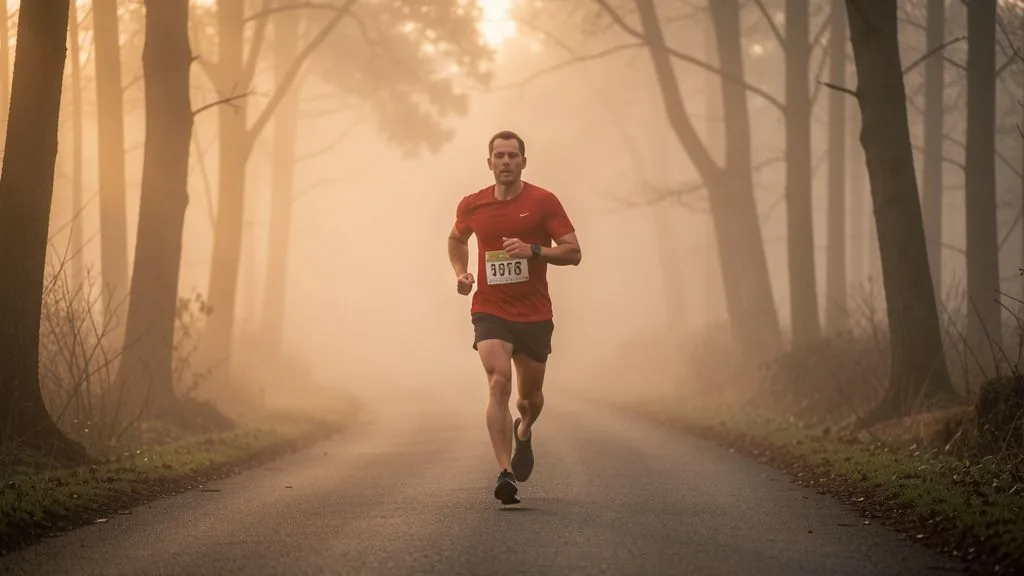
Somewhere between kilometre 30 and 35 it goes quiet in your head — and then loud. Whatever runs through your mind at that moment is not background noise, it is a performance variable of its own: self-talk is one of the best-studied tools in sport psychology. The effects are small but they reproduce, and unlike training volume or equipment a working cue costs exactly nothing. This article covers what the research actually supports, which phrasings work, and how to build a race-day script that survives fatigue.
What self-talk is — and what it is not
Self-talk is defined as the internal or spoken dialogue an athlete runs with themselves during a task. What matters is the function, not the form: a sentence counts as self-talk when it steers your attention, appraisal or action. "Two laps to go" is self-talk; "I hope this works out" is too — just with the opposite sign.
The literature separates two families, and this distinction is the single most practical point in the whole topic:
- Instructional self-talk gives a technical direction: "short steps", "hands loose", "eyes up". It points attention at one specific, checkable aspect of movement.
- Motivational self-talk addresses effort and confidence: "you trained for this", "ten more minutes, then it's allowed to hurt", "stay calm, you belong here". It changes how you appraise the situation.
There is a third variant — the emotional one, a sentence that regulates an emotion ("that's just adrenaline, not fear"). In racing it is often the most effective of the three, because it does not aim at the legs but at your interpretation of your own body signals.
The evidence: a small effect, but a reliable one
The broadest synthesis is a 2011 meta-analysis by Hatzigeorgiadis and colleagues, pooling 32 studies with more than 2,000 participants. The result: a mean effect size of roughly 0.5 in favour of self-talk interventions. For scale, that is about the same order as other psychological race tools such as visualisation, and clearly smaller than an extra twelve-week training block.
Three findings from that literature matter for endurance athletes:
- Perceived exertion drops. At identical output, subjects using motivational self-talk report a lower RPE. The same kilometre feels easier — this is the best-supported effect of all.
- Time to exhaustion rises. In controlled tests to failure on the bike or treadmill, participants using motivational self-talk lasted measurably longer than controls with a neutral internal dialogue.
- Instructional works for technique, motivational for endurance. Fine-motor and technical tasks respond better to technical cues; gross-motor and endurance tasks respond better to motivational ones. If you need both, place them at different points in the session.
Honesty requires a caveat: many of these studies use small samples, lab-style tasks and short measurement windows. There is no solid evidence that self-talk changes VO2max or lactate threshold. What changes is how much of your existing capacity you actually access — a difference that can be worth several minutes over 42 kilometres. How effort is produced physiologically is covered under RPE and lactate threshold in the training glossary.
The four rules that make the difference
Not every sentence works. Four characteristics have emerged from the research that decide between effect and placebo:
- Short. One to three words, at most a short phrase. Working-memory capacity drops under fatigue — a cue you cannot say in one breath is too long.
- Personal. Phrasings you do not believe yourself have no effect. "I am strong" sounds silly to many people; "you did every Tuesday interval this winter" is verifiable and therefore credible.
- State-specific. The cue has to match the situation. "Stay relaxed" during a hill sprint is the wrong instruction; "hands low, short steps" fits.
- Rehearsed. The effect shows up mainly once the cue is automatic. A sentence you use for the first time at kilometre 35 is a foreign body.
The second person is no accident either: studies suggest that addressing yourself as "you" works slightly better in endurance tasks than the first person. The reason is distance — you talk to yourself like an athlete you are coaching, and that coaching perspective helps precisely when your own judgement degrades under fatigue.
Instructional self-talk: holding form when the legs are tired
The instructional cue is the tool for the second half of a race, where running economy measurably decays. From kilometre 25 onward most runners lose cadence, stride length grows, the pelvis tips forward, the shoulders rise. A single technical cue targets exactly one of these — the one that breaks first for you.
How to find it: have someone film you in the final half hour of a long run, or watch yourself on a straight stretch. Which feature changes first? If you overstride, take "short steps"; if your shoulders climb, take "shoulders down"; if your arms cross the midline, take "hands to hips". Seven levers for better running economy covers the technical features in detail.
Dosing matters: a technical cue is a brief impulse, not a permanent state. Use it deliberately for 30 to 60 seconds, then let it go. Anyone thinking about cadence non-stop loses the automaticity that makes a good stride possible in the first place.
Motivational self-talk: shifting the appraisal
The motivational cue works not on movement but on interpretation. Fatigue is to a large extent an appraisal: the body sends signals, the brain decides whether they mean "dangerous" or "normal for this effort". This is exactly where self-talk intervenes.
Three phrasing patterns have proven themselves in practice:
- Look back instead of forward. "You ran 30 kilometres at minus two degrees in February" is stronger than "you will make it". Proven facts beat hope.
- Shrinking. Not the whole race but the next tree, the next kilometre, the next three minutes. Attention windows under five minutes are manageable under fatigue.
- Reframing. "This is not a collapse, this is kilometre 32 — it always feels like this." That phrasing removes the alarm character from the signal without denying it.
What does not work is denial: "I feel great" in the middle of a genuine low creates an internal contradiction the brain will not resolve. The effective lines admit that it is hard and shift only the appraisal.
The race-day script in five scenes
A script is not a mantra, it is a small library: one prepared sentence for each critical situation. Five scenes are enough for a marathon, a half marathon or a bike race.
- Start corral: a sentence that brakes your pace. "First three kilometres: too slow is correct." The most common cause of a blow-up is starting too fast — the cue works against your own arousal.
- Kilometre 10: an instructional form cue. "Shoulders loose, hands low."
- Halfway: a facts cue. "You are on plan, this is your pace."
- Kilometre 30 to 35: the low cue. "This is kilometre 33, it always feels like this — ten more minutes."
- Final three kilometres: a permission cue. "Now it's allowed to hurt." It marks the point where control is replaced by commitment.
Write the five lines on an index card and rehearse them over the final six weeks in exactly the situations where you need them — in the long run from kilometre 25, in the last interval, in the tempo run. How to build mental preparation as a whole is covered in race-day mental preparation; scenario work with real images is added by visualisation in sport.
Self-talk in cycling and triathlon
On the bike the emphasis shifts: there, self-talk is less a tool against exhaustion than one against your own poor judgement. Most performance lost on the bike comes not from weak legs but from too many watts in the first 30 minutes. A line like "first half hour 20 watts under plan" works more directly than any motivational slogan because it carries a concrete number.
Triathlon adds a specific wrinkle: three disciplines mean three transitions and therefore three situations in which attention easily drifts. One cue per discipline has proven itself — "long and calm" in the water, "steady, drink" on the bike, "short steps, upright" on the run. The transitions themselves get their own line, because time disappears there without feeling like effort; T1 and T2 in detail shows where the seconds hide.
A second point that is often missed: self-talk is also a tool against abandoned sessions. Standing at the door in rain and five degrees, you do not decide with your legs but with a sentence. "Ten minutes, then I decide again" is one of the most effective of all, because it shrinks the decision without cancelling it.
Common mistakes
- Too many cues. Anyone holding five sentences at once has no attention left for running. One to three is enough.
- Positive thinking only. "Everything is great" in a genuine low creates contradiction. Reframing beats denial.
- The cue arrives too late. A sentence you first use at kilometre 38 is no longer automatic, it is work.
- Wrong cue for the task. Technical instructions in the final sprint, motivational slogans during form work — both miss the point.
- Self-talk as a substitute for training. No cue replaces a missing long run. Psychology accesses what is physiologically there.
- Not documented. If you never note which line worked in which situation, you start from scratch at every race.
How Peakora handles this
Peakora does not prescribe mental drills — it provides the data base that makes a script credible in the first place. Every session lands in the history with duration, pace, heart rate, RPE and training stress; from that come the facts that work as a look-back cue: 14 weeks of build-up at 62 kilometres per week, three 30-kilometre runs, a threshold of 4:12 min/km in the last test. Anyone with those numbers in their head does not need to talk themselves up at kilometre 33 — they can quote themselves.
The training stress score (TSS), the fitness curve (CTL) and the form value (TSB) are the driest form of self-talk there is: numbers showing that the preparation happened. What the abbreviations mean is explained in understanding training stress; for the marathon build-up as a whole, see the marathon training page.
Frequently asked questions about self-talk
What is self-talk in sport?
Self-talk is the dialogue you run with yourself during exercise, whether silently or out loud — from a technical cue like "shoulders loose" to a motivational one like "you trained for this". Both forms affect attention, confidence and how hard the effort feels.
Does self-talk really help with fatigue?
Yes, with a caveat: studies show motivational self-talk lowers perceived exertion at the same output and extends time to exhaustion in controlled tests. The effect is measurable but moderate — it does not replace training, it helps you access what is already there.
Should I speak out loud or silently?
Cues spoken out loud show slightly larger effects in studies because they bind attention and breathing rhythm more tightly. In a race, short silent cues are more practical — practise the same words out loud in training so they stick on race day.
How many cues do I need?
One to three. One technical cue for form, one motivational cue for hard sections and optionally one for breathing. Nobody reliably recalls more than three words per situation once fatigue sets in.
What if I talk myself down during a race?
Name it, then reframe it: "I'll never make it" becomes "the next kilometre, not the whole 42". Negative self-talk is normal — what matters is a prepared replacement line you have already rehearsed in training.
Your plan with Peakora
Personalised training with threshold runs, intervals, adaptive tapering and race-day pacing — plus the training history your script is built from. Start free, no credit card required.
Start free