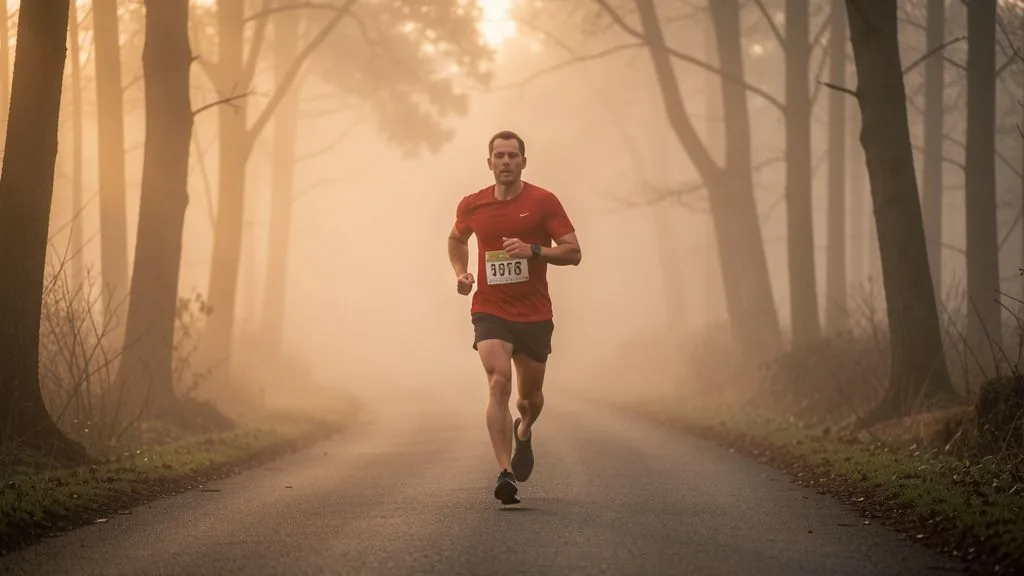
The finishing kick is the moment a race is decided — and at the same time the least trained part of it. Most runners do not have a problem going out too fast; they have a problem having anything left at the end. The reason has little to do with willpower and a lot to do with pacing, glycogen and whether a fast kilometre ever sat at the end of a tired session in training.
Why there is any reserve left at all
A 10K is run more than 90 percent aerobically. Energy comes from oxygen, fat and carbohydrate, and the system runs the whole way in a range where it can work steadily. That is exactly why something is left at the end — a remainder of anaerobic capacity the race never touched, because you saved it for the closing surge.
Three things determine how much of that reserve is actually available:
- Anaerobic capacity: In a well-trained runner it covers the last 30 to 60 seconds of a 5K at a clearly higher pace. There is no more than that — anyone who believes they can produce a track-style sprint finish over the last 800 metres is confusing a 400-metre race with a road race.
- Muscle glycogen: The real bottleneck over long distances. Once the store is empty, willpower is irrelevant — all that remains is holding pace on reduced power.
- Neuromuscular freshness: How many fast fibres you can still recruit at the end depends on how often you called on them under fatigue in training. That is the trainable part.
The fourth factor is mental, but not in an esoteric sense: the kick begins at the moment you stop monitoring your pace and start focusing on the field and the finish. That is learnable — see mental preparation for race day.
How much reserve is realistic — numbers per distance
The following magnitudes come from comparing split and finish times in amateur races. They are not promises but corridors: anyone who produces much more started too slowly; anyone who produces none either went out too hard or never trained the kick.
- 5K: The last 600 to 800 metres 15 to 25 seconds per kilometre faster than race average. The kick accounts for 10 to 20 seconds of total time here — in a 20-minute race that is a whole block of placings.
- 10K: The last one to two kilometres 10 to 20 seconds per kilometre faster. Running the final two kilometres 30 to 40 seconds quicker than goal pace means you paced the race well.
- Half marathon: The last three to five kilometres 5 to 12 seconds per kilometre faster. More than that only happens with a clearly too-slow start.
- Marathon: 3 to 8 seconds per kilometre over the last two kilometres, often just holding pace. A "sprint" over the final five kilometres only works for runners who started well below their capability.
One useful benchmark: a negative split of 60 to 90 seconds over a half marathon signals good pacing — a kick worth four minutes signals three kilometres of tempo wasted at the start. The maths behind pacing is covered in race pacing strategy for the marathon.
The right moment: when the kick begins
The most common mistake is not a kick that is too slow but one that starts too early. Surge from kilometre 15 in a half marathon and you pay double in the last three kilometres. Rule of thumb: the kick starts where you still have 8 to 12 percent of the total distance ahead of you.
- 5K: from 600 to 800 metres to go. Anything earlier is not a kick but a pace change with compound interest.
- 10K: from kilometre 8, meaning the final two kilometres. From kilometre 7 only if the legs feel clearly better than expected.
- Half marathon: from kilometre 18. The last 3.1 kilometres are the only ones where a pace change does not immediately backfire on total time.
- Marathon: from kilometre 38, often only from kilometre 40. The marathon forgives nothing that happens after kilometre 30.
A second marker is breathing: as long as you can breathe in a three- or four-step rhythm, you have reserve. When breathing flips to 2:2 or 1:1, you have reached the point where you can no longer accelerate, only hold. How breathing rate and pace couple is explained in breathing while running.
The three stages of a kick
A kick is not a single sprint but a sequence. Going straight to full throttle loses more in the final 200 metres than it gains in the first 300.
Stage 1 — The pace change
The first step is not acceleration but redistribution: shorter, quicker steps, a more upright posture, more active arm drive. Pace rises by 5 to 10 seconds per kilometre — no more. This stage lasts 300 to 600 metres and exists to break the body out of its uniform rhythm and raise fibre recruitment.
Stage 2 — The hard kilometre
Now comes the part that hurts: pace at or slightly above your 10K best, breathing in a 2:2 rhythm, eyes 10 to 15 metres ahead on the ground, not on the watch. Look at heart rate here and you lose — it responds with a 15 to 20 second delay and is worthless as a control variable over the last two kilometres.
Stage 3 — The sprint finish
The final 150 to 200 metres. This is no longer about economy but about whatever is left: arms driving hard, cadence up, stride length not artificially lengthened. The most common error here is too long a stride — it acts like a brake because the foot lands ahead of the centre of mass (see foot strike in running).
How to train the kick
A kick is a capability, not a personality trait. Training it requires stimuli where fast running happens at the end of a tired session. Four formats cover it, and three of them cost no extra training time.
- Fast-finish long run: The most important building block for half marathon and marathon. The final 20 to 30 percent of the long run moves to race pace or slightly above — in a 30 km run that means the last 6 to 9 kilometres. It trains the exact situation in which the kick happens: tired legs, intact mechanics.
- Progression run: A run that gets faster in three or four steps, for example 4 km easy, 3 km moderate, 2 km brisk, 1 km fast. The stimulus is not the peak but the sequence — the body learns to keep accelerating as fatigue rises.
- Strides at the end of a set: Two or three strides of 150 to 200 metres after the final interval set. The extra cost is two minutes; the effect on neuromuscular recruitment under fatigue is significant.
- Race-pace blocks at the end: In the competition phase, a tempo run whose last 2 to 3 kilometres go above race pace. That is the most direct preparation for the sprint finish.
A word on dose: two of these stimuli per week is enough. More buys nothing, because the kick is not an endurance problem but a fatigue and recruitment problem. How these stimuli fit into weekly load is shown in TSS — training stress score.
The empty ending: why the marathon kick often fails
Beyond 30 kilometres the limiting factor is different. A typical runner's muscle glycogen store lasts roughly 90 to 120 minutes at moderate intensity — in a marathon therefore until kilometre 26 to 32, depending on pace, training state and carbohydrate intake. After that, energy comes increasingly from fat, which yields less ATP per gram and lowers the intensity you can sustain.
Concretely for the kick that means:
- Carbohydrate from kilometre 10: 30 to 60 grams per hour, not when hunger arrives. Start eating at kilometre 30 and the kick is already gone — absorption takes 20 to 30 minutes. Details in fuelling the marathon.
- Count sodium in: Beyond 60 to 90 minutes plain water is not enough. A sodium deficit directly reduces the contractility of muscle — see electrolytes in running.
- Keep the first 30 kilometres controlled: Every second too fast in the first 10 kilometres costs three to five at the end. That is not a platitude but the consistent finding of race analyses.
And one point many underestimate: the brain runs on carbohydrate too. Studies on central fatigue show that rinsing the mouth with a carbohydrate solution measurably lowers perceived effort without anything reaching the stomach — an effect that genuinely helps over the final kilometres. The mechanism is described under carbohydrate mouth rinsing.
The most common mistakes over the final kilometres
- Starting too early: The classic. Surge from kilometre 15 in a half marathon and you have nothing left at kilometre 19 — losing 60 to 90 seconds instead of gaining 20.
- Increasing stride length instead of cadence: Almost everyone instinctively lengthens the stride in a sprint finish. That leads to landing ahead of the centre of mass and a braking effect worth several percent. Raising cadence is always the better route — see cadence in running.
- Watching the watch: Over the final two kilometres a glance at the watch is no longer information but distraction. Pace feel is more reliable there than any number.
- Eating too little: In anything beyond 90 minutes a missing kick is usually a fuelling problem, not a training problem.
- Never training the kick: Run uniformly in training and you will have no access on race day to a pace you have never run under fatigue.
Kick in heat, cold and on rolling courses
The environment shifts the limits down, not up. Above 25 degrees Celsius cardiac drift rises sharply — the pace you can still hold at kilometre 35 is 10 to 20 seconds per kilometre slower than at 15 degrees. A kick remains possible, but the reference point is the day's pace, not your personal best. How cardiac drift works is covered under cardiac drift in running.
On hilly courses the kick follows the topography. A climb in the final two kilometres is run at even effort, not even pace — the descent afterwards is where the seconds actually sit. Give everything in the last climb and you lose more on the following descent than you gained at the top (see downhill running).
How Peakora plans the kick
Peakora does not treat the kick as a motivational formula but as part of race strategy. From goal time, distance and previous bests the engine computes a pacing plan with target splits and marks the window in which a pace change makes sense. In the competition phase the plan places fast-finish long runs and progression runs automatically in the final weeks before the target race — depending on the distance and on how much residual load (TSB) is still open.
Concretely: for a marathon with a 3:30 goal the final kilometres sit in the plan with a corridor of 4:55 to 5:05, while the first 5 kilometres are deliberately set at 5:05 to 5:10. For a sub-45 10K the kick corridor is 4:15 to 4:20 over the last two kilometres. The point is simple: know the number beforehand and you no longer have to invent it mid-race. Terms such as TSB, CTL and race corridor are explained in the training glossary; the wider framework for race preparation sits on the marathon pillar page.
Frequently asked questions about the finish kick
How much faster can you run in the finishing kick?
Realistically 10 to 25 seconds per kilometre over the final one to two kilometres in a 5K or 10K, 5 to 12 seconds in a half marathon and 3 to 8 seconds in a marathon. A kick worth two minutes per kilometre always means you started too slowly.
When should the finish kick start?
In a 5K with 600 to 800 metres to go, in a 10K over the last two kilometres, in a half marathon from kilometre 18 and in a marathon no earlier than kilometre 38. Starting earlier costs more than the kick gains.
Can you train a finishing kick?
Yes. What matters are runs that end with fast kilometres: the fast-finish long run, the progression run and short strides at the end of interval sets. If you never get faster while tired in training, you will not do it in a race.
Why does my marathon kick collapse?
Because after 30 to 32 kilometres the limiting factor is usually muscle glycogen, not anaerobic reserve. A kick is only possible if you ran the first 30 kilometres under control and took on enough carbohydrate.
Does a finishing kick make sense in trail and ultra races?
Only over the last one or two kilometres and only if fuelling went well. Beyond four hours a sprint finish buys almost nothing, whereas running steadily without walking breaks buys several minutes.
Race strategy instead of guesswork
Peakora computes your target splits from goal time and personal bests and places fast-finish runs automatically in the weeks before your race. Start free, no credit card required.
Start free