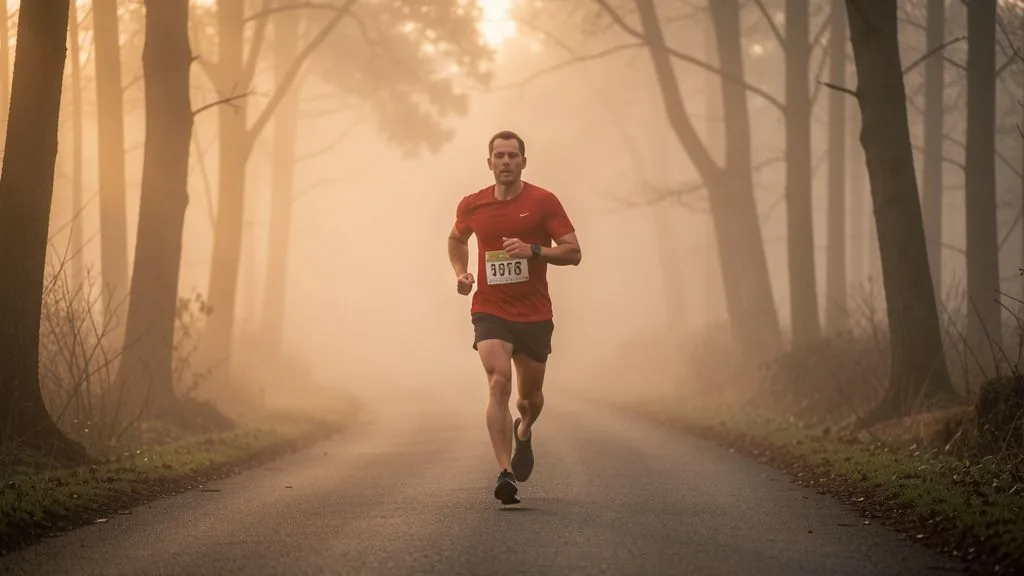
Heartburn is one of the most common and least discussed complaints in endurance sport. An estimated 30 to 50 percent of runners and cyclists know the burning sensation behind the breastbone during or shortly after exercise; in ultrarunners and long-distance triathletes the rate is higher still. The cause rarely lies in the stomach alone. It is the interplay of mechanical pressure, meal timing and a blood supply that goes where it is needed most under load — and not to the digestive tract.
What happens mechanically during exercise
At the junction between oesophagus and stomach sits the lower oesophageal sphincter, a ring of smooth muscle. At rest it maintains a pressure of roughly 10 to 30 mmHg and prevents acidic stomach contents from flowing back. Under load this valve comes under pressure from two sides: from below the stomach contents push up, from above the support disappears.
Blood redistribution is the decisive factor. During intense work, splanchnic blood flow drops by up to 80 percent — blood is redirected to the working muscles and the skin. The stomach is not only less well perfused, it also empties more slowly. At the same time saliva production falls, and with it the bicarbonate that normally neutralises the oesophagus. Add posture: at 170 steps per minute, every step delivers a brief upward impulse to the stomach.
The result is reflux that is not always perceived as heartburn. It often shows up as pressure behind the breastbone, throat clearing, a sour taste, a cough or nausea — symptoms many athletes misread. If you regularly feel sick while running, see nausea while running: reflux is one of the eight main causes there.
Why the sport matters
- Running: vertical impact is the main factor. With every step, forces of two to three times body weight act briefly. The fuller the stomach and the harder the surface, the stronger the effect. Downhill running and intervals make it worse because they raise step frequency and impulse.
- Cycling: here posture is the problem. A low-mounted handlebar and a large saddle-to-bar drop bend the upper body far forward; the upper abdomen is compressed and the oesophagus sits below stomach level. The time trial position is the worst place for a sensitive stomach.
- Swimming: horizontal body position and breath-holding under pressure create forces that favour reflux. On top of that, breathing under load means swallowing air, which distends the stomach.
- Strength training: the Valsalva manoeuvre in squats and deadlifts is a classic trigger. If you know reflux, exhale deliberately on heavy sets instead of holding your breath.
One pattern stands out in practice: cyclists report more silent reflux during the ride, runners more acute heartburn afterwards. Both share the same cause, only the time course differs.
The five triggers that really matter
Sports medicine separates mechanical reflux from dietary reflux. In practice the two overlap, and almost always several factors act at once.
- Meal timing. The single most important lever. A fatty meal three hours out is usually fine, a low-fat one 30 minutes out is not. Fat, protein and fibre delay gastric emptying to two to four hours; carbohydrates leave the stomach within 60 to 90 minutes.
- Caffeine and alcohol. Both relax the sphincter and increase acid production. Coffee on an empty stomach before a hard session is one of the most reliable ways for sensitive athletes to provoke heartburn.
- Fruit sugar and acidity. Fruit juices, smoothies and many gels contain free fructose in concentrations that irritate the stomach. Citrus fruit, tomatoes and vinegar are well-known triggers.
- Dehydration. At a fluid deficit of two percent of body weight, gastric emptying measurably slows. Drink too little and you get not just performance problems but digestive problems too.
- Large single fluid volumes. Half a litre at once fills the stomach and raises pressure. 150 to 200 millilitres every 15 to 20 minutes is better tolerated than 500 millilitres in one go.
One frequently overlooked point: what matters is often not a single food but the combination. A croissant with coffee two hours before a long run is problematic three times over — fat, caffeine and a full stomach at the start. Details on timing are in what to eat before running.
What helps immediately in training
- Shift the eating window. Keep three hours before intense sessions. For long easy runs an hour is often enough if the meal was carbohydrate-based and low in fat.
- Carbohydrate over fat. Rice, oats, banana, white bread instead of cheese, nuts or sausage. Gastric emptying decides the pressure in the upper abdomen.
- Take gels with water. A gel without water is a hyperosmolar solution that draws water from the stomach wall. At least 150 millilitres alongside — most gel packaging states it.
- Take gels earlier in the race. From 25 kilometres on, gastric emptying is already reduced by duration. Starting intake only then adds extra pressure.
- Antacids as a fallback. Chewable tablets with calcium carbonate work within minutes and are unproblematic in recreational sport. For races: test beforehand, never on race day.
- Adjust position. A handlebar 1 to 2 centimetres higher, shorter stems and a more upright position often reduce upper abdominal pressure on the bike noticeably — without a measurable aerodynamic penalty for most recreational riders.
One measure that works surprisingly well: walk upright rather than sit in the first minutes after eating. The stomach empties faster upright than seated.
Gut training: what adaptation really delivers
The stomach is trainable, but not to the extent that training forums suggest. Two things genuinely improve: emptying speed and tolerance of carbohydrate concentrations. Both need two to four weeks of regular exposure, not three sessions.
Concretely: start with 30 grams of carbohydrate per hour in a long easy session and increase by 15 to 20 grams every two weeks until you reach 60 to 90 grams per hour. This is the same approach described in gut training for race preparation. The combination matters: gut training without adjusting reflux triggers achieves little. Anyone who increases exposure but keeps drinking coffee on an empty stomach is training against a wall.
What cannot be trained is anatomy. A hiatus hernia — part of the stomach pushing up through the diaphragm — is a mechanical problem and responds poorly to training. Around 20 percent of adults in Europe have one, most without knowing. If heartburn has existed for years, occurs independently of food and load, and is worse lying down at night, that is a case for assessment, not for training optimisation.
Race day: the concrete sequence
- Evening before: familiar carbohydrates, little fat, no alcohol. Alcohol the night before a race is a doubly bad plan — it disrupts recovery and relaxes the sphincter overnight.
- 3 hours out: 150 to 200 grams of carbohydrate, low fat. A proven breakfast, nothing new.
- 90 minutes out: a final small portion, such as a banana or half a gel with water. Optionally an antacid if you have tested it in training.
- 30 minutes out: 300 to 400 millilitres of water, no coffee if sensitive, no fruit juice.
- During the race: gels from kilometre 8 to 10, each with water. If pressure builds: ease off the pace briefly, sit up, take a few sips of water. Reflux usually settles within two to three minutes.
- After the finish: fluids with electrolytes for the first 30 minutes, then solid food slowly. The sphincter often needs an hour after exercise before it closes normally again.
For drink choices on race day, see homemade sports drink — mixed yourself, concentration and acidity can be tuned deliberately to a sensitive stomach, which is barely possible with commercial products.
Common mistakes
- Experimenting on race day. Antacids, new gels, a different breakfast — anything stomach-related gets tested at least twice in training.
- Confusing reflux with nausea. Taking gel after gel against heartburn makes things worse. With a sour taste and upper abdominal pressure, water helps, not more sugar.
- Drinking too much. Overhydration is as much a problem in reflux as dehydration. 150 to 200 millilitres per serving, repeatedly, not all at once.
- Ignoring symptoms. Recurring reflux under load is a signal, not toughness. Training for months with a burning breastbone risks oesophagitis.
- Not checking position. A bike fitting costs less than a season of stomach trouble. The link between saddle-to-bar drop and reflux is mechanically well explained and often the simplest fix in practice.
What Peakora has to do with it
A training plan cannot cure heartburn — but it can set the framework so symptoms become rarer. In Peakora, session duration, intensity and your perceived effort feed into planning. If you note in the training log that a session came with stomach trouble, the next adjustment accounts for it: shorter load peaks, more time between sessions, adjusted weekly volume.
In practice, for sensitive athletes: long runs stay long but are not additionally stacked with intense stimuli. Fuelling in the plan depends on duration and intensity — anyone who knows the stomach gives out at 25 kilometres gets intake scheduled earlier. The fundamentals of load management are in the Peakora encyclopaedia, and the season build-up on the marathon training page.
In the end one simple rule remains: the stomach is not a training tool to be overridden by willpower. It responds to timing, concentration and posture — three screws anyone can turn themselves.
Frequently asked questions about heartburn in sport
Does drinking water help heartburn while running?
A few sips of water dilute stomach acid and often ease acute heartburn within minutes. Larger volumes backfire because they fill the stomach and raise pressure on the sphincter. With frequent symptoms, adjusting meal timing works better than drinking during the race.
How long before a run should I stop eating?
Three hours before hard sessions and races is the standard. A low-fat, low-fibre snack up to 90 minutes before works for most people. Fat, protein and fibre delay gastric emptying and clearly increase reflux risk.
Is coffee before a run a problem?
Caffeine relaxes the lower oesophageal sphincter and increases acid production. If you are sensitive, drink coffee at least two hours beforehand or switch to tea. A caffeine gel during a race usually affects the stomach less than a cup of coffee on an empty stomach.
Why is heartburn worse on the bike than running?
The bent-over position compresses the upper abdomen and gravity works against the oesophagus. Running adds vertical impact on top. A higher handlebar, a more upright position and shorter cranks often reduce the pressure noticeably.
When does heartburn need medical assessment?
Immediately with difficulty swallowing, weight loss, blood in the stool or vomiting. New night-time reflux more than twice a week and symptoms from age 50 also need assessment. Chronic reflux can permanently change the oesophagus.
Plan your training with Peakora
A training plan that accounts for stomach and digestion, tuned to volume, intensity and how you feel. Start free, no credit card required.
Start for free