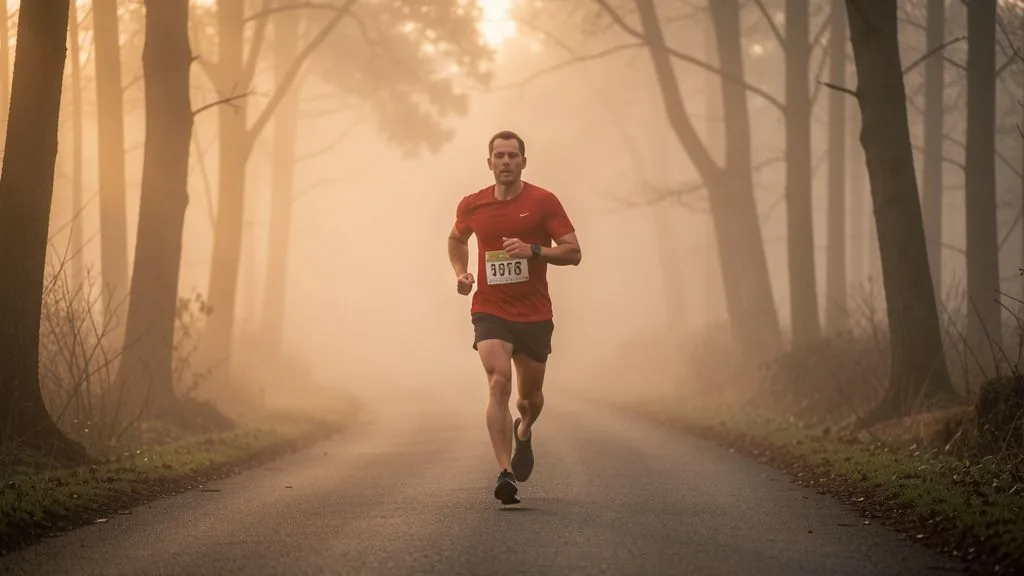
Your arms will not make you faster — but they will cost you speed if they do it wrong. They produce no meaningful propulsion, yet they consume oxygen, and in trials where the arms were fixed in place the energy cost at identical pace rose by roughly 3 to 10 percent. That is exactly why arm work pays off: it is the only major technique component you can change within two weeks without touching your training volume.
Why the arms swing at all
When you run, pelvis and ribcage rotate in opposite directions. That is not a quirk, it is mechanics: as the right leg swings forward it creates angular momentum, and the body has to cancel it out or it would keep rotating further with every stride. The arms take on that counterweight role — the right arm swings forward while the right leg is behind.
Block the arm swing and the body finds another route: it rotates the shoulders harder, increases trunk tension or changes cadence. All three cost energy. So the question is never "arms or no arms", only "how". A free, controlled arm swing is not a style feature — it is the precondition for pelvis and ribcage to shed their rotation cleanly.
The five building blocks of arm technique
- Shoulders low and loose. The single most common fault: shoulders creep towards the ears the moment it gets hard. That drains the neck and narrows the airways, raising heart rate at the same pace. Check in every ten minutes: shoulder blades back and down, arms hanging.
- Elbow bent but mobile. Around 90 degrees at the forward and backward swing is a good anchor. What matters is that the angle opens and closes again — a rigidly fixed angle tightens forearm and shoulder.
- Hands not in a fist. A loosely closed hand, as if holding a raw egg. Clenching activates the forearm and pulls up through the fascial chain into the shoulder.
- Drive backwards, not forwards. The arm swing works best behind the body axis. In front, it is enough for the hand to reach roughly chin height — reaching far forward adds no propulsion and costs cadence.
- No crossing. The hands stay either side of the body axis. Crossing in front of the chest creates extra trunk rotation — the work the trunk just saved gets bought back.
The seven tips that actually change something
Seven concrete adjustments follow from the building blocks above. Do not work through them all at once — take two per week.
- 1. Think from back to front. Imagine pulling the elbow backwards, as if pulling a rope behind you. That impulse activates the latissimus and stabilises the trunk — without you having to consciously "run upright".
- 2. Initiate cadence through the arm. Want more steps per minute? Get the arm faster first. Arms and legs run on the same rhythm; pushing the legs causes tension, accelerating the arm pulls everything along. It is the most elegant route to a higher cadence.
- 3. Shoulder check every ten minutes. A quick mental scan: are the shoulders up? Are the hands relaxed? Usually that alone is enough. The hands control the whole chain — clenched fists are the most reliable early warning of a tense upper body.
- 4. Elbow tighter uphill. On a climb the arm drive gets shorter and stronger, the elbow angle closes, cadence rises as stride shortens. That is no accident: you need more angular momentum cancellation per stride. Downhill is the opposite — arms slightly more open, swing calmer, otherwise you brake your own descent.
- 5. Check the arms under fatigue. Arm technique falls apart first, long before the legs are tired — typically from kilometre 25 in a marathon or minute 60 of a tempo run. Counter-steering here (loosen shoulders, open hands, hold cadence) costs less time in the closing stages than reacting at kilometre 35.
- 6. Technique before pace. A new arm swing often feels "wrong" at easy pace because it is less familiar. Practise it for two weeks only at aerobic pace and in short strides — not in intervals. Under high load the body reverts to the old pattern.
- 7. Short and often beats long and rare. Two or three times a week for 3 to 4 minutes of deliberate practice beats one 30-minute session at the weekend. Motor learning needs repetition in a fresh state, not volume.
Four drills for the technique
- Running drills with arms: 3 × 30 metres of skipping and butt kicks with a deliberately short, fast arm drive. This couples arm and leg rhythm directly.
- Standing arm swing: Stand tall, 30 seconds of arm swing at running rhythm, eyes on the hands either side of the body axis. Sounds trivial, reliably fixes crossing.
- Strides with a focus: 4 × 80 metres at a brisk pace, single instruction "elbow back". Short enough to hold concentration, fast enough to test transfer into race pace.
- Shoulder and neck mobility: 20 seconds of shoulder circles, 20 seconds of neck rolls, 2 sets before running. Start tight, stay tight — those five minutes before a run are the cheapest lever you have.
If you are working on running technique anyway, do not treat the arms in isolation: they are part of a chain of foot strike, pelvic stability and trunk tension. A good starting point is the article on improving running technique, which sets out the order of the building sites.
What the evidence actually supports
There is less solid research on arm technique than on foot strike, but the direction is clear. In controlled trials with fixed arms, oxygen cost at identical speed rose by roughly 3 to 10 percent, depending on how the arms were fixed and on pace. The effect is larger at higher speed, because leg frequency and therefore the need for compensation rise too.
Less clear is which specific arm position is optimal. Studies comparing elbow angles mostly find only small differences between 80 and 110 degrees. In practice that means: the exact angle is secondary, what matters are the three big lines — shoulders loose, no crossing, drive backwards. Anyone chasing the perfect angle is optimising the unimportant part.
Somewhat better supported is the link between arm swing and cadence. Arms and legs couple in the central rhythm generator, and an imposed higher arm frequency lifts leg frequency with it. If you want to move your cadence from 165 to 175 steps per minute, the arm is the detour that works.
How it ties into running economy
Running economy asks: how much oxygen does a kilometre cost at a given pace? Arm work is one line item in that calculation. The arms account for roughly 3 to 8 percent of total energy cost in running — far less than the legs, but large enough that a tense upper body becomes measurably expensive. The key terms around training control and technique are covered in the Peakora glossary.
The second effect is indirect and often underestimated: tense shoulders and high neck tone change your breathing. The accessory respiratory muscles — intercostals, upper chest — then work against shoulder tension, tidal volume drops slightly, and heart rate rises at the same pace. So if you finish a hard run with a stiff neck, you do not just have a stiff neck: you have handed part of your capacity to unnecessary muscle tension.
That is why the arms deserve to be treated as a recovery and load topic, not just a technique detail. How fatigue overall affects technique is described in the article on cardiac drift in running — why heart rate creeps up at constant pace and what role declining economy plays. More on the system behind it is in running economy training.
Common mistakes
- Shrugging the shoulders. The classic under fatigue and in the cold. Check it instead of ignoring it — the tightness otherwise travels through the neck into your breathing.
- Reaching too far forward. A long forward swing looks dynamic but adds no propulsion and costs cadence. The impulse belongs backwards.
- Pumping against the running direction. Anyone deliberately "driving the arms forward" to get faster shortens the backward swing — exactly the part that does something.
- Practising technique in training, forgetting it in the race. Under race pressure the body reverts to the old pattern. That is why deliberate practice belongs in the final weeks before a race, not only in the base phase.
- Treating arm work as a substitute for core training. The arm swing can only stabilise what the trunk can hold. Without core strength the prettiest arm technique collapses as soon as the legs tire.
How Peakora handles upper-body work
In the Peakora engine technique is not a separate training block but part of the sessions: strides, running drills and technique runs are stored as their own session types and scheduled regularly in the build phase, reduced in the specific phase and replaced by short openers during taper. That gives technique small but constant stimuli over weeks instead of cramming it into one block. If you add core or strength work on top, the fitness curve (CTL/ATL/TSB) shows how the extra load affects recovery — so you can counter-steer before technique falls apart in the long runs.
Frequently asked questions about arm swing
How important is arm technique in running?
More important than most runners think. When the arms are fixed in place during testing, oxygen cost at the same pace rises measurably — roughly 3 to 10 percent in studies. The arms provide no meaningful propulsion but burn energy when they swing badly.
How bent should the elbow be when running?
About 90 degrees at the point of the forward and backward swing, with the angle opening and closing. A rigidly held angle tightens forearm and shoulder. Uphill the elbow can close more, on easy runs it can open up.
Should the arms cross the midline of the body?
No. The hands stay either side of the body axis, swinging forward to about chin height and back to the hip. Crossing the midline creates trunk rotation that works against the running motion and costs stride length.
Can arm swing help increase cadence?
Yes. Arms and legs run on the same rhythm — a shorter, faster arm drive pulls the legs along. If you want five to ten percent more steps per minute, initiate it through the arms rather than pushing the legs.
How long does a new arm technique take to stick?
First effects show after two to four weeks but do not hold under fatigue yet. Realistically four to eight weeks with two short technique blocks per week until the new arm swing stays stable at race pace.
Plan technique and load together
Peakora schedules technique stimuli, strides and core work as fixed parts of your plan — and shows you how they affect your form. Start free, no credit card required.
Start free